Ligand Pharmaceuticals Inc. (Public, NASDAQ:LGND) http://www.ligand.com/home
IR: Ligand - Investor Relations - Investor Overview
GF: Ligand Pharmaceuticals Inc.: NASDAQ:LGND quotes & news - Google Finance
YF: LGND: Summary for Ligand Pharmaceuticals Incorpor- Yahoo! Finance
SA: LIGAND PHARMACEUTICALS INCORPORATED (LGND) Stock - Seeking Alpha
SEC: EDGAR Search Results
Ligand is a BioPharma company with a business model that is based upon the concept of developing or acquiring royalty revenue generating assets and coupling them to an efficiently lean corporate cost structure. Ligand's goal is to produce a bottom line that supports a sustainably profitable business. By diversifying the portfolio of assets across numerous technology types, therapeutic areas, drug targets, and industry partners, we offer investors a de-risked opportunity to invest in the increasingly complicated and unpredictable pharmaceutical industry. We believe Ligand has assembled one of the largest and most diversified portfolio of current assets in the industry for a company of its size, currently exceeding 60 programs, with the potential to generate revenue in the future. These therapies address the unmet medical needs of patients for a broad spectrum of diseases including hepatitis, muscle wasting, Alzheimer's disease, dyslipidemia, diabetes, anemia, COPD, asthma, rheumatoid arthritis, osteoporosis and cancer. Ligand has established multiple alliances with the world's leading pharmaceutical companies including GlaxoSmithKline, Merck, Pfizer, Bristol-Myers Squibb and AstraZeneca.
SARM
http://www.ligand.com/research#SARM
Medical Need: To produce the therapeutic benefits of testosterone on muscle and bone with improved safety, tolerability and patient acceptance.
Primary Medical Targets: The clinical applications for SARMs include the treatment of aging-associated sarcopenia, cancer cachexia, osteoporosis, and male hypogonadism.
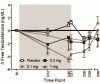
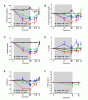
Description - Selective androgen receptor modulators (SARMs) are novel drugs that selectively modulate the activity of the androgen receptor in different tissues. Ligand is developing LGD-4033, a non-steroidal, orally active SARM currently in a Phase I multiple ascending dose study.
IR: Ligand - Investor Relations - Investor Overview
GF: Ligand Pharmaceuticals Inc.: NASDAQ:LGND quotes & news - Google Finance
YF: LGND: Summary for Ligand Pharmaceuticals Incorpor- Yahoo! Finance
SA: LIGAND PHARMACEUTICALS INCORPORATED (LGND) Stock - Seeking Alpha
SEC: EDGAR Search Results
Ligand is a BioPharma company with a business model that is based upon the concept of developing or acquiring royalty revenue generating assets and coupling them to an efficiently lean corporate cost structure. Ligand's goal is to produce a bottom line that supports a sustainably profitable business. By diversifying the portfolio of assets across numerous technology types, therapeutic areas, drug targets, and industry partners, we offer investors a de-risked opportunity to invest in the increasingly complicated and unpredictable pharmaceutical industry. We believe Ligand has assembled one of the largest and most diversified portfolio of current assets in the industry for a company of its size, currently exceeding 60 programs, with the potential to generate revenue in the future. These therapies address the unmet medical needs of patients for a broad spectrum of diseases including hepatitis, muscle wasting, Alzheimer's disease, dyslipidemia, diabetes, anemia, COPD, asthma, rheumatoid arthritis, osteoporosis and cancer. Ligand has established multiple alliances with the world's leading pharmaceutical companies including GlaxoSmithKline, Merck, Pfizer, Bristol-Myers Squibb and AstraZeneca.
SARM
http://www.ligand.com/research#SARM
Medical Need: To produce the therapeutic benefits of testosterone on muscle and bone with improved safety, tolerability and patient acceptance.
Primary Medical Targets: The clinical applications for SARMs include the treatment of aging-associated sarcopenia, cancer cachexia, osteoporosis, and male hypogonadism.
Description - Selective androgen receptor modulators (SARMs) are novel drugs that selectively modulate the activity of the androgen receptor in different tissues. Ligand is developing LGD-4033, a non-steroidal, orally active SARM currently in a Phase I multiple ascending dose study.