

The online chat-rooms that attract self-identified military personnel, as well as others who leave posts on these sites, are the only real source of information about how enlisted soldiers think about anabolic steroids. Much of my confidence in the more substantial postings is based on what I know about American police officers’ use of steroids […]
Anabolic Steroid Articles

Our steroid articles provided detailed, practical information on how anabolic steroids are used to build muscle size, strength and otherwise improve physical performance. They cover topics such as the history of steroids, steroids in baseball, the medical uses of steroids including testosterone replacement therapy (TRT), the side effects of steroids and how to manage steroid side effects.
Steroids in the U.S. Military – The View From the Ranks (Part 1)

“What is the perception of AAS [anabolic-androgenic steroids] among the vast number of servicemen?” an anonymous website commentator asked on October 24, 2007. “Same brainwashing? I would assume that having a strong soldier would be a top priority …” To which a like-minded poster added: “it’s really a general expectation that the ideal Soldier is […]
Entertainment on Steroids (Part 2)

When it comes to “entertainers” and drug use, there are two distinct genres of popular entertainment. One of them is charged with enforcing ethical norms, while the other is not. The managers of major American sports leagues and federations are expected to enforce codes of behavior that prominently include zero tolerance for criminal behaviors that […]
Entertainment on Steroids (Part 1)

It has long been an open secret that many performers in the entertainment industry take, or are widely presumed to take, anabolic steroids and human growth hormone (hGH), along with their “recreational” drugs like cocaine and marijuana. No one should be surprised that performers whose careers require taut skin and well-defined muscles would use PIED’s […]
Safety and Effectiveness of Testosterone at 1000 Milligrams per Week
Q: You talked about a gram per week of testosterone. Isn’t that ridiculous? What about say 200 mg? A: It is my view that the farther one is from one’s natural, untrained state, the harder it is to gain more muscle. There comes a point where the body essentially finds a new balance and may […]
The Science of Trenbolone, Part 4
As we close out this article series, there are still some important aspects of trenbolone left to cover. So, in this final installment, we are going to start off discussing how androgens impact fat stores. We’ll move on from there and into the realm of side effects and finish up with my closing thoughts, including […]
The Science of Trenbolone, Part 3

We are going to dig more into trenbolone’s anabolic properties in this part of the article series. It is worth reiterating that all studies relevant to today’s topics were performed on animals. So, my goal is to cover what is available within the literature and begin to discuss what is relevant to us, as bodybuilders. […]
The Science of Trenbolone, Part 2
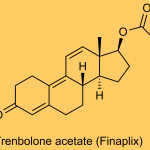
In the last article, we covered a lot of ground, focusing primarily on the history of trenbolone as well as its metabolic fate in mammals. If you have not already read part one, I’d urge you to go back and give it a read before moving on, as some of the topics covered there will […]
The Science of Trenbolone, Part 1
I. Preamble Many of you may have already come across my original Science of Trenbolone “article” that has been circulating bodybuilding boards for many years. I use the term “article” quite loosely though, as I never realized at the time that it would become so widely shared. The original intent of that “article” was simply […]
Exogenous Growth Hormone and Nocturnal Secretions

One of growth hormone’s more hallmark characteristics is its large sleep-related secretion, which occurs near the onset of slow wave (stage three) sleep [1-2]. This nighttime secretion accounts for nearly 70% of the entire daily GH secretory output in males. The nocturnal pulse is sexually dimorphic in nature, and significantly less pronounced in women [3-4]. […]