
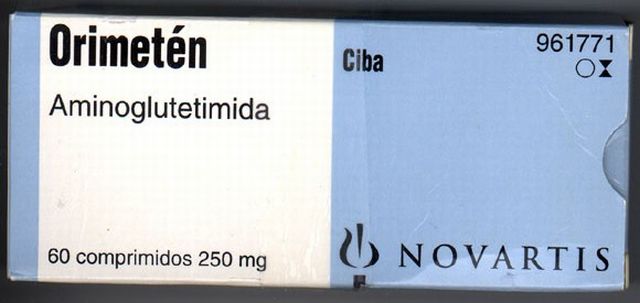
Cytadren, at moderate doses, is a fairly effective inhibitor of aromatase and a weak inhibitor of desmolase (an enzyme needed for the production of all steroids), and at higher doses becomes an effective inhibitor of desmolase. It can therefore be used when using aromatizable steroids, though it is not the drug of choice for this purpose. Years back, aromatase inhibitors such as Arimidex and letrozole were much more expensive than Cytadren and much less available, so in the past Cytadren was often used as an AI. That use is today obsolete.
Inhibition of desmolase — the undesired side effect of Cytadren — will lead, at least temporarily, to decreased production of cortisol. Contrary to the other claims, there is no evidence, nor good reason to believe, that reducing cortisol below normal would be of benefit to the weight training athlete, and considerable evidence that it is a bad idea. Thus, desmolase inhibition is to be avoided.
The claim that Cytadren significantly inhibits natural production of testosterone is not correct. The desmolase step is rate limiting for the production of cortisol, but not for testosterone: thus, a slowing of desmolase activity does not slow production of testosterone significantly. However, the conclusion that natural athletes should not use Cytadren is correct, but for a different reason. Natural athletes have no need of the antiaromatase activity, and the anti-desmolase activity, reducing cortisol below normal, is not desirable. It would only be desirable if cortisol levels were abnormally high, which should not be the case.
The claim that 2-4 tablets per day (500-1000 mg) should be taken is extraordinarily bad advice. I do not believe that more than 250 mg/day should be taken, and that should be taken very carefully, divided into 125 mg (half a tab) in the morning, and 62.5 mg (quarter tab) six and twelve hours after that. The two days on on, two days off idea is also not a good one, since that gives no antiaromatase activity half of the time.
It has been demonstrated that 250 mg/day is not much less effective than 1000 mg/day in inhibiting aromatase, but the smaller dose results in much less desmolase inhibition.
If desmolase has been substantially inhibited and then this is suddenly discontinued, cortisol rebound occurs. While the dosing protocol given above generally allows the user to stop “cold turkey,” since desmolase inhibition is low, tapering down is nonetheless a good idea, and is in fact necessary if, inadvisedly, doses higher than recommended were used.
Arimidex (anastrozole) and Femara (letrozole) are superior drugs and should be used instead of Cytadren if it is available and the user can afford it.
Aminoglutethimide is the chemical name of active ingredient in Cytadren. Cytadren is a registered trademark of Novartis Pharmaceuticals in the United States and/or other countries.
About the author

Bill Roberts is an internationally-recognized expert on anabolic steroids and performance-enhancing drugs (PEDs). He received a bachelor degree in Microbiology and Cell Science and completed the educational and research requirements for a PhD in Medicinal Chemistry at a major American university.
Bill entered the nutritional supplement industry prior to completing his doctoral thesis but his education was invaluable so far as being able to design/improve nutritional supplement compounds, since it was in the field of designing drug molecules and secondarily some work in transdermal delivery.
His education was not specifically "geared" toward anabolic steroids other than expertise with pharmacological principles having broad applications. This has allowed Bill to provide unique insight into the field of anabolic pharmacology with knowledge of points which he would not have known otherwise.