
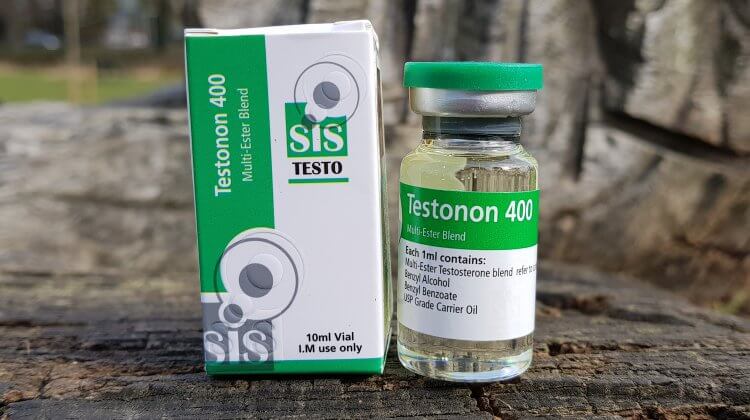
Testosterone, as the natural product drug and one of the most widely used anabolic steroids, is the most convenient choice for a reference drug to which all others will be compared. And while it is entirely possible to construct maximally-effective steroid cycles without employing testosterone, most do not do this, but instead use testosterone as their foundation. Either approach can be entirely sound.
As a bodybuilding drug, testosterone is almost always used as an injectable ester, due to poor oral bioavailability and the impracticality of high dose transdermal or sublingual delivery. Testosterone also is provided as an injectable suspension. Discussion here is in reference to these injectable preparations.
Pharmacologically, testosterone acts both via the androgen receptor and via other means. In practice, it is found to combine synergistically both with those anabolic steroids categorized as Class I and those categorized as Class II, and therefore is described as having mixed activity.
Particular properties of testosterone that are of note include that it converts enzymatically both to dihydrotestosterone (DHT) and to estradiol (the most important of the estrogens.)
While with normal levels of testosterone and normal enzyme activity these conversions are in fact desirable, with supraphysiological testosterone levels caused by drug administration they can be undesirable. DHT is at least three times more potent (effective per milligram) than testosterone at the androgen receptor (AR): therefore, in those tissues which convert testosterone to DHT, there is effectively three times as much androgen as elsewhere in the body. Thus, whatever level of androgen is experienced by the muscle tissue is effectively multiplied threefold or more in the skin and in the prostate. This can be excessive.
Dutasteride (Avodart) can be used to keep DHT levels normalized despite heavy testosterone use. Most users do not do this out of concern for excessively reducing DHT, which may be a valid concern at full label dosing, but which I do not think is a concern with low-dose use (½ tab every other day) in the context of a high-dose testosterone cycle.
Finasteride (Proscar) may be employed instead, if one wishes to use a 5alpha-reductase inhibitor. In this case, in the context of a high-dose testosterone cycle, one tab (5 mg) of this drug per day is unlikely to excessively decrease DHT.
Excess conversion to estrogen is another undesirable occurrence since it contributes to inhibition of the hypothalamic/pituitary/testicular axis (HPTA), can cause or aggravate gynecomastia, can cause bloating, and can give unfavorable fat pattern distribution. This conversion can be controlled by use of aromatase inhibitors such as Arimidex or letrozole, and/or the effects of excess estradiol may be blocked in relevant tissues by Clomid or Nolvadex.
Among the most significant differences of synthetic anabolic steroids compared to testosterone is that they may avoid either or both of these enzymatic conversions. In the past, this was a very important advantage. However, now that these conversions can be well-controlled, high-dose testosterone need not have all the adverse side effects that once inevitably accompanied its use.
Testosterone used as the sole androgen is capable of giving very effective results, particularly with doses of one gram or more per week, and can give substantial results with only 500 mg/week. If no other drugs are used to control estrogen, however, side effects such as gynecomastia are fairly likely. Prostate enlargement, acne or worsening of acne, and acceleration of male pattern baldness (for those genetically susceptible to it) are more problematic with testosterone – again, in the absence of enzymatic control — than with many synthetics because of the effectively-higher androgen levels seen in these tissues as a result of local conversion to the more-potent DHT.
So, to minimize these effects, the choices for a highly-effective cycle that is low in side effects are to either control these enzymatic conversions with ancillary compounds while using testosterone at high dose; to instead use synthetics which do not undergo these conversions; or to combine moderate dose testosterone (100-200 mg/week) with synthetics.
An anti-aromatase is preferable in a testosterone cycle to a selective estrogen receptor modulator (SERM) such as Clomid or Nolvadex for controlling estrogen because the SERMs either do nothing towards reducing effect of elevated estrogen in aggravating or causing acne, or themselves contribute adversely. Additionally, abnormally elevated estrogen levels may be deleterious for other reasons.
With regard to inhibition of the hypothalamic/pituitary/testicular axis (HPTA), 200 mg/week of injected testosterone is approximately 2/3 to 3./4 suppressive, while 100 mg/week is about 50% suppressive. For this reason, low dose testosterone use is not particularly efficient, as natural production is already “worth” 100-200 mg/week, and this is mostly lost with the first 200 mg/week of injectable that is used. The particular synthetics which are low-suppressive are, for this reason, more efficient for low-dose use than is testosterone.
In terms of planning HPTA recovery after a cycle, for the above reason there is little point in beginning post-cycle therapy (PCT) until testosterone levels from the cycle have fallen to being commensurate with use of no more than about 200 mg/week. So for example, if using 800 mg/week, it would be advisable to wait two half-lives. (After a number of days equal to the half life, levels will drop to that commensurate with 400 mg/week use, and after that same number of days again levels will again fall in half, now to levels to commensurate with 200 mg/week use.) So for example if the half-life of the ester used were 5 days, one would wait till 10 days after the last injection to begin PCT, when the drug in question is testosterone, due to the particulars of its suppressive properties.
With use of an anti-aromatase, 600-750 mg/week of injected testosterone is a good dosage range for a novice. Without an anti-aromatase, it may be preferred to limit usage to 500 mg/week, although there can be risk of gynecomastia at doses even as low as 200 mg/week if no anti-estrogen is used. More advanced users may favor one gram of testosterone per week. Still-higher doses such as 2 grams per week generally provide only a small further increment in performance, with that generally being noticeable only if a plateau has been reached at 1 gram per week. Amounts higher than this are employed by some pro bodybuilders but probably with only a slight further incremental effect.
About the author

Bill Roberts is an internationally-recognized expert on anabolic steroids and performance-enhancing drugs (PEDs). He received a bachelor degree in Microbiology and Cell Science and completed the educational and research requirements for a PhD in Medicinal Chemistry at a major American university.
Bill entered the nutritional supplement industry prior to completing his doctoral thesis but his education was invaluable so far as being able to design/improve nutritional supplement compounds, since it was in the field of designing drug molecules and secondarily some work in transdermal delivery.
His education was not specifically "geared" toward anabolic steroids other than expertise with pharmacological principles having broad applications. This has allowed Bill to provide unique insight into the field of anabolic pharmacology with knowledge of points which he would not have known otherwise.