
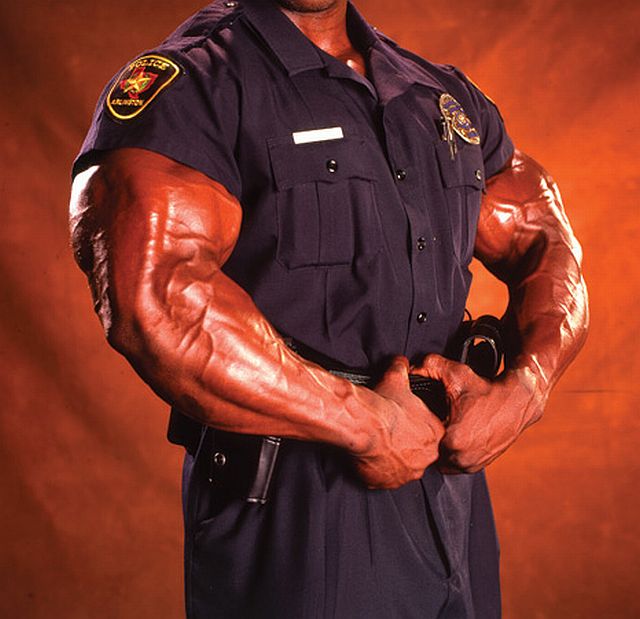
As the U.S. Congress prepares to renew its assault on anabolic steroid use among professional athletes at a hearing scheduled for May 18, longtime observers of doping control initiatives will recognize the selective indignation that continues to sensationalize the use of these drugs by athletes. The fact that certain groups of steroid consumers have been spared the special opprobrium reserved for sports heroes who fail to serve as proper “role models” for youth demonstrates once again how arbitrary and politically motivated the formulation and enforcement of drug laws can be.
One of the remarkable anomalies of the anti-steroid campaign of the past two decades is that it has virtually ignored the many reports of steroid use by police officers in the United States and in other countries. Unknown but clearly significant numbers of policemen have imported, smuggled, sold, and used anabolic steroids over this time period. According to an article that appeared in the FBI Law Enforcement Bulletin in 1991: “Anabolic steroid abuse by police officers is a serious problem that merits greater awareness by departments across the country.” (1) In 2003 another expert offered a similar assessment. Little research has been done on the use of steroids by police, said Larry Gaines, former executive director of the Kentucky Chiefs of Police Association. “But I think it’s a larger problem than people think.”.(2)
A segment of the CBS-TV program “60 Minutes” had already made that point on November 5, 1989. “Beefing Up the Force” presented interviews with three officers whose use of steroids had apparently caused the hyper-aggressiveness that had gotten them into serious trouble. The worst case involved what one psychiatrist called “a real Jekyll and Hyde change” in the personality of a prison security guard in Oregon who had kidnapped and shot a woman who made a casual remark he didn’t like. He got 20 years in prison, and she was paralyzed for life. The personality he presented during his prison interview made it seem utterly improbable that he would have been capable of such an act. But his testosterone level when he committed the crime was 50 times the normal level. This broadcast conveyed the message that steroid problems were lurking in many police departments across the country, and that police officials were turning a blind eye to a significant threat to public safety.
It was no accident that the “60 Minutes” segment paid special attention to a “hard core group” of steroid users on the Miami police force. Two years earlier the Miami Herald had run a long article on steroid-using police officers. The seven notorious Miami “River Cops”, who in 1987 were on trial for alleged crimes including cocaine trafficking and conspiracy to commit murder, included Armando “Scarface” Garcia, a weightlifter who had publicly admitted to taking steroids. “There’s a great potential for an officer abusing steroids to physically mistreat people,” said the police chief of nearby Hollywood, Florida, who had told his investigators to be on the lookout for officers who looked like “small mountains.” (3) The Miami Herald article may have been the first of the tiny number of analytical treatments of this subject that have appeared in American newspapers since the 1980s.
It is not surprising that police officials spent the 1980s more or less oblivious to the steroid issue. The notoriety and eventual demonizing of the anabolic steroid followed the Ben Johnson Olympic scandal of September 1988, which initiated the transformation of the social (and then the legal) status of these drugs. The Anabolic Steroids Control Act of 1990 made unauthorized possession of steroids a criminal offense, and from that point on the anti-steroid crusade was gradually annexed by the larger War on Drugs that Richard Nixon had launched in 1969. The BALCO “designer steroid” indictments announced by the Department of Justice in February 2004 gave the federal takeover of the anti-steroid campaign an official status it had never had before.
Prohibiting police officers from using anabolic steroids would appear to be self-evident given what is known about how these drugs can produce hyper-aggressive behavior. But understanding the use of these drugs by police officers and other men whose professional roles involve physical strength and assertiveness requires us to examine the two opposing arguments that have been advanced to favor or oppose the use of steroids by law enforcement personnel. The functional argument holds that the physical and psychological effects of steroids promote the safety of the officer and, therefore, public safety, as well. The deviance argument holds that, on the contrary, both the physical and emotional effects of the drugs endanger the public and expose drug-taking officers to serious legal risks resulting from their dangerous drug-induced behaviors.
The idea that steroids might actually play a functional (and therefore legitimate) role in preparing police officers to do their jobs was not beyond the pale in 1987. For example, the Miami Herald exposé prompted a former Miami police chief, Ken Harms, to make the following comment: “It’s probably time that the department makes a conscious decision about whether it’s acceptable for officers to take steroids.” (4) The sheer political incorrectness of this statement, when judged by today’s standards, speaks volumes about how the social status of these drugs has changed in the interim. Although Chief Harms did not go on to parse the pros and cons of steroid-taking by police officers, it is not difficult to imagine what he might have said.
Large numbers of men around the world consume steroids because their professions or criminal activities require physical self-assertion and self-confidence. A 1996 report from Scotland, for example, identifies policemen, firefighters, military personnel, and private security guards as steroid consumers. (5) In Australia the list includes prison guards and the elite troops who in 1998 were discovered to be “using steroids to bulk up, boost stamina and self-esteem and to recover more quickly from injuries they have sustained.” (6) In Britain, Australia and some European countries, nightclub bouncers use the drugs to produce the “frilled neck lizard response” that intimidates unruly customers. (7)
“The thinking is that big is better than small, tough is better than weak,” says Gene Sanders, a former police officer and a longtime police psychologist in California. “There is sort of an underground, unspoken tradition among several departments that I’ve worked with that if you really want to bulk up, this is the best way to do it.” (8) A website maintained by the Drug Enforcement Administration (DEA) reports the same attitude toward functional steroid use by police officers: “Law enforcement personnel have used steroids for both physical and psychological reasons. The idea of enhanced physical strength and endurance provides one with ‘the invincible mentality’ when performing law enforcement duties.” (9)
Steroids are also used by criminals as aggression-enhancing drugs. In Oslo, Norway, enforcers known as “torpedoes” take combinations of steroids and amphetamines to produce the psychopathic state that enables them to kill and maim their victims. (10) Danish motorcycle hoodlums put methyl testosterone capsules under their tongues before gang fights to work themselves into a rage. (11) Such vignettes from the steroid underground suggest how little we know about the overall social effects of the black market that serves an international market of action-oriented males that includes a growing number of recreational athletes of all ages.
The functional argument thus proposes that steroid use is an essentially rational and practical strategy to deal with the special challenges and hazards of certain kinds of physically demanding work. From this perspective, these action-oriented professionals — “[o]ccupational users such as doormen [bouncers], police and prison warders … have a definite objective; often feeling threatened by aspects of their work they believe they must increase their size and aggression both to threaten and protect others.” (12)
Russell Dobash, a professor at Manchester University, has also pointed to the practical attitude of some steroid users: “Bodybuilding is most often the entrée to taking steroids, but people who take the drugs often do it because they see their body as important to their job. Some people have the stereotypical image of a bodybuilder as unemployed. But in a sample of steroid-users that we looked at, there were a range of occupations, particularly among professions where your body can be instrumental to your job.” (13)
The conflict between the functional and the deviance models of steroid use can be seen in “the stereotypical image of [the] bodybuilder” as a socially dysfunctional (unemployed) type whose deviance lies in the social disorientation that has left him with no economic role in society. His functional (and socially useful) counterpart is someone who puts drugs to “instrumental” use. We have already seen that the use of steroids by police officers has been regarded as instrumental pharmacology of this kind by at least a segment of the profession. However, given the long tradition of prohibitionist thinking about “drugs” in modern societies, it is hardly surprising that condemnation based on the deviance model of police steroid use has been more influential than the functionalist rationale for steroid-boosted law enforcement.
The deviance model assumes that steroid use already indicates a character defect in the drug-taker. This viewpoint was applied to military doping in December 2004 when the executive director of the Australian Defence Association criticized the functionalist view of doping soldiers. “The Australian people spend a lot on defence,” he said, “and they want value for their money, and they want a defence force that is physically fit and mentally capable. If you’re using perception-altering substances or steroids you’re hardly likely to be physically or mentally fit.” (14) When Copenhagen’s Police Station No. 1 was hit by a steroid scandal in 2000-2001, the city’s chief of police stated: “Combining strength training with the use of doping drugs is so sick that it simply doesn’t belong on a police force. It is sad that young, well-built people feel too frail and weak to serve on the force, so they fill themselves with that kind of poison and bulk up to the point where they are revolting to look at.” (15)
The deviance argument has also appeared in American commentaries on steroid-using policemen. In 1987, for example, Dr. Philip Greenberg, the psychiatrist for the Miami Beach Police Department, put it as follows: “Any policeman taking something … to build up muscle tissue would have to be a very confused specimen to begin with.” (16) When the police chief of Boca Raton, Florida, was asked in 2003 what could cause an officer to use steroids, he replied: “Stupidity and self-absorption and an egocentric mentality.” (17)
Stupidity, self-absorption and an egocentric mentality are certainly compatible with the racism that a few steroid-using policemen have demonstrated, and not only in the United States. The Danish cops who were indicted for steroid possession in 2000 were also found to be in possession of written materials that included a plan to castrate accused Muslim rapists. (18)
Postulating a correlation between steroid use and racist eccentricity goes straight to the heart of our society’s unresolved conflict over the meaning of androgenic drug use. Does the choice to augment oneself with this illegal drug signal a broader propensity to embrace unwholesome beliefs or engage in antisocial behaviors? The current anti-steroid sentiment being promoted by politicians and many others with media access assumes this is the case. It is, therefore, striking that when the serial killings of black men by a white, steroid-using police officer made headlines in 1989, the authorities who might have done so made no effort to connect these deadly events with the drugs that may well have played a role in provoking them.
This case of allegedly steroid-fueled police violence comes from Texas. Over a period of seven years during the 1980s, a Houston police officer named Scott Tschirhart shot to death three black men in circumstances that led to protests and a grand jury investigation. Cleared by the grand jury, Tschirhart was eventually fired by Houston’s black police chief shortly after the third killing in 1989. (19)
It was well known to his fellow officers that Tschirhart was a user of anabolic steroids, and they had watched the drugs transform him as a bodybuilder and as a policeman. “The bigger he got … the worse he got about strutting around and bragging,” a veteran officer recalled. “You could really see him changing.” (20) But the Houston Police Department had no policy against steroid use, so no one intervened until the third fatal shooting provoked the department to investigate this officer’s unusually violent career.
Even the appearance of sequential racial killings by a known steroid user and reputed bigot did not put the issue of cops and steroids on the national agenda. Nor did the “60 Minutes” segment broadcast shortly after Tschirhart’s firing ignite any further interest in the major media that might have put this issue on the national agenda. In 1985 Dr. Robert Kerr, a notorious provider of steroids to thousands of elite athletes and other customers, had testified in the Superior Court of California in Los Angeles that he had written steroid prescriptions for 500 law enforcement personnel in the Los Angeles area. And nothing happened. (21)
A realistic approach to the use of steroids by police officers must also be prepared to depart from the deviance model for the purpose of recognizing those cases where it becomes difficult or impossible to distinguish between therapy and enhancement. For example, a policeman’s use of steroids can have a medical rationale. A model Ohio county deputy and Gulf War Marine Corps veteran convicted of steroid possession in 2003 said he had imported the drugs from Yugoslavia as an effective therapy for his chronic fatigue syndrome. “I never wanted to look like Arnold,” he said. “I was tired of being tired. I wanted to feel better.” (22)
How can we explain our society’s current steroid policy, which treats the drug use of a baseball player as more reprehensible than that of a police officer?
First, there is the importance of image. Athletes who double as entertainers do not benefit from the halo effect that wraps public safety personnel in a presumption of innocence, regardless of whether this aura is firmly rooted in reality. We are accustomed to the idea of the police confiscating steroids, not injecting or ingesting them.
Second, there is the matter of logistics. Subjecting America’s half million police officers to systematic steroid screening would impose huge additional costs on city governments that already face chronic deficits. Similar budgetary considerations have drastically limited the drug testing of the nation’s school children, despite the court decisions that have legalized such procedures. Forcing a miniscule number of elite athletes to serve as our society’s pharmacological virgins is a far more practical way to pledge allegiance to the illusion of a “drug-free” society.
Finally, there is our society’s profoundly ambivalent attitude toward male hormone drugs that produce tangible benefits. The new social acceptability of bodybuilding, embracing its worship of muscularity and its unabashed ethos of self-improvement, represents an unmistakable, if camouflaged, acceptance of synthetic testosterone drugs and their desired effects, ranging from sculptured torsos to sexual self-confidence. In a similar vein, significant numbers of sports fans already accept athletic doping drugs as acceptable enhancements that make possible the performances they want to see. Finally, popular hormone-based “anti-aging” therapies employ the same drugs that could put a steroid-using policeman in prison.
The problem for those monitoring police forces for steroid abuse is that some steroid users will not display obviously disordered behaviors. In the absence of systematic drug testing, the most promising policy would be to investigate every case of hyper-aggressive behavior by police officers and employ targeted drug testing in such cases. Above all, officials must keep an eagle eye on those members of the force who find special fulfillment in competitive bodybuilding, including those bodybuilding competitions that are sponsored by police departments. (23) As police authorities in Berlin found out in 2002, it is likely that a disproportionate number of these people should not be entrusted with power and a gun. (24)
Footnotes
(1) Charles Swanson and Larry Gaines, “Abuse of Anabolic Steroids,” FBI Law Enforcement Bulletin (August 1991): 19.
(2) Stephen Hudak, “Steroids: a threat to police officers,” Cleveland Plain Dealer (July 25, 2003).
(3) Angie Cannon, “Steroid-Using Police Causing Brutality Fears,” Miami Herald (May 18, 1987).
(4) Angie Cannon, “Steroid-Using Police Causing Brutality Fears,” Miami Herald (May 18, 1987).
(5) Doug Gillon, “Questions for House – ‘Explosion’ in Numbers Abusing Steroids,” Glasgow Herald (April 15, 1996).
(6) “Elite soldiers face charges as ‘police uncover drug use’,” Sydney Morning Herald (July 24, 2002).
(7) Mark Dunn, “Three groups pinpointed as steroid users,” Herald Sun [Australia] (July 18, 2003).
(8) “Cops accused of using steroids to bulk up and give themselves an edge,” Associated Press (February 4, 2005).
(9) “Steroid Abuse by Law Enforcement Personnel” [Drug Enforcement Administration]. See.Accessed on January 29, 2005.
(10) “Torpedomiljø hardner,” Aftenposten [Oslo] (November 7, 2000).
(11) Interview with a Danish physician with anti-doping experience, Odense, Denmark, January 14, 2005.
(12) R.T. Dawson, “Drugs in sport – the role of the physician,” Journal of Endocrinology 170 (2001): 57.
(13) Jon Ungoed-Thomas, “Police taking steroids to counter thugs,” The Sunday Times (December 6, 1998).
(14) Brendan Nicholson, “Defence force strikes legal hitch on drug tests,” The Age [Melbourne] (December 24, 2004).
(15) “Politidoping: Sigtede betjente bliver i tjeneste,” Jyllands-Posten [Denmark] (November 24, 2000).
(16) Angie Cannon, “Steroid-Using Police Causing Brutality Fears,” Miami Herald (May 18, 1987).
(17) Pamela Perez, “Steroid cases worry Boca police,” Palm Beach Post (July 15, 2003).
(18) “Fem betjente sigtet,” Jyllands-Posten (December 23, 2000).
(19) “Researchers say police steroid use a dangerous trend,” Houston Post (November 18, 1989).
(20) “Officer more aggressive since steroids, colleagues say,” Houston Post (November 17, 1989).
(21) Mark Wangrin, “Steroid use by law officers raises fears,” Austin American-Statesman (November 5, 1989).
(22) Stephen Hudak, “Steroids: a threat to police officers,” Cleveland Plain Dealer (July 25, 2003).
(23) For example, the 1st Annual Nation’s Capitol Police and Fire Bodybuilding Championships were held on June 7, 2003, at Bowie State University in Bowie, Maryland. See www.bodybuildbid.com/articles/newsevents/2003policfirebodybild.html. Accessed February 4, 2005.
(24) “Polizei-Doping erschreckt Körting,” die tageszeitung (June 25, 2002).
About the author

John Hoberman is the leading historian of anabolic steroid use and doping in sport. He is a professor at the University of Texas at Austin and the author of many books and articles on doping and sports. One of his most recent books, “Testosterone Dreams: Rejuvenation, Aphrodisia, Doping”, explored the history and commercial marketing of the hormone testosterone for the purposes of lifestyle and performance enhancement.
Leave a Reply
You must be logged in to post a comment.