
Not since the travels of Juan Ponce de Leon has the fountain of youth seemed so close!
Title:Viral mediated expression of insulin-like growth factor I blocks the aging-related loss of skeletal muscle function
Researchers:
Elisabeth R. Barton-Davis*, Daria I. Shoturma*, Antonio Musaro, Nadia Rosenthal, and H. Lee Sweeney*,
* Department of Physiology, University of Pennsylvania School of Medicine, Philadelphia, PA and Cardiovascular Research Center, Massachusetts General Hospital, Charlestown, MA
Source:
Proc Natl Acad Sci U S A 1998 Dec 22;95(26):15603-7
Summary:
Although the mechanisms underlying age associated muscle loss are not entirely understood, researchers attempted to moderate the loss by increasing the regenerative capacity of muscle. This involved the injection of a recombinant adeno-associated virus directing overexpression of insulin-like growth factor I (IGF-I) in differentiated muscle fibers.
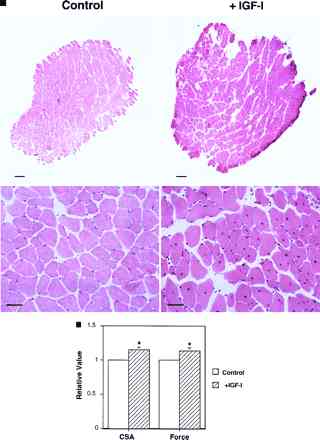
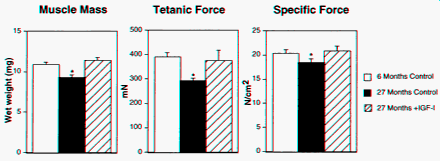
They demonstrated that the IGF-I expression promotes an average increase of 15% in muscle mass and a 14% increase in strength in young adult mice (Figure 1), and remarkably, prevents aging-related muscle changes in old adult mice, resulting in a 27% increase in strength as compared with uninjected old muscles (Figure 2). Muscle mass and fiber type distributions were maintained at levels similar to those in young adults. These results suggest that gene transfer of IGF-I into muscle could form the basis of a human gene therapy for preventing the loss of muscle function associated with aging and may be of benefit in diseases where the rate of damage to skeletal muscle is accelerated.
Discussion:
I’m not sure where to begin. This study has the potential to completely change the way we age.
In this experiment, a recombinant adeno-associated virus, directing overexpression of insulin-like growth factor I (IGF-I)in mature muscle fibers, was injected into the muscles of mice. The DNA that was originally in the virus was removed along with markers that stimulate immune response. DNA coding for IGF-1 was then put into the virus along with a promoter gene to ensure high rates of transcription. The results, as you can see by figures 1 & 2, were dramatic.
IGF-1 plays a crucial role in muscle regeneration. IGF-1 stimulates both proliferation and differentiation of stem cells in an autocrine-paracrine manner, although it induces differentiation to a much greater degree.IGF-1, when injected locally, increases satellite cell activity, muscle DNA, muscle protein content, muscle weight and muscle cross sectional area.The importance of IGF-1 lies in the fact that all of its apparent functions act to induce muscle growth with or without overload although it really shines as a growth promoter when combined with physical loading of the muscle.
IGF-1 also acts as an endocrine growth factor having an anabolic effect on distant tissues once released into the blood stream by the liver. IGF-1 possesses the insulin-like property of inhibiting degradation, but in addition can stimulate protein synthesis. The insulin-like effects are probably due to the similarity of the signaling pathways between insulin and IGF-1 following ligand binding at the receptors.
The ability of IGF-I to stimulate protein synthesis resembles the action of GH, which was shown in separate studies on volunteers to stimulate protein synthesis without affecting protein degradation. Although it is often believed that the effects of GH are mediated through IGF-1, this cannot be the case entirely. First, the effects of the two hormones are different, in that GH does not change protein degradation. Second, the effect of GH is observed with little or no change in systemic IGF-1 concentrations. Age related muscle loss has been prevented with GH injections, however it is believed that this is accomplished through IGF-1.
The results of this study are similar to other studies where IGF-1 was injected directly into muscle tissue, resulting in increases in size and strength of experimental animals. Using a virus as a genetic vehicle has an advantage over simply injecting the growth factor. The effects of a single viral treatment last significantly longer (months if not years) because the muscle cell itself is constantly overproducing its own IGF-1 from injected DNA.
The fact that the IGF-1 produced by the muscle of these mice did not reach the blood stream is interesting. Systemic injections of IGF-1 have not been successful in inducing this kind of anabolic effect in humans. In addition, IGF-1 produced by the liver is genetically different than that produced by muscle tissue. It could be that providing additional DNA for the muscle to produce it’s own IGF-1 is the key to achieving anabolic and rejuvenative effects specifically in skeletal muscle.
In this study there was a preferential preservation of type IIb muscle fibers in aging mice. These are the fibers most sensitive to muscle hypertrophy from training and they are also the first fibers to disappear with aging. In the mice receiving the engineered virus, there was also a preservation of the motor neuron, leading to an increase in functional capacity. It is speculated that age related muscle loss is secondary to the loss of neuronal activation of type-II fibers. By preventing the degeneration of typ-II motor units, functional capacity could be maintained into old age. This technique may also serve useful in the prevention of osteoporosis. Further study is necessary to determine wether IGF-1 is having an effect only on muscle fibers or on nervous tissues as well.
Finally, it was also exciting to see muscle growth in theyoungmice who received the injection (15% increase in muscle mass). This means that the injection provided levels of IGF-1 far and above what the muscle normally has access to and not simply a preservation of normal levels. Remember that this was not combined with exercise. The growth of the injected muscles happened even without an extreme mechanical stimulus. The mice were simply allowed to run around as they usually do. Because of these dramatic results, the authors expressed concern about the use of this technique to enhance performance or cosmetic appearance. Research Update is not my personal soap box so I won’t go off on the gender centered hypocrisy of cosmetic enhancement in our society. All we can hope for is that this technique will be used to treat more important diseases such as muscular dystrophy and thereby become somewhat available for other uses as well.

Leave a Reply
You must be logged in to post a comment.