Does HGH improve or grow Androgen Receptors?

Max Magnus

New Member
Newby to HGH,....

Was wondering if there is any data that shows HGH improving or Multiplying Androgen Receptors?

Its rumored to slow the aging process, but
does HGH help muscle Growth?

Thoughts /Comments?
 
Yes rHGH increases androgen receptors in muscle, making them more sensitive to AAS, but also, AAS increases GH receptors in muscle, making them more
sensitive to GH (which makes the muscle produce more IGF-1, improving protein synthesis and therefore enhancing muscle growth).

(Although the only study demonstrating this used men with low T as subjects, so technically this has only been proven in hypogonadal men, but it probobly applies to everyone.)

What you're looking for is in in the "Androgens" section of this review of the state of adult rHGH replacement therapy, but it's also a great, fairly easy to understand, up to date (2023) summary of what scientists know about rHGH's effects on many systems in the body (which has been surprisingly little given GH replacement has been around for 40+ years).

 
Last edited:
Yes rHGH increases androgen receptors in muscle, making them more sensitive to AAS, but also, AAS increases GH receptors in muscle, making them more
sensitive to GH (which makes the muscle produce more IGF-1, improving protein synthesis and therefore enhancing muscle growth).

(Although the only study demonstrating this used men with low T as subjects, so technically this has only been proven in hypogonadal men, but it probobly applies to everyone.)

What you're looking for is in in the "Androgens" section of this review of the state of adult rHGH replacement therapy, but it's also a great, fairly easy to understand, up to date (2023) summary of what scientists know about rHGH's effects on many systems in the body (which has been surprisingly little given GH replacement has been around for 40+ years).

Thanks Friend... How much 'daily GH' do you recommend ?
 
Thanks Friend... How much 'daily GH' do you recommend ?
I'm on 4iu / day, AM dose followed by fasted cardio, and I get very slight carpal in one finger for a few minutes in the early morning. I see no need to increase or decrease atm, as improvements continue at a rapid pace.

But of course you'll have to find what works for you and your goals. I'm looking at long term anti-aging.

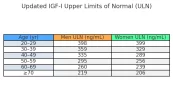
For greatest safety, you should let IGF guide you. Look up upper limit of normal (ULN) for your age, and target an IGF of 1.3x ULN if you want to keep your long term risk profile to a minimum.

3F51A436-DCE5-4CBC-983B-ED8082525F6D.webp
 
I'm on 4iu / day, AM dose followed by fasted cardio, and I get very slight carpal in one finger for a few minutes in the early morning. I see no need to increase or decrease atm, as improvements continue at a rapid pace.

But of course you'll have to find what works for you and your goals. I'm looking at long term anti-aging.

For greatest safety, you should let IGF guide you. Look up upper limit of normal (ULN) for your age, and target an IGF of 1.3x ULN if you want to keep your long term risk profile to a minimum.

View attachment 337031
How many hours after last injection should bloods be drawn ?
 
Awesome thanks, I’m not familiar with IGFBH3. What Values should I be looking for ?

Divide IGF/IGFBP-3 to get the free to bound IGF-1 ratio.

A ratio below .2 means impaired IGF bioavailabilty, usually because estrogen is too high if you're using AAS. Lowering E2 will lower IGFBP-3 and improve the ratio. It could also be high inflammation (CRP) or liver enzymes (ALT/AST).
 
Last edited:
Divide IGF/IGFBH-3 to get the free to bound IGF-1 ratio.

A ratio below .2 means impaired IGF bioavailabilty, usually because estrogen is too high if you're using AAS. Lowering E2 will lower IGFBH-3 and improve the ratio. It could also be high inflammation (CRP) or liver enzymes (ALT/AST).


you mean igf1 binding PROTEIN right?
 
Divide IGF/IGFBP-3 to get the free to bound IGF-1 ratio.

A ratio below .2 means impaired IGF bioavailabilty, usually because estrogen is too high if you're using AAS. Lowering E2 will lower IGFBP-3 and improve the ratio. It could also be high inflammation (CRP) or liver enzymes (ALT/AST).
Got it! I will be adding it to my next panel. Thank for the knowledge
 
im trying to
Divide IGF/IGFBP-3 to get the free to bound IGF-1 ratio.

A ratio below .2 means impaired IGF bioavailabilty, usually because estrogen is too high if you're using AAS. Lowering E2 will lower IGFBP-3 and improve the ratio. It could also be high inflammation (CRP) or liver enzymes (ALT/AST).

interesting, is there somewhere i could learn more about this and the specifics of igfbp, estrogen and factors impacting it like ast/alt/liver health and inflammation like you mention here?
 
im trying to


interesting, is there somewhere i could learn more about this and the specifics of igfbp, estrogen and factors impacting it like ast/alt/liver health and inflammation like you mention here?

First let me correct something I noticed after the edit time limit passed:

Low E2 *increases* IGFBP-3, reducing free IGF-1.

High E2 suppresses it, increasing free IGF-1.

For instance, AI's are known to increase IGFBP3 significantly (60%+ in some cases), crushing free IGF-1. Perhaps the most relevant factor of them all in the BB community. You might think your IGF-1 is great, but if you're using an AI you're neutralizing it:


This is a very complex topic, and unfortunately I haven't found a single source that summarizes all the factors that increase or decrease IGFBP-3 expression. It's spread out over many different papers.

What's not complicated is that IGFBP-3 reduces the effective level of functional IGF-1. That's been clearly established.

The body seems to produce more IGFBP-3 in response to high GH levels, trying to counteract supra-physiological levels. In other words, with large rHGH doses IGFBP-3 increases making the ratio lower blunting IGF-1 effectiveness.

Studies show children on rHGH treatment with different IGF-1 levels typically have a very similar growth rates because IGFBP increases to moderate IGF-1 effects when rHGH dose is high.


Inflammation increases IGFBP-3, possibly as a feedback mechanism from cancer cells to lower free IGF-1 and slow tumor growth.

Men with fast developing benign prostate hyperplasia often have low IGFBP-3 (therefore higher free IGF-1), while high levels of IGFBP-3 (suppressed free IGF-1) are associated with low rates of enlarged prostate.

High levels of IGFBP-3 are associated with longer lives, but rapid cognitive decline and slow walking speed.

If I come across a clearly written summary of factors I'll post it here.
 
Last edited:
I'm on 4iu / day, AM dose followed by fasted cardio, and I get very slight carpal in one finger for a few minutes in the early morning. I see no need to increase or decrease atm, as improvements continue at a rapid pace.

But of course you'll have to find what works for you and your goals. I'm looking at long term anti-aging.

For greatest safety, you should let IGF guide you. Look up upper limit of normal (ULN) for your age, and target an IGF of 1.3x ULN if you want to keep your long term risk profile to a minimum.

View attachment 337031
How’s the overall shape coming along? Seeing solid improvements? And if it’s not a secret, what are your current stats looking like?

Personally, I haven’t noticed much difference between doing fasted cardio or not, but GH definitely helps keep the shape tight, even with some diet slip-ups - that’s a huge plus. I’m planning to start a bulk soon, and I’m thinking there’s probably no need to bump up the GH, since at 4iu my IGF is already 700+, which is about twice the recommended range for my age based on your chart.
 
i think hgh increases androgen receptors since hgh speeds up your bodies clock
i think thats why guys who use gear when they are older get better results and why all the tren i used when I was young didnt do shit
 
Back
Top