Low Blood Pressure Heart Attacks Heart Failure and Death

malfeasance

Member
"For the second, published Oct. 29, 2016, in The Lancet, researchers analyzed data from CLARIFY, a registry of more than 22,600 people with heart disease from 45 countries. They determined that, compared with people who had systolic blood pressure of 120 to 139 mm Hg and diastolic pressure of 70 to 79, people with a systolic blood pressure of 140 mm Hg or higher were more likely to experience heart attacks or strokes, to be hospitalized with heart failure, or to die within a five-year period. But the same was true for heart attacks, heart failure, and death in people with low blood pressure (systolic pressure below 120 mm Hg and diastolic pressure under 70 mm Hg).

In an analysis published online April 5, 2017, by The Lancet, German researchers pooled data from two clinical trials involving 31,000 men and women ages 55 or older who had cardiovascular disease or advanced diabetes. Participants were assigned to take either ramipril (Altace), telmisartan (Micardis, Activin), both drugs, or neither drug for about five years. The researchers determined that systolic pressures below 120 mm Hg and diastolic pressures below 70 mm Hg were associated with an increased risk of dying from heart disease or any cause compared with systolic pressures between 120 mm Hg and 140 mm Hg and diastolic pressures between 70 and 80 mm Hg. Diastolic pressures of less than 70 mm Hg were also associated with an increased risk of having a heart attack and hospitalization for heart failure."


 
I guess I am old people. LOL. So it's maybe relevant for me.

What about the "old people" in the middle with 70-80 diastolic and 120-140 systolic?

They were all old people.

The results were divided up by blood pressure results.
 
It's probably more to do with why it is low vs the fact it is low.

For e,g the article talks about clogged arteries, which is probably more prevalent 10-30 years ago vs now.

German researchers pooled data from two clinical trials involving 31,000 men and women ages 55 or older who had cardiovascular disease or advanced diabetes.
 

“The researchers caution that their findings cannot prove that very low diastolic blood pressure -- a measure of pressure in arteries between heartbeats when the heart is resting and also the "lower" number in a blood pressure reading -- directly causes heart damage, only that there appears to be a statistically significant increase in heart damage risk among those with the lowest levels of diastolic blood pressure.”

"The take-home message is there is increased likelihood that if we use blood pressure drugs to push patients' systolic blood pressures down to 120, which is a strategy supported by recent clinical trials, the consequence in those starting out with low diastolic blood pressures (e.g., below 80) may be that the diastolic number falls so low that we risk doing damage," says J. William McEvoy, M.B.B.Ch., M.H.S., assistant professor of medicine and member of the Ciccarone Center for the Prevention of Heart Disease at the Johns Hopkins University School of Medicine.
 
"For the second, published Oct. 29, 2016, in The Lancet, researchers analyzed data from CLARIFY, a registry of more than 22,600 people with heart disease from 45 countries. They determined that, compared with people who had systolic blood pressure of 120 to 139 mm Hg and diastolic pressure of 70 to 79, people with a systolic blood pressure of 140 mm Hg or higher were more likely to experience heart attacks or strokes, to be hospitalized with heart failure, or to die within a five-year period. But the same was true for heart attacks, heart failure, and death in people with low blood pressure (systolic pressure below 120 mm Hg and diastolic pressure under 70 mm Hg).

In an analysis published online April 5, 2017, by The Lancet, German researchers pooled data from two clinical trials involving 31,000 men and women ages 55 or older who had cardiovascular disease or advanced diabetes. Participants were assigned to take either ramipril (Altace), telmisartan (Micardis, Activin), both drugs, or neither drug for about five years. The researchers determined that systolic pressures below 120 mm Hg and diastolic pressures below 70 mm Hg were associated with an increased risk of dying from heart disease or any cause compared with systolic pressures between 120 mm Hg and 140 mm Hg and diastolic pressures between 70 and 80 mm Hg. Diastolic pressures of less than 70 mm Hg were also associated with an increased risk of having a heart attack and hospitalization for heart failure."


It's a bit more nuanced than they're indicating, giving the wrong impression about what's ideal.

Provided we're talking about otherwise healthy people (no heart disease, diabetes, etc), let's see what the same source, Harvard med school, says 6 years later using the most up to date data:

IMG_1593.webp

A look at diastolic blood pressure - Harvard Health.


I don't see a wrong impression here though.. lol. They're just reporting findings. The key is to figure out the cause of the Isolated diastolic hypotension
 
The Biology (or is it pathophysiology) checks out too. It's during diastole that the coronary arteries receive blood. if the pressure is too low, coronary arteries don't get enough blood, Coronary tissues get starved of oxygen, get ischemic .. and die. More tissue ischemia/death= weak heart ergo heartfailure
 
In an analysis published online April 5, 2017, by The Lancet, German researchers pooled data from two clinical trials involving 31,000 men and women ages 55 or older who had cardiovascular disease or advanced diabetes. Participants were assigned to take either ramipril (Altace), telmisartan (Micardis, Activin), both drugs, or neither drug for about five years. The researchers determined that systolic pressures below 120 mm Hg and diastolic pressures below 70 mm Hg were associated with an increased risk of dying from heart disease or any cause compared with systolic pressures between 120 mm Hg and 140 mm Hg and diastolic pressures between 70 and 80 mm Hg. Diastolic pressures of less than 70 mm Hg were also associated with an increased risk of having a heart attack and hospitalization for heart failure."


this was my focus


Either way @malfeasance,

still good for all of us to keep track of this stuff. may open up stuff later
 
Having high or low BP can be bad for those with a heart condition.
For those that are healthy and free of disease it seems lower is generally better in the long run as it accrues less damage.
 
Having high or low BP can be bad for those with a heart condition.
For those that are healthy and free of disease it seems lower is generally better in the long run as it accrues less damage.

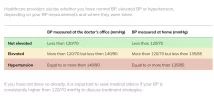
Of the three major cardio societies that establish worldwide medical BP guidelines, the most recent (ESC 2024) removed the lower boundary for "normal" systolic, since evidence doesn't show any lower limit where risk stops going down.

For healthy people, ideal is now <120 / 60-70. Canada just adopted this standard a week ago. (Canuck primarily care docs online are bitching about the workload due to all the patients they'll need to put on meds now, but cardiologists are cheering it).

IMG_1604.webp

The 2 older standard "ideals" are 110-120 / 60-80.

These are different from treatment "targets" for folks with hypertension using BP meds though, which allow for slightly higher levels that are achievable without side effects, though I'm sure getting into the ideal range is better for the patient if it can be done in a way that's tolerable.

One of the more interesting leading edge treatments is "renal denervation". Started 25 years ago, in plain english, it's "disconnecting" a nerve that causes arteries in the kidney to contract raising blood pressure.

It's a 30 minute simple procedure. and while it's mostly been used for medication non-responders, it's now being offered to young people with mild high blood pressure (inherited, not lifestyle or weight).

The thinking is it's a better way to protect them from long term hypertension damage without needing a lifetime of medications.

So far, there doesn't seem to be a downside. No real risk of low blood pressure from this, blood pressure most often falls into normal range permanently, and kidneys stay very healthy afterwards.
 
Last edited:
Of the three major cardio societies that establish worldwide medical BP guidelines, the most recent (ESC 2024) removed the lower boundary for "normal" systolic, since evidence doesn't show any lower limit where risk stops going down.

For healthy people, ideal is now <120 / 60-70. Canada just adopted this standard a week ago. (Canuck primarily care docs online are bitching about the workload due to all the patients they'll need to put on meds now, but cardiologists are cheering it).

View attachment 333198

The 2 older standard "ideals" are 110-120 / 60-80.

These are different from treatment "targets" for folks with hypertension using BP meds though, which allow for slightly higher levels that are achievable without side effects, though I'm sure getting into the ideal range is better for the patient if it can be done in a way that's tolerable.

One of the more interesting leading edge treatments is "renal denervation". Started 25 years ago, in plain english, it's "disconnecting" a nerve that causes arteries in the kidney to contract raising blood pressure.

It's a 30 minute simple procedure. and while it's mostly been used for medication non-responders, it's now being offered to young people with mild high blood pressure (inherited, not lifestyle or weight).

The thinking is it's a better way to protect them from long term hypertension damage without needing a lifetime of medications.

So far, there doesn't seem to be a downside. No real risk of low blood pressure from this, blood pressure most often falls into normal range permanently, and kidneys stay very healthy afterwards.
I was basing my statement off of some longevity type studies/info i have seen and not off what modern medicine/governments have decreed to be best. As sometimes those organizations base their recommendations off of lobbyists and what is economical for them i find. I think people should look at all info then decide for themselves accordingly. we all have our own comfort zones
 
I was basing my statement off of some longevity type studies/info i have seen and not off what modern medicine/governments have decreed to be best. As sometimes those organizations base their recommendations off of lobbyists and what is economical for them i find. I think people should look at all info then decide for themselves accordingly. we all have our own comfort zones

I hear you, I look for what's best for longevity as well. Just addressing concerns about "too low" bp increasing risk, which these slow to change and hard to convince organizations are beginning to recognize isn't an issue for otherwise healthy people. The elimination of a hard lower limit for systolic is very telling that there must be compelling evidence showing it's not a concern, or they would've left good enough alone. I heard preventative cardiologists saying to achieve the lowest long term risk get systolic as low as you can without falling over years ago.

Cholesterol standards of treatment are even worse and slower to change. There's not even an attempt in primary care to reach LDL levels that stop plaque accumulation, and certainly not the LDL levels we know can reverse arterial buildup that can be achieved in most people.

I'll make a post about my stack for that, and the importance of keeping the "plaque regression window" open, before locking in narrowed arteries permanently by intentionally speeding up calcification, which is the approach used for the last 40 years.
 
LDL levels we know can reverse arterial buildup that can be achieved in most people.

What LDL levels have clinically been proven to reverse arterial buildup, without the use of a statin?

I have nothing against the use of statins.
However you did bring up the point that LDL levels reverse buildup which is not the same as statins reverse buildup.
 
I hear you, I look for what's best for longevity as well. Just addressing concerns about "too low" bp increasing risk, which these slow to change and hard to convince organizations are beginning to recognize isn't an issue for otherwise healthy people. The elimination of a hard lower limit for systolic is very telling that there must be compelling evidence showing it's not a concern, or they would've left good enough alone. I heard preventative cardiologists saying to achieve the lowest long term risk get systolic as low as you can without falling over years ago.

Cholesterol standards of treatment are even worse and slower to change. There's not even an attempt in primary care to reach LDL levels that stop plaque accumulation, and certainly not the LDL levels we know can reverse arterial buildup that can be achieved in most people.

I'll make a post about my stack for that, and the importance of keeping the "plaque regression window" open, before locking in narrowed arteries permanently by intentionally speeding up calcification, which is the approach used for the last 40 years.
What i hac seen over the years from these types of organizations it they do not look for what is most optimal for longevity. They base their criteria off of what has been proven to be unhealthy for a certain condition. So over time they find that lower levels of BP or glucose levels can be unhealthy as compared to what they have been. Seems like the long way to get things done to me. I find that is what is best for the vascular system for LDL is not what may be the best for longevity, immune system or the brain etc..
 
What LDL levels have clinically been proven to regress buildup, without the use of a statin?

70 is the threshold at which regression was observed in a small minority, and below 40 is where it becomes prevalent in the majority.

If you combine ezetimibe, bempodoic acid (not a fan), and a hard to acquire for most pcsk9 inhibitor you're looking at a roughly 85% reduction which would get the vast majority below 40.

But you hit the nail on the head. A statin is the only accessible way for most to get below 40 unless they have the $7,000 / yr for a pcsk9 inhibitor.

And statins are explicitly used as plaque "stabilizers", aka calcification accelerators, since that's what the "stabilize" euphemism really means, in addition to LDL reduction.

Pitavastatin is the lone exception among statins. There's good evidence this rarely used (due to cost) statin actively inhibits calcification, and the higher the dose, the slower calcification progresses even as it lowers ldl more aggressively, the opposite of other statins, strongly suggestive it leaves the pre-calcification regression window open longer than when using other statins.

Especially for those of us with bad lipids but a zero calcium score, when combined with other non-calcification promoting ldl lowering agents like ezetimibe, bempodoic acid, (and if you can do it a pcsk9) that combo could achieve deeper regression, and a smaller blockage of the artery before access to the lipid core is eventually blocked off by calcification and your narrowed arteries are "locked in".
 
70 is the threshold at which regression was observed in a small minority, and below 40 is where it becomes prevalent in the majority.

By using a statin or no statin?
Is the effect of regression due to the use of a statin at low LDL levels, or due to low LDL levels? That's what im talking about.
 
By using a statin or no statin?
Is the effect of regression due to the use of a statin at low LDL levels, or due to low LDL levels? That's what im talking about.

It's LDL level that's the overwhelmingly more important determinant of regression, regardless of what brings LDL down.

Statins offer some effects that help the process. mainly anti inflammation and endothelial function improvement, but that's not a major factor and more about preventing additional buildup while regression is taking place. GLPs and even Cialis have similar properties.

Another unique advantage of Pitavastatin relevant to your question though... Regression depends on "reverse cholesterol transport", the ability of HDL to remove fat from the arterial lipid core and transport it to the liver for disposal. How well HDL does this is mostly determined by a factor called "efflux", which Pita improves significantly.

Probably a good idea to add an important disclaimer here. If someone's at high risk, this stuff doesn't apply, and getting the lipid core calcified with conventional statins is the fastest, proven way to reduce risk of a heart attack or stroke. I'm taking about getting the arteries as clear as you can by prevent calcification for as long as possible, while promoting the fastest regression you can, for non high risk people.
 
Last edited:
It's LDL level that's the overwhelmingly more important determinant of regression, regardless of what brings LDL down.

Not sure why you keep talking about a statin, it is not relevant to my question.

Do you have clinical studies that show, that the low LDL levels < 40 that you mentioned pior, is the primary driver/determinant for regression, without the use of a statin?

The last time I searched, Icould not find any, maybe I did not dig deep enough. Almost every study I found, regardless of whether they mentioned it or not, involved the use of a statin in their sample or testing methodology.
 
Last edited:
Not sure why you keep talking about a statin, it is not relevant to my question.

Do you have clinical studies that show, that the low LDL levels < 40 that you mentioned pior, is the primary driver/determinant for regression, without the use of a statin?

The last time I searched, Icould not find any, maybe I did not dig deep enough. Almost every study I found, regardless of whether they mentioned it or not, involved the use of a statin in their sample or testing methodology.

I dropped this into GPT as well and GPT also claims that LDL is the best determinant for regression.

I then asked it for sources and then it showed me a list of trials, all of which either either Statins as mono-therapy or Statins as combination therapy.

After removal of all trials that used statins, it then said that it was no longer the primary determinant for regression as there are no trials that did not use statins that showed regression. It changed its tune from LDL being the primary determinant to it being correlated.

Am i missing something?
I hate quoting GPT cause I know majority of the info it gives is wrong but I do use it as a search engine for information sources.
@Ghoul

1749909338275.webp
 

Sponsors

Back
Top