

displacement

Deezznutzz

Member
If using xkawns 250 cyp recipe help me understand displacement. I am doing research and have never messed with this before so it's confusing. If I follow this recipe do I need to know anything about displacement? Or will this recipe will just make 100ml so 10 vials? Please explain to me displacement in full. I don't understand what it means or what I need to do about it or anything. If I had to guess what it mean I would have a lot extra then 100 ml when I was finished?
 

Attachments

  • N.jpg
    N.jpg
    29.8 KB · Views: 22
Density = g/cm^3
Displacement = density^-1 = ((cm^3)/g)
1 cm^3 = 1 ml

As example:

You have a 1l (1000 ml = 1000 cm^3) glas filled to the top with water and you add 20g of sugar (saccharose)

Density of water APPROX 1 g/cm^3
Density of saccharose 1.6 g/cm^3

So displacement of saccharose is 1.6^-1 = 0.625 ((cm^3)/g).
Therefore will 20g sugar displace 12.5 ml (cm^3) water. (20 * 0.625).

Metric ftw btw

EDIT:
For your specific problem:
Density of Test C approx 1.1 g/cm^3 (source pubchem)
So displacement 0.909 (cm^3)/g

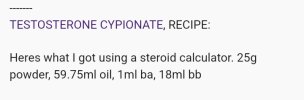
25g * 0.909 (cm^3)/g + 59.75ml (Oil)+ 1ml (BA) + 18ml (BB) = 101.475 ml total volume. This means 246.336 mg Test C/ml
 
Last edited:
Density = g/cm^3
Displacement = density^-1 = ((cm^3)/g)
1 cm^3 = 1 ml

As example:

You have a 1l (1000 ml = 1000 cm^3) glas filled to the top with water and you add 20g of sugar (saccharose)

Density of water APPROX 1 g/cm^3
Density of saccharose 1.6 g/cm^3

So displacement of saccharose is 1.6^-1 = 0.625 ((cm^3)/g).
Therefore will 20g sugar displace 12.5 ml (cm^3) water. (20 * 0.625).

Metric ftw btw
I'm just asking what the displacement is I need the dummy version. Does this recipe look good to go or do I need to do something different for displacement? Like what happens if I just follow this recipe and I don't do anything for displacement? Is it displacement something I'm supposed to change in the powder weight that is set on the base killer calculator at 0.85?
 
I'm just asking what the displacement is I need the dummy version. Does this recipe look good to go or do I need to do something different for displacement? Like what happens if I just follow this recipe and I don't do anything for displacement? Is it displacement something I'm supposed to change in the powder weight that is set on the base killer calculator at 0.85?
Yes change it to 0.909
 
Yes change it to 0.909
So help me understand this a little better. What happens if you leave it at the 0.85 setting. Do you get less or more finished product? Sorry for the noob questions but I'm doing research I'm way far from trying this LOL
 
Yes change it to 0.909
It says 1G displacement is 0.909. So does that mean if I'm using 25 G of powder I mutiply that number by 25 and enter it in the powder weight? Or do I just ignore the one gram part and just put 0.909 for the powder weight if I'm using 25G?Thanks
 
So help me understand this a little better. What happens if you leave it at the 0.85 setting. Do you get less or more finished product? Sorry for the noob questions but I'm doing research I'm way far from trying this LOL
At 0.85 you will get more total volume of oil with less concentration of Test C <250 mg/ml (see edit from 1st post.

At 0.909 you should get exactly 100ml of oil with 250 mg/ml Test C

Higher than 0.909 you will get less than 100ml oil with higher concentration >250 mg/ml Tes C
 
It says 1G displacement is 0.909. So does that mean if I'm using 25 G of powder I mutiply that number by 25 and enter it in the powder weight? Or do I just ignore the one gram part and just put 0.909 for the powder weight if I'm using 25G?Thanks
Basskiller calc will calc the amount of the oil, BA and BB you need for your desired total volume, concentration and percentage of BA & BB
 
Basskiller calc will calc the amount of the powder you need for your desired total volume, concentration and percentage of BA & BB
Thanks man you're like a wizard LOL. I suck at math but I think I got this figured out. So if I was to leave it at .85 and added the oil I would end up with too much and it would be a little diluted? So by changing it to the .909 it allows you to not come out with a weaker product? And if I left it at .5 I could do the top off method where I just add half the oil and then later when everything is mixed add some more oil to where it was just 100 ml finished ? But the smartest way we do it would be to change it to the .909 cause then all the measurements are exact. I think I got it if that's all right. Thanks for your help
 
Last edited:
Thanks man you're like a wizard LOL. I suck at math but I think I got this figured out. So if I was to leave it at .85 and added the oil I would end up with too much and it would be a little diluted? So by changing it to the .909 it allows you to not come out with a weaker product? And if I left it at .5 I could do the top off method where I just add half the oil and then later when everything is mixed add some more oil to where it was just 100 ml finished ? But the smartest way we do it would be to change it to the .909 cause then all the measurements are exact. I think I got it if that's all right. Thanks for your help
Yes exactly.
Keep in mind that heat will change the density so you should add room temp. Oil to the room temp. Brew ... Just for the sake of completeness
 
Back
Top