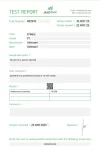
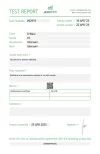
WtsBulk Hormones - Primo Raw HPLC

I’ve got to be honest… I really didn’t think it was primo. I got primo raws from another vendor and theirs had the shiny fish scale appearance with a smell while wtsbulk has 0 smell and looks like sugar. I’m very relieved to see it test as primo.
This is good result the smells you discoverd are often due to the solvents left over. Sometimes they achieve in washing it all out. Sometimes they dont. All in all this is a good example of good raws for the most part. No smell indicative they dried it out right.

People love to say the smell test is sufficient in determining a compound but it's actually not. Its just telling of the solvent system that is typical of a compound.

Also, the crystal forms that you're describing are typical different compounds. It seems to me that some suppliers are grinding up the crystals, which is why you're saying sometimes they come out fishy-scale. Grinding it up releases some of the solvents, which is probably why it has no smell when it comes out as a powder.
 
This is good result the smells you discoverd are often due to the solvents left over. Sometimes they achieve in washing it all out. Sometimes they dont. All in all this is a good example of good raws for the most part. No smell indicative they dried it out right.

People love to say the smell test is sufficient in determining a compound but it's actually not. Its just telling of the solvent system that is typical of a compound.

Also, the crystal forms that you're describing are typical different compounds. It seems to me that some suppliers are grinding up the crystals, which is why you're saying sometimes they come out fishy-scale. Grinding it up releases some of the solvents, which is probably why it has no smell when it comes out as a powder.
Do you have any studies/college in chemistry? I saw your post and you are more knowledgeable that a regular guy who brew stuff at his home
 
Do you have any studies/college in chemistry? I saw your post and you are more knowledgeable that a regular guy who brew stuff at his home
Extremely dedicated to learning everything I can and hyper ADHD can do a lot. Done this with many topics in my life. However this particular topic is important since its my health and others. Thanks.
 
Extremely dedicated to learning everything I can and hyper ADHD can do a lot. Done this with many topics in my life. However this particular topic is important since its my health and others. Thanks.
If you really want to do it right, make a spreadsheet or an excel file with all the items needed from A to Z with links to the specific items so that ppl can easily source the whole setup, plus all the solvents needed for every different raw.

Next step then is to make a detailed guide on how to do it, best would be a video but that can be tricky so a written step by step works fine.
 
If you really want to do it right, make a spreadsheet or an excel file with all the items needed from A to Z with links to the specific items so that ppl can easily source the whole setup, plus all the solvents needed for every different raw.

Next step then is to make a detailed guide on how to do it, best would be a video but that can be tricky so a written step by step works fine.
For sure I want to make a video cuz I'm getting into chemistry these days anyways So I'm pretty sure I can make a video that's not directly related to the subject if you catch my drift. But a text guide wouldn't be too hard to do either. preferably with some nice pictures for those who only read books with pictures.
 
This is good result the smells you discoverd are often due to the solvents left over. Sometimes they achieve in washing it all out. Sometimes they dont. All in all this is a good example of good raws for the most part. No smell indicative they dried it out right.

People love to say the smell test is sufficient in determining a compound but it's actually not. Its just telling of the solvent system that is typical of a compound.

Also, the crystal forms that you're describing are typical different compounds. It seems to me that some suppliers are grinding up the crystals, which is why you're saying sometimes they come out fishy-scale. Grinding it up releases some of the solvents, which is probably why it has no smell when it comes out as a powder.
Grinding up releases solvents? I don’t think this is accurate… not trying to be a dick here… but these powders have to be homogenized… therefore… grinding would only make it a better mixture… have you ever been in a real lab setting?? Not intro chem bs… organic etc…
 
Grinding up releases solvents? I don’t think this is accurate… not trying to be a dick here… but these powders have to be homogenized… therefore… grinding would only make it a better mixture… have you ever been in a real lab setting?? Not intro chem bs… organic etc…
I'm sorry, I'm referring to deep completely different process.

You're referring to something else.

I'm talking about re-crystallization.
 
Last edited:
Why am I even wasting my time talking to you?? When you clearly don’t know shit about what you are talking about
* Freshly grown steroid crystals trap pockets of mother‑liquor (or build a solid‑solution).
* A coarse grind/mesh‑screen right after collection opens those inclusions and doubles the exposed surface area.
* Volatile solvents—acetone, EA, IPA—flash off fast once they hit open air; you can literally smell it.
 • Paracetamol‑ethanol study (Allesø et al., Int J Pharm, 2009) proved it: fracture planes vent near‑surface solvent in minutes, but not the stuff buried deeper.
 • Same principle shows up in ICH training notes on “attrition‑enhanced drying.”

Result: you start vacuum drying with less liquid weight and a looser bed that the vacuum can pull through.


2  What grinding can’t do

* It doesn’t supply the heat or low‑pressure gradient needed for solvent locked in the lattice.
* Deeper inclusions and solid‑solution solvent move by slow diffusion; only sustained 40‑50 °C and <10 mbar gets you to ≤500 ppm (ICH Q3C limits).
* That’s why every commercial route still lists “tray‑vac at 45 °C, overnight” after the mill step.


3  So the timeline is:

1. Filter/wash the cake.
2. Quick coarse grind or wet‑mill → blow off the easy solvent, break agglomerates.
3. Load into vacuum oven or agitated dryer → hit spec.
4. Final micronize/jet‑mill only if the product spec needs <20 µm PSD.

Different tools, different jobs.

We are clearly talking about two different concepts. I'm under the impression that the people who even made the Raws were using re-crystallization to purify their product After the initial synthesis, in which case what I stand and what I said is valid.
 
Why am I even wasting my time talking to you?? When you clearly don’t know shit about what you are talking…

Are you actually going to respond to the proof I posted above? Because from the way you're talking, it's clear you don’t have a clue about what I know. You’re making fast assumptions without reading, which honestly just reflects on your own understanding.

Don’t underestimate people. I can back up everything I say with solid research. I don’t talk bullshit, and I don’t spread misinformation. I always do my homework before I speak on anything.

Receipts are above.
• Coarse‑grinding big recrys chunks vents near‑surface solvent (see Allesø 2009, Int J Pharm).
• Vac‑dry finishes the job; every scale‑up SOP runs that combo.


Do you do the same? I sure hope so.
 
Last edited:
Back
Top