Save your unusable raws Guaranteed.

I'm still trying to wrap my head around this, so the raws went from yellow->white.

This entire process is based off the premise that whatever solvent used only dissolves the API and not impurities, therefore allowing us to filter out the impurities and then remove the solvent?
 
I'm still trying to wrap my head around this, so the raws went from yellow->white.

This entire process is based off the premise that whatever solvent used only dissolves the API and not impurities, therefore allowing us to filter out the impurities and then remove the solvent?
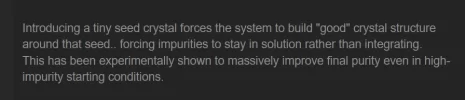
See Walter's posts in this thread. He does a good job explaining. Shared many resources.


Last edited:
This entire process is based off the premise that whatever solvent used only dissolves the API and not impurities, therefore allowing us to filter out the impurities and then remove the solvent?
thats only first step of the prcoess.

i see it as a 3 way step process
 
What i gathered from the past few pages

1) Dissolve in ethanol
2) Filter bottletop filter
3) Freezer to crash out the API
4) Dry out solvents in vac chamber

Are we assuming whatever impurities they are, does not crash out as well?
 
Are we assuming whatever impurities they are, does not crash out as well?
only from dissolution with ehanol removing insoluble impurities.

crashing it out of solution gives you the white crystals which in turns gets you the nice sexy white api. which also removes soluble impurities

and then you get to drying which removes solvents/water
 
crashing it out of solution gives you the white crystals which in turns gets you the nice sexy white api. which also removes soluble impurities

Thats the part im trying to wrap my head around.
How do we prevent similar impurities from crashing out?
We've seen some really well tested 96+% TNE and TC with weird smell and color (when brewed) recently.


If we can find a solvent that only dissolves the API and nothing else, that'd make things perfect, but we don't even know what the impurities are
 
Thats the part im trying to wrap my head around.
How do we prevent similar impurities from crashing out?


If we can find a solvent that only dissolves the API and nothing else, that'd make things perfect, but we don't even know what the impurities are
Read the resources posted above. Just the act of API crystallization ("crashing") selectively purifies the compound if done right. That is the purification mechanism.

Yes, whatever people end up with should be tested and ensure purity and solvent removal.
 
Read the resources posted above. Just the act of API crystallization ("crashing") selectively purifies the compound if done right. That is the purification mechanism.

I was trying to wrap my head around whats preventing unwanted crap from crashing out together with the API.

Basically this. I guess we need a really high purity seed as well.
1761074046380.webp

I know Acetone doesn't turn up in GCMS, but not sure about the rest.
 
Last edited:
I was trying to wrap my head around whats preventing unwanted crap from crashing out together with the API.

Basically this. I guess we need a really high purity seed as well.
View attachment 355955

I know Acetone doesn't turn up in GCMS, but not sure about the rest.
According to the almighty Grok AI. You can use two processes Ethanol with water or Ethyl Acetate with hexane. Both purify in a different way depending on what contamination there is..

Impurity Profile:
Crude testosterone enanthate often contains polar impurities (e.g., proteins, hydroxylated steroids, pigments from microbial synthesis) or non-polar impurities (e.g., steroidal byproducts like testosterone or other esters, lipophilic residues from chemical synthesis). The solvent system’s polarity determines its ability to selectively remove these impurities during recrystall
Solvent Properties:
Ethanol/Water: Ethanol (dielectric constant ~24) is a polar, protic solvent that dissolves testosterone enanthate well at 60–65°C (~100–200 mg/mL). Water, a highly polar anti-solvent, reduces solubility to induce crystallization, effectively excluding polar impurities.
Ethyl Acetate/n-Hexane: Ethyl acetate (dielectric constant ~6) is a moderately polar, aprotic solvent, also effective for dissolving testosterone enanthate. n-Hexane (dielectric constant ~1.9), a non-polar anti-solvent, enhances selectivity for non-polar impurities


Idk man... science
 
I kinda did both procedures to be safe but the hexane deffinatly removed the yellow color! It also said to add a small amount of usp grade activated carbon to help as well during the hot filtration. It doses inherently absorb a small amount of api, reducing overall yield though. I ordered some to give it a shot
 
I kinda did both procedures to be safe but the hexane deffinatly removed the yellow color! It also said to add a small amount of usp grade activated carbon to help as well during the hot filtration. It doses inherently absorb a small amount of api, reducing overall yield though. I ordered some to give it a shot

I was actually looking at activated carbon to use in oil lol.
It doesn't dissolve so i could just filter it out.

Problem is...i didn't know the purity of the carbon so it might make things worse :rolleyes:

The solubility seems kinda bad. I was looking at TNE and it'd take a f load of ethanol just to dissolve it..GPT was giving me something like 10–20 mg/mL
 
I was actually looking at activated carbon to use in oil lol.
It doesn't dissolve so i could just filter it out.

Problem is...i didn't know the purity of the carbon so it might make things worse :rolleyes:

The solubility seems kinda bad. I was looking at TNE and it'd take a f load of ethanol just to dissolve it..GPT was giving me something like 10–20 mg/mL
Usp grade low ash, low ph, 300 mesh was surprisingly difficult to find. Luciky I found some obscure website out of new jersey thay really reasonable.
Honestly you should be able to dissolve alot more tne per ml than that. I was doing 500mg per ml no problem.
 
I was doing 500mg per ml no problem.

TNE?
I might just mess around just for kicks when my raws arrive.

The next question would then be..how to test if it's safe to use?
Jano has GCMS for 170$ but alot of stuff..doesn't turn up on it AFAIK.
 
TNE?
I might just mess around just for kicks when my raws arrive.

The next question would then be..how to test if it's safe to use?
Jano has GCMS for 170$ but alot of stuff..doesn't turn up on it AFAIK.
I was doing test cyp and test e, not sure why no ester would effect the solubility that much. I ran it through grok and its saying 150mg/ml for TNE when heated. It will probably make recrystilization that much easier.
Jano has GCMS for 170$ but alot of stuff..doesn't turn up on it AFAIK.
Great questions, I was under the assumption that GCMS could pick up solvents. If not I'll do a few cold ethanol washes and dry the hell out of it . Got any ideas ? Or just start over and only use ethanol
 
Great questions, I was under the assumption that GCMS could pick up solvents. If not I'll do a few cold ethanol washes and dry the hell out of it . Got any ideas ? Or just start over and only use ethanol
even hplc i think is good enough.

if any solvents in there jano will tell you. its too different from steroid molecule to not be caught. especially while testing raws
 

Sponsors

Latest posts

Back
Top