Does Low E2 Crush IGF-1 Conversion on GH?

Hey guys,

I’ve been diving into the endocrinology behind the relationship between Estradiol (E2) and IGF-1, and I wanted to get some input from the seasoned guys here.

Basically, my main question is this: If someone has low or completely crushed estrogen, is their growth going to be severely stunted compared to someone running normal or high E2 levels while on HGH?

Here is my current situation as an example:

- I’m currently in a cutting phase, entering reverse dieting next week.
- I naturally run low E2.
- I’m currently running 6IU of GH per day.
- I just got my bloods back, and my IGF-1 came in at a mere 104 ng/mL.

I should mention that I unfortunately didn't test my baseline IGF-1 prior to starting the HGH, so I don't have a pre-GH number to compare this to.

However, given that 104 ng/mL is basically baseline anyway (or even low depending on age), does this mean I am essentially not getting the anabolic/growth benefits from the exogenous GH?

I know there are a few variables at play here. Since I'm cutting, my calories and insulin are low, which I know downregulates hepatic conversion of GH to IGF-1. But I'm also wondering how much of a role my low E2 is playing in this. We know estrogen is highly neuroprotective, great for joints, and generally anabolic, but does a lack of systemic E2 directly blunt the liver's ability to pump out IGF-1, or local IGF-1 expression in the muscle tissue?

Am I just wasting my GH right now, or is the lipolysis/fat burning still happening efficiently despite the low IGF-1 serum levels?

Would love to hear your thoughts or see any studies you guys have dug up on this.

Thanks.
 
Hey guys,

I’ve been diving into the endocrinology behind the relationship between Estradiol (E2) and IGF-1, and I wanted to get some input from the seasoned guys here.

Basically, my main question is this: If someone has low or completely crushed estrogen, is their growth going to be severely stunted compared to someone running normal or high E2 levels while on HGH?

Here is my current situation as an example:

- I’m currently in a cutting phase, entering reverse dieting next week.
- I naturally run low E2.
- I’m currently running 6IU of GH per day.
- I just got my bloods back, and my IGF-1 came in at a mere 104 ng/mL.

I should mention that I unfortunately didn't test my baseline IGF-1 prior to starting the HGH, so I don't have a pre-GH number to compare this to.

However, given that 104 ng/mL is basically baseline anyway (or even low depending on age), does this mean I am essentially not getting the anabolic/growth benefits from the exogenous GH?

I know there are a few variables at play here. Since I'm cutting, my calories and insulin are low, which I know downregulates hepatic conversion of GH to IGF-1. But I'm also wondering how much of a role my low E2 is playing in this. We know estrogen is highly neuroprotective, great for joints, and generally anabolic, but does a lack of systemic E2 directly blunt the liver's ability to pump out IGF-1, or local IGF-1 expression in the muscle tissue?

Am I just wasting my GH right now, or is the lipolysis/fat burning still happening efficiently despite the low IGF-1 serum levels?

Would love to hear your thoughts or see any studies you guys have dug up on this.

Thanks.
Being in a calorie deficit is a igf1 crusher IME, your still gonna get the stimulus of lypolysis independent of igf1, so fat burning benefits are still present, possibly enhanced, what’s not getting maximized is possible protein synthesis signaling because of low IGF1, but if fat loss is what you’re after you’re good but with IGF 1 that low, you’re not maximizing anabolic or repair benefits. The good thing is that if you’re on testosterone, it’s at least preserving your muscle.
 
Last edited:
Also to answer your question, Estrogen enhances hepatic growth hormone receptor expression, improves growth hormone to IGF1 conversion in the liver, and improves igf1 receptors in tissue , so with low E2 you’re gonna see a lower IGF1 which is apparent from your lower score, reduce collagen synthesis, more poor connective tissue response, and reduced GH efficiency so basically at 6 ius you’re kind of wasting GH imo, even if you’re GH dose is high, I was in a steep calorie deficit for around two years and struggled with low IGF1 myself, it wasn’t until I started eating at a maintenance level of calories then my IGF1 started to get into an acceptable range.
 
@Ateam2023 did a good job of answering.

Generally speaking IGF1 is the feast hormone and HGH is the famine hormone.

There is an ancient switch that toggles between the two states depending on nutritional input. Usually a starved state increases HGH but doesn't generally suppress IGF1. But increasing IGF1 is down to HGH production and positive factors related to food and rest.

So being well fed, rested and relaxed will increase liver output of IGF1.

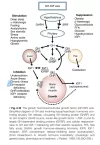
You can ignore half of the picture below because you're injecting. But the rest is pretty much accurate.

The top part is stimulation and suppression of HGH. The bottom half is IGF1 production in the liver.

I've got a big thread about HGH and it goes into the biology. Or you could just read an endocrinology textbook.

BTW you don't even need circulating IGF1 to build muscle. It's made locally.

1000114349.webp
 
You should stop GH for 3 or 4 weeks when you are in your surplus and check your baseline dude

GH is such a long term thing that 3-4 weeks isn't' going to change anything and you will get valuable information to base dosing decisions on.

I am not suggesting this is a likely scenario- but lets say your body was already producing GH on the higher end of the scale for your age and you already had above normal IGF levels

Then you started injecting exogenous HGH which shut down your natural production, but for your body, isn't does at a sufficient amount to match what you were already producing

That's a more likely scenario for someone using 2iu, not 6. Unless there is something wrong with your 6- or you are an extreme outlier

Supposedly Chase Irons used 12iu every day and never got his IGF above 200 or something. Everyone is different.

It's worth stopping to know your natty igf
 
I wouldn't even bother with it if this is how my body metabolised it lol
Well, there is more to it than just free igf that's detectable on a blood test

GH alone has its own benifits, before converting to IGF

And IGF tissue levels are not really testable

Just because he has low measurable blood serum gf doesn't mean it wasn't benefiting him
 
Back
Top