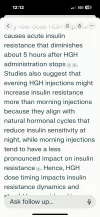
Anyone tried the thrice weekly big bolus like this protocol recommends? Or have any opinions or disagree?

MESO-Rx
Anabolic Steroids

Follow along with the video below to see how to install our site as a web app on your home screen.
Note: This feature may not be available in some browsers.

Got the study name? Would love to read it
An interesting side note is the rHGH used from Eli Lily was 2.6iu/mg. A reminder that IU is a measure of activity (ability to increase IGF), and that 3iu per mg is an assumption based on perfectly manufactured rHGH, but never actually confirmed with any UGL product.
Purity does not equal activity.
Seems pretty straight forward to me. It increased LBM, reduced fat but did not affect strength or oxygen uptake. Don't look into what they said past that.I'm not understanding this. The study says this for example "A recent double-blind, placebo-controlled study involving 27 women and 34 men, 68 to 88 years of age, who were given growth hormone or placebo for 6.5 months confirmed the effects of growth hormone on body composition; there was no change in muscle strength or maximal oxygen uptake during exercise in either group.<a href="https://www.nejm.org/doi/full/10.1056/nejmp020186#core-r003" data-xml-rid="r003">3</a> "
Then when I went to the source cited it says this ....
"Conclusions: Physiologic doses of growth hormone given for 6 months to healthy older men with well-preserved functional abilities increased lean tissue mass and decreased fat mass. Although body composition improved with growth hormone use, functional ability did not improve. Side effects occurred frequently."
It says body fat was lowered and muscle increased. But what you're saying is functionally its not making a difference so they don't count that as a net benefit?
I'm not understanding this. The study says this for example "A recent double-blind, placebo-controlled study involving 27 women and 34 men, 68 to 88 years of age, who were given growth hormone or placebo for 6.5 months confirmed the effects of growth hormone on body composition; there was no change in muscle strength or maximal oxygen uptake during exercise in either group.<a href="https://www.nejm.org/doi/full/10.1056/nejmp020186#core-r003" data-xml-rid="r003">3</a> "
Then when I went to the source cited it says this ....
"Conclusions: Physiologic doses of growth hormone given for 6 months to healthy older men with well-preserved functional abilities increased lean tissue mass and decreased fat mass. Although body composition improved with growth hormone use, functional ability did not improve. Side effects occurred frequently."
It says body fat was lowered and muscle increased. But what you're saying is functionally its not making a difference so they don't count that as a net benefit?

 pubmed.ncbi.nlm.nih.gov
That makes sense though. Nobody wants to tax payer fund this, so I can see why there is that spin on "anti-aging" anything.
It doesn't seem like adding hgh will make you live more years overall but it does seem like it'll make the years you live more enjoyable at small to moderate doses. You'll be a happier old person with more lean mass and less fat (assuming you're within normal ranges for all this).
Could you say anti-aging is the wrong word to use then, and instead say you'll have a better quality of life for a longer time? Higher lean body mass has many metabolic benefits that will keep you from getting sick later on in life.
Now how much is that in QSC/Sigma Aldrich tier HGH?At physiological doses, generally 3iu and below:
On one hand we know
-increased lean body mass
-increased bone density
-reduced visceral fat (especially vital for men)
Are all clearly associated with longevity.
On the other, those with lower natural GH levels live longer as a group (though not necessarily "healthy years") and rHGH use is connected to greater cancer risk.
Personally I think with careful management. extra vigilance against cancer, rHGH may extend longevity, and certainly boost "quality of life" for the years remaining, which gives a person the will to live and motivation to take the steps necessary to ensure life goes on as long as possible vs "giving up" because life in a decrepit body ravaged by so called "normal aging" sucks.

Quick search to get a " general" idea, excuse the ai ,Been running 10 iu on MWF, so far so good it seems, but can’t decide on am or pm dosing. Which is best when watching/trying to reduce insulin resistance?
how long have you been doing this m-w-f protocol? And have you noticed an effect on fbg? Or Rhr? , basically how long and any significant changes? TiaBeen running 10 iu on MWF, so far so good it seems, but can’t decide on am or pm dosing. Which is best when watching/trying to reduce insulin resistance?

i too was considering this 3x weekly dosing, but waiting for a few more reports from users doing this protocol,Also curious how it’s treating your RHR, HRV, and FBG. Looking to run this experiment for myself eventually.
That was the general gist I got out of ai too, but then watched some Kurt Havens video where they were absolutely convinced of the opposite.Quick search to get a " general" idea, excuse the ai ,