Chronic low HDL but good LDL (need advice)

Wesley Vissers goes there frequently. And Peter Bond is part of the founders. Some will know him but in NL he's a figure with a lot of cred. I would highly recommend his book to beginners and intermediate users: Order Book on Steroids

Its full of in depth information. Unlike the steroid book from llewelyn.
lol i was going to ask if you saw Vissers and Bonac there. Great to know that some societies on Earth have their heads somewhat out of their asses on this topic.
 
Trying to recap, I am not on cycle nor have been for 2 years, my ldl is 141 which is not great but my best in years and my hdl is 41. Is this common, its still within range but low
 
Last edited:
How’s the diet, cardio, bf%?
Eqq whites for breakfast, chicken 3 times a day, maybe beef three to four times a week. Carbs rice, toast, maybe pizza once a week.

Cardio havent done in 3 months due to groin pull just cant get moving. However weights 4 times a week and 3 times per week BJJ/Muay Thai-striking.

I can see upper abs so I am guessing around 15%.

These are relatively better numbers for me as I usually in 180's, however this year is one of my lowest but with that my HDL has gone down significantly as well
 
Eqq whites for breakfast, chicken 3 times a day, maybe beef three to four times a week. Carbs rice, toast, maybe pizza once a week.

Cardio havent done in 3 months due to groin pull just cant get moving. However weights 4 times a week and 3 times per week BJJ/Muay Thai-striking.

I can see upper abs so I am guessing around 15%.

These are relatively better numbers for me as I usually in 180's, however this year is one of my lowest but with that my HDL has gone down significantly as well
Might be time for a statin medication. Much of this is genetically mediated and PED use will only exacerbate the issue. Seems your diet and lifestyle are not the issue.
 
Might be time for a statin medication. Much of this is genetically mediated and PED use will only exacerbate the issue. Seems your diet and lifestyle are not the issue.
my doctor said he is not worried about it until my ldl goes over 200. With my job i have to get bloodwork every year as a part of insurance reduction. 141 was lowest I ever had in last 19 years
 
my doctor said he is not worried about it until my ldl goes over 200. With my job i have to get bloodwork every year as a part of insurance reduction. 141 was lowest I ever had in last 19 years
I was wrong. You need a new doctor and a statin. Pitavastatin 2 mg daily for 4 to 6 weeks, re-check labs, increase to 4 mg for 4 to 6 weeks, re-check labs, add Zetia. Or cheaper route is rosuvastatin 5 mg for 4 to 6 weeks, increase to 10 mg as needed. Even if you were not using PEDS, LDL over 200 is lunacy.

Look up some of the posts from @Ghoul regarding the most recent data on lipids. The literature is now advising that total cumulative exposure to dyslipidemia is the issue (area under the curve), similar to pack-years in smoking. There is no reason on this earth that an otherwise healthy person (who plans to use PEDs further) should have an LDL over 100, preferably under 70. You should also check your ApoB and Lp(a) to further asses CVD risk.
 
my doctor said he is not worried about it until my ldl goes over 200. With my job i have to get bloodwork every year as a part of insurance reduction. 141 was lowest I ever had in last 19 years

Primary care physicians are often decades behind current knowledge.

We know, for instance, 5000 mg/dl of cumulative lifetime LDL/years of exposure is the point significant atherosclerotic plaque has begun to build up in arteries (in other words, by 5000 meaningful heart disease has begun to develop). IE, average LDL 200 x 20 years is 4000.

Any preventative cardiologist would be looking to get your LDL below 55 at this point. That's what most guidelines call for.

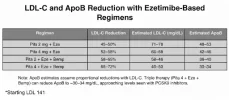
Pitavastatin 4mg + Ezetimebe would get you to 60-65 with almost no risk of side effects. Add bempedoic acid, also beet unlikely to cause sides, and you'd be down to ~50.

Below 60 and you're reversing plaque accumulation.

Your long term cardiovascular health is at risk here and the clock is ticking.

(not just heart attack and stroke risk, but peripheral artery disease cutting off blood to your extremities. esp legs, incurable erectile dysfunction, neurodegeneration etc).
 
Last edited:
Primary care physicians are often decades behind current knowledge.

We know, for instance, 5000 mg/dl of cumulative lifetime LDL/years of exposure is the point significant atherosclerotic plaque has begun to build up in arteries (in other words, by 5000 meaningful heart disease has begun to develop). IE, average LDL 200 x 20 years is 4000.

Any preventative cardiologist would be looking to get your LDL below 55 at this point. That's what most guidelines call for.

Pitavastatin 4mg + Ezetimebe would get you to 60-65 with almost no risk of side effects. Add bempedoic acid, also beet unlikely to cause sides, and you'd be down to ~50.

Your long term cardiovascular health is at risk here and the clock is ticking.
Decades is being generous...

Can't thank you enough brother for the knowledge drops on this subject.

And maybe one day we will figure out why some bro's who have no qualms about pinning 2 grams of UGL gear weekly and take multiple orals will not touch a statin
 
Decades is being generous...

Can't thank you enough brother for the knowledge drops on this subject.

And maybe one day we will figure out why some bro's who have no qualms about pinning 2 grams of UGL gear weekly and take multiple orals will not touch a statin

I can sympathize with statin-phobia, I had it too, and at one time it was justified. Though I think it's funny some will turn to "natural supplements" like red yeast rice, which is the same active ingredient as primitive first generation statins that had all the horrible side effects that made people afraid of statins.

Even modern statins, like rosuvastatin (crestor), the most commonly prescribed, while much better than older statins, still carries an elevated diabetes risk.

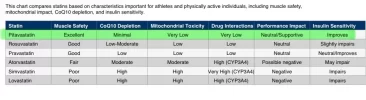
We finally have a statin that does exactly what we need it to do, without "off target" effects, Pitavastatin. (that's why it's dose is so small, 1-4mg, vs 5-80mg of other statins. It's a precisely engineered tiny receptor specific molecule, a "sniper rifle" instead of a "shotgun").

Sadly most front line docs don't know about. I was with a buddy who used telehealth to get a prescription (sometimes the easiest route). The provider said she was a cardiac nurse and never heard of it (but was impressed when she looked it up to write the prescription).

It's about $115 in the US for 90 pills (was $1500 a couple of years ago). Expensive by statin standards. But if you have insurance it'll be covered and you pay a "generic drug" deductible. If you're 40 or older it's $0 by law.

Finally, $45 for 100 tabs from India pharma is an option.

I keep posting this but it's worth repeating:

IMG_1924.webp


IMG_2364.webp
 
Last edited:
If you're 40 or older it's $0 by law.


View attachment 345051


View attachment 345053
Do you have any further info on this piece? I'm mid 40's and paying $50 / mo for pita.

Also, is there any data re: dissipation of efficacy of the statins (specifically Pita) on any given dosage? For example, if you come out of the gate with 4 mg Pita and 10 Zetia and you get a nice low LDL and ApoB, is there any indication this would stop working over time? Said another way, is there any reason to use the minimal effective dosage / combination of Pita and Zetia for as long as possible before increasing Pita to 4 mg and adding Zetia? My sense is the answer is no, only because we want to invert that data about cumulative dyslipidemia exposure, aka get the LDL / ApoB as low as possible for as long as possible.
 
Last edited:
Do you have any further info on this piece? I'm mid 40's and paying $50 / mo for pita.

Also, is there any data re: dissipation of efficacy of the statins (specifically Pita) on any given dosage? For example, if you come out of the gate with 4 mg Pita and 10 Zetia and you get a nice low LDL and ApoB, is there any indication this would stop working over time? Said another way, is there any reason to use the minimal effective dosage / combination of Pita and Zetia for as long as possible before increasing Pita to 4 mg and adding Zetia? My sense is the answer is no, only because we want to invert that data about cumulative dyslipidemia exposure, aka get the LDL / ApoB as low as possible for as long as possible.

There is no evidence statins lose efficacy over time. The mechanism of action of all three of these meds doesn't wear off.

Compliance drops over time, with most people stopping taking their statin daily within the first year. Same as blood pressure meds. That's not side-effect related, it's just people feel fine, bp and lipids don't cause symptoms, so they don't bother taking it any more. As a result of failing to get on or adhere to meds, most heart attacks and strokes, 80%, the #1 cause of death and disability, were avoidable. Compliance rates go way up for AFTER surviving a heart attack.

There is very little difference between 2mg and 4mg pitavaststin, and if 2mg gets you below 55, you could argue it's reasonable to take the lower dose 2mg. While side effects are extremely unlikely, if doubling to 4mg only yields 1-2 points less LDL, why bother. On the other hand, I'd drop bempedoic acid in favor of 4mg Pita if it gets you to goal LDL, instead of Pita 2mg + Bemp. Bemp can slow collagen turnover, and in those over 75 there's a slightly higher risk of tendon injuries, and 2 meds are easier to deal with than 3 ofc.

$0 deductible statins for over 40 applies to 98% of health care covered adults in the US. If you're being charged you need to speak to whoever covers your medication. It was part of the Obamacare law.

“Because low- to moderate- dose statins are strongly recommended by the United States Preventive Services Task Force (USPSTF) for primary prevention of cardiovascular disease in adults aged 40–75 years who are at risk, the Patient Protection and Affordable Care Act (PPACA) in the United States requires most health insurance plans to cover the costs of these drugs without charging the insured patient a copayment or coinsurance, even if he or she has not yet reached his or her annual deductible.”

 
There is no evidence statins lose efficacy over time. The mechanism of action of all three of these meds doesn't wear off.

Compliance drops over time, with most people stopping taking their statin daily within the first year. Same as blood pressure meds. That's not side-effect related, it's just people feel fine, bp and lipids don't cause symptoms, so they don't bother taking it any more. As a result of failing to get on or adhere to meds, most heart attacks and strokes, 80%, the #1 cause of death and disability, were avoidable. Compliance rates go way up for AFTER surviving a heart attack.

There is very little difference between 2mg and 4mg pitavaststin, and if 2mg gets you below 55, you could argue it's reasonable to take the lower dose 2mg. While side effects are extremely unlikely, if doubling to 4mg only yields 1-2 points less LDL, why bother. On the other hand, I'd drop bempedoic acid in favor of 4mg Pita if it gets you to goal LDL, instead of Pita 2mg + Bemp. Bemp can slow collagen turnover, and in those over 75 there's a slightly higher risk of tendon injuries, and 2 meds are easier to deal with than 3 ofc.

$0 deductible statins for over 40 applies to 98% of health care covered adults in the US. If you're being charged you need to speak to whoever covers your medication. It was part of the Obamacare law.

“Because low- to moderate- dose statins are strongly recommended by the United States Preventive Services Task Force (USPSTF) for primary prevention of cardiovascular disease in adults aged 40–75 years who are at risk, the Patient Protection and Affordable Care Act (PPACA) in the United States requires most health insurance plans to cover the costs of these drugs without charging the insured patient a copayment or coinsurance, even if he or she has not yet reached his or her annual deductible.”

Given the minimal difference between 2 and 4 of pita, if you're within 10 - 20 % of your LDL / ApoB goal on 2 of pita would you add the Zetia before going to 4 of pita?
 
Given the minimal difference between 2 and 4 of pita, if you're within 10 - 20 % of your LDL / ApoB goal on 2 of pita would you add the Zetia before going to 4 of pita?

I would use Pita 4mg, and save the Ezetimebe for when and if I needed additional reduction. Unlike BP meds, there's no advantage to low dose multiple different mechanism of action meds, vs a larger dose of a single med. One pill, low cost or free. Anything that makes it more likely to stick with long term is useful. In theory risk of sides are very slightly higher on 4mg, but 1,2, and 4 are all sitting near zero risk.

Though keep in mind, the mantra regarding LDL in preventative cardiology is "The lower the better".

We evolved to have 0 LDL. We only have this issue because of a genetic mutation (PCSK9) that interferes with the liver's LDL clearance function. In the groups (isolated tribes, and occasionally random individuals), that don't have functioning PCSK9, and therefore 0 LDL, they don't have any plaque, no infarction heart attacks, almost no strokes, and suffer no health problem from having 0 LDL.

Every cell that requires LDL for something, like testosterone production, has a "factory" that synthesizes cholesterol on demand from basic elements that are abundant. No external LDL is necessary. In fact, they make so much, we need HDL to transport the excess away and back to the liver for disposal.

PCSK9 inhibitors, like Repatha, were developed to replicate what these long living 0 LDL genetic groups have naturally.
 
Last edited:
I would use Pita 4mg, and save the Ezetimebe for when and if I needed additional reduction. Unlike BP meds, there's no advantage to low dose multiple different mechanism of action meds, vs a larger dose of a single med. One pill, low cost or free. Anything that makes it more likely to stick with long term is useful. In theory risk of sides are very slightly higher on 4mg, but 1,2, and 4 are all sitting near zero risk.
GOAT-ed
Thanks again brother.
 
It seems that ancient man even millions of years ago was producing LDL. Just like other vertebrates have LDL as it is needed. It is used to make cell membranes, hormones, the brain as well as being used in other functions. I have seen no good evidence that there are tribes with zero LDL but would like to see such data. While there LDL levels are lower seems their cholesterol in general ranges from 100-150ish and LDL from 50-75 from my reading.
 
It seems that ancient man even millions of years ago was producing LDL. Just like other vertebrates have LDL as it is needed. It is used to make cell membranes, hormones, the brain as well as being used in other functions. I have seen no good evidence that there are tribes with zero LDL but would like to see such data. While there LDL levels are lower seems their cholesterol in general ranges from 100-150ish and LDL from 50-75 from my reading.
These tribes don’t have suppressed HDL from PED use. If folks are going to run gear their HDL low, LdL should be minimal. For gen pop with normal HDL I don’t think such aggressive LDL treatment is so critical
 
Back
Top