Filtering finished oils

Make it yourself to be safe..
#badtubgear lol
In 30 year use i never had any inflamation of dirty gear.
Edit: you do not use ugl tabs ?

No I don't use UGL tabs, but I did in the past.

I have gotten knots and systemic inflammation from UGL gear, and there's also nasty shit you don't want to inject that doesn't necessarily cause obvious symptoms.
 
Make it yourself to be safe..
#badtubgear lol
In 30 year use i never had any inflamation of dirty gear.
Edit: you do not use ugl tabs ?
Tabs aren’t nearly as much an infection risk. There's not as much mystery around inflammatory ingredients like solvents, and less incentive to use harmful ingredients in general. Your most likely risks there are mislabeling and variance. There might be 50 milligrams of clen in my Anadrol tab. But if you're so inclined, you can get and test oral compound raws, and buy most everything else as domestic or Indian Pharma. (For now)

I believe that many UGLs do their best to produce a good product. It's in their interests not to have customers with necrotic asses leaving bad Yelp reviews. But I find it unlikely that they've invested in meaningful quality control processes and other systems to reduce the impact of human error. I would also stipulate that the odds of me screwing something up due to lack of skill and experience are greater than an established UGL brewer's. I'm swapping one set of risks for another, but I'm gaining control. Some of us may be control freaks.

I don't have a pharma grade flow hood and so I'll be brewing in an environment closer to a bathtub than some UGLs. It would not shock me to find a golden retriever hair floating around in a batch; the damn things get into everything else.

But let's put it this way: if you were a skydiver, would you want some unknown person, with a criminal background*, who works anonymously and has no legal liability, of unknown skill and education, to pack your parachute...or would you rather do it yourself?

I take a medication which suppresses my immune system. Sterility and inflammatory solvents are important concerns for me. Autoimmune diseases inflict a high baseline inflammatory load already; I don't want to add more than necessary.

I'm not quite packing my own chute yet, but it seems like the smart choice for me. Your mileage may vary.

It's cool to hear from old hands who've had a long successful track record with no issues, though. Other than just being lucky and physically robust, is there anything to which you can attribute your trouble-free career? e.g. what do you look for in a source? What precautions do you take? Do you actually use the alcohol swab?

* No offense to our brave sources; I love you all for the risks you take to keep us swole.
 
Filtered 15ml of SSA Test C in to a sterile
20ml vial for the first time earlier today.

Pinned 0.5ml of the filtered oil in to my pec and so far so good (I’d feel soreness starting pretty much straight away pre-filtering).
Wow, that's not something I'd expect. Do you have a theory as to how the unfiltered and filtered oils differ that would explain the soreness?
 
Wow, that's not something I'd expect. Do you have a theory as to how the unfiltered and filtered oils differ that would explain the soreness?

Could be anything.

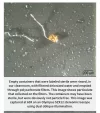
Particulates from "quality" Chinese vials:

IMG_9582.webp

Stopper coring material:

IMG_9542.webp

Or just good old bacteria. Unfortunately, the process of testing oils for bacteria is difficult because the oil and excipients interfere with the test. In pharma, bacteria testing of oil based injectables has to be customized for a specific formulation, and if anything in that formulation changes, the test needs to be recalibrated to account for that. Since UGL formulations are unknown, vastly different from brand to brand, and even batch to batch. the ability to detect bacteria in those isn't very good.
 
Last edited:
Wow, that's not something I'd expect. Do you have a theory as to how the unfiltered and filtered oils differ that would explain the soreness?
It probably contains particulate. In fact when I inspected the stromusc oil I saw some ‘dust’ like material floating in it.
 
Could be anything.

Particulates from "quality" Chinese vials:

View attachment 338974

Stopper coring material:

View attachment 338975

Or just good old bacteria. Unfortunately, the process of testing oils for bacteria is difficult because the oil and excipients interfere with the test. In pharma, bacteria testing of oil based injectables has to be customized for a specific formulation, and if anything in that formulation changes, the test needs to be recalibrated to account for that. Since UGL formulations are unknown, vastly different from brand to brand, and even batch to batch. the reliability of those tests to detect bacteria isn't very good.
they used 18g on 2ml vials? ofc if i did that i would be able to see the plastic in my vial.

might aswell stick my dick in phone carger, maybe it will not be big enough!

minimize the rubber getting into your solution by using smaller needles to break less of it off to draw from 2ml vials. its not impossible get rid of but the danger is so small its w.e.
 
It probably contains particulate. In fact when I inspected the stromusc oil I saw some ‘dust’ like material floating in it.
Funnily enough this wasn't the Stromusc Test E that I have from SSA (that doesn't agree with me either) - what I filtered today was their Test C 250 in the blank/generic vials (which also created massive sore lumps all over my body when I started it).
 
I'm surprised honestly, I've been sticking to domestic gear because I figured it'd be sterile and clean, but this has definitely raised some concerns.

Thankfully, I came across this thread. Filtering actually looks pretty straightforward, even though sourcing filters and vials here in the EU isn't the easiest. I ended up ordering some 0.22µm PTFE 25mm filters, sterile vials, and a blacklight off AliExpress.

It's a shame I only recently got into this side of things, because now I've got the itch to try brewing my own. That said, with the current state of the raws, finding decent quality materials to experiment with isn’t worth it.

I guess I'll stick with Chinese oils and just filter them myself as there seems to be no point in paying three times as much for something I still have to worry about and filter anyway.
 

Is anyone surprised?

I'm surprised honestly, I've been sticking to domestic gear because I figured it'd be sterile and clean, but this has definitely raised some concerns.

Not surprised honestly.
I honestly won't be surprised if most domestic gear are repackaged India or China oils either. GCMS would help identify EO or cross product / chemical contamination but it won't work for identifying the vast majority of pseudo-pharma or UGL-like (for export only) India oils.
 
I'm surprised honestly, I've been sticking to domestic gear because I figured it'd be sterile and clean, but this has definitely raised some concerns.

I guess I'll stick with Chinese oils and just filter them myself as there seems to be no point in paying three times as much for something I still have to worry about and filter anyway.
I think there may be different levels/kinds of risk attached to highly reputable, long-standing domestic sources vs. Chinese TLA sources. There are concerns beyond contamination that may have meaningful differences between types and tiers of sources.

1. Reputation at risk is the only real leverage we have. A source who’s getting business based on hard-earned reputation has something to lose. Chinese and domestic sources without a lot of reputational equity at stake have nothing to lose. They can just disappear and rebrand every few months, and maybe even make a little extra on an exit scam in the process.

2. Cheaper sources appear to get away with more and get held accountable for less, overall. Cheaper sources may also have less budget to do things “right”, e.g. they may re-use filters beyond their useful life, or not have the money to invest in needed lab gear and supplies.

3. Domestic sources appear mostly to be brewers of their own gear, whereas these Chinese sources are often resellers without much insight into the production of the final product. So they can lie or just be wrong about the contents, production process, and everything else we’d like to know.

4. Chinese resellers of unbranded oils may be selling product from different producers from one day to the next, so what was true yesterday is not necessarily true today.

You might have a reasonable argument that gear from an experienced domestic source with an excellent reputation is likely to be of better quality on average.

All that said, to my knowledge, no source has ever demonstrated the kinds of organization, technology, processes, controls, internal and external oversight that would lead one to conclude that they will never ship contaminated products, at least occasionally. Or that contaminated products will be identified and recalled after shipping to reduce the customer impact. Or that any domestic source could afford to do all that at the volumes they’re likely to be selling.

I mean - we wash our fruits and vegetables to remove the pesticides and other unsavory substances. Doesn’t matter where the fruit’s from. Why wouldn’t we filter our oils?

 
I think there may be different levels/kinds of risk attached to highly reputable, long-standing domestic sources vs. Chinese TLA sources. There are concerns beyond contamination that may have meaningful differences between types and tiers of sources.

1. Reputation at risk is the only real leverage we have. A source who’s getting business based on hard-earned reputation has something to lose. Chinese and domestic sources without a lot of reputational equity at stake have nothing to lose. They can just disappear and rebrand every few months, and maybe even make a little extra on an exit scam in the process.

2. Cheaper sources appear to get away with more and get held accountable for less, overall. Cheaper sources may also have less budget to do things “right”, e.g. they may re-use filters beyond their useful life, or not have the money to invest in needed lab gear and supplies.

3. Domestic sources appear mostly to be brewers of their own gear, whereas these Chinese sources are often resellers without much insight into the production of the final product. So they can lie or just be wrong about the contents, production process, and everything else we’d like to know.

4. Chinese resellers of unbranded oils may be selling product from different producers from one day to the next, so what was true yesterday is not necessarily true today.

You might have a reasonable argument that gear from an experienced domestic source with an excellent reputation is likely to be of better quality on average.

All that said, to my knowledge, no source has ever demonstrated the kinds of organization, technology, processes, controls, internal and external oversight that would lead one to conclude that they will never ship contaminated products, at least occasionally. Or that contaminated products will be identified and recalled after shipping to reduce the customer impact. Or that any domestic source could afford to do all that at the volumes they’re likely to be selling.

I mean - we wash our fruits and vegetables to remove the pesticides and other unsavory substances. Doesn’t matter where the fruit’s from. Why wouldn’t we filter our oils?
Fantastic!!!!!

If you go back to the front of the thread you can see I was concerned that filtering would legitimize floaters. See QSC for example. BBBG was adamant about that as well. I give him the credit as it was his mission way earlier than mine.

It is not unreasonable to filter and also crucify vendors who ship floaters out IMO.
 
I think there may be different levels/kinds of risk attached to highly reputable, long-standing domestic sources vs. Chinese TLA sources. There are concerns beyond contamination that may have meaningful differences between types and tiers of sources.

1. Reputation at risk is the only real leverage we have. A source who’s getting business based on hard-earned reputation has something to lose. Chinese and domestic sources without a lot of reputational equity at stake have nothing to lose. They can just disappear and rebrand every few months, and maybe even make a little extra on an exit scam in the process.

2. Cheaper sources appear to get away with more and get held accountable for less, overall. Cheaper sources may also have less budget to do things “right”, e.g. they may re-use filters beyond their useful life, or not have the money to invest in needed lab gear and supplies.

3. Domestic sources appear mostly to be brewers of their own gear, whereas these Chinese sources are often resellers without much insight into the production of the final product. So they can lie or just be wrong about the contents, production process, and everything else we’d like to know.

4. Chinese resellers of unbranded oils may be selling product from different producers from one day to the next, so what was true yesterday is not necessarily true today.

You might have a reasonable argument that gear from an experienced domestic source with an excellent reputation is likely to be of better quality on average.

All that said, to my knowledge, no source has ever demonstrated the kinds of organization, technology, processes, controls, internal and external oversight that would lead one to conclude that they will never ship contaminated products, at least occasionally. Or that contaminated products will be identified and recalled after shipping to reduce the customer impact. Or that any domestic source could afford to do all that at the volumes they’re likely to be selling.

I mean - we wash our fruits and vegetables to remove the pesticides and other unsavory substances. Doesn’t matter where the fruit’s from. Why wouldn’t we filter our oils?


This, along with the fact that contamination being "visible" is some kind of threshold for harm. The limits of vision aren't somehow calibrated so that particles below it are harmless. 100um is about as small as can be seen. Filters we and pharma uses for injectables are .22um, 500 times smaller than we can see, for a reason.

Just filter it all, and don't buy into the "I've been doing this for xxx years and it's fine" bullshit if you care about your long term health.

Risk is cumulative, a single contaminated injection may not mean much, but no one, not the hardest street drug addict or diabetic injects the huge volume of liquid we do.
 
Tabs aren’t nearly as much an infection risk. There's not as much mystery around inflammatory ingredients like solvents, and less incentive to use harmful ingredients in general. Your most likely risks there are mislabeling and variance. There might be 50 milligrams of clen in my Anadrol tab. But if you're so inclined, you can get and test oral compound raws, and buy most everything else as domestic or Indian Pharma. (For now)

I believe that many UGLs do their best to produce a good product. It's in their interests not to have customers with necrotic asses leaving bad Yelp reviews. But I find it unlikely that they've invested in meaningful quality control processes and other systems to reduce the impact of human error. I would also stipulate that the odds of me screwing something up due to lack of skill and experience are greater than an established UGL brewer's. I'm swapping one set of risks for another, but I'm gaining control. Some of us may be control freaks.

I don't have a pharma grade flow hood and so I'll be brewing in an environment closer to a bathtub than some UGLs. It would not shock me to find a golden retriever hair floating around in a batch; the damn things get into everything else.

But let's put it this way: if you were a skydiver, would you want some unknown person, with a criminal background*, who works anonymously and has no legal liability, of unknown skill and education, to pack your parachute...or would you rather do it yourself?

I take a medication which suppresses my immune system. Sterility and inflammatory solvents are important concerns for me. Autoimmune diseases inflict a high baseline inflammatory load already; I don't want to add more than necessary.

I'm not quite packing my own chute yet, but it seems like the smart choice for me. Your mileage may vary.

It's cool to hear from old hands who've had a long successful track record with no issues, though. Other than just being lucky and physically robust, is there anything to which you can attribute your trouble-free career? e.g. what do you look for in a source? What precautions do you take? Do you actually use the alcohol swab?

* No offense to our brave sources; I love you all for the risks you take to keep us swole.
Of course i do use alcohol pads to clean vial every use, and clean the inject spot.
 

What are the odds anything even changes lol.

If the filters are reused, it's highly likely those vials will have cross product contamination as well. It usually won't show up in HLPC as it's below Jano's cutoff.

I'm actually waiting to see if a mod will come in and close his thread.
It's kind of easy for vendors to setup some kind of software / image detection and have each finished vial be inspected for visible stuff like fibers.
 

Sponsors

Back
Top