
MESO-Rx
Anabolic Steroids

Navigation
Install the app
How to install the app on iOS
Follow along with the video below to see how to install our site as a web app on your home screen.
Note: This feature may not be available in some browsers.
More options
Style variation
Guest viewing limit reached
- You have reached the maximum number of guest views allowed
- Please register below to remove this limitation
- Already a member? Click here to login
You are using an out of date browser. It may not display this or other websites correctly.
You should upgrade or use an alternative browser.
You should upgrade or use an alternative browser.
Giant Semaglutide Thread (and other GLP-1 / GIP agonists)
- Thread starter Doodle
- Start date

Photon
Member
Interesting data:
Retatrutide (LY3437943) TFA is a triple agonist peptide of the glucagon receptor (GCGR), glucosedependent insulinotropic polypeptide receptor (GIPR), and glucagon-like peptide-1 receptor (GLP-1R). Retatrutide TFA binds human GCGR, GIPR, and GLP-1R with EC50 values of 5.79, 0.0643 and 0.775 nM, respectively. Retatrutide TFA can be used for the research of obesity.
Source:
The novel GIP, GLP-1, and Glucagon Triple Receptor Agonist LY3437943 Exhibits Robust Efficacy in Preclinical Models of Obesity and Diabetes
American Diabetes Association – 81st Annual Scientific Sessions; Virtual; 25-29 June 2021
TLDR from this paper (see attached images):
Retatrutide compared to native ligands:
1.7x weaker at GLP1r agonism
2.5x weaker at GCCR agonism
7x STRONGER at GIPr agonism
This article shows that even tho it's weaker at the GCCR by 2.5x the glucose output from hepatocytes (liver cells) is only 0.6x weaker. So it's quite effective at burning liver fat directly or gluconeogenesis? I'm not sure.
These agonism numbers make it an "unbalanced ligand" or agonist. Compared to Mazdutide which is much more balanced in it's profile. I'm still to find the EC50 for Mazdutide.
See attached slides for reta. I've got a few more articles to read on it.View attachment 341132View attachment 341133View attachment 341134
Are you going down the rabbit hole trying to look for ways to justify the use of Maz? The best way to evaluate, is to test it yourself. I've pulled the numbers before, decided the information was rubbish and ended up with Reta.
The issue with comparing these numbers, is that some are evaluated in vitro, mouse, humans or are inconsistently reported between different websites. Good luck finding a source for the info too. Alot of chemical websites report different numbers, which you cannot find a source for. You can't really compare these GLPs simply based off these. It also depends on how you react to them and so on.
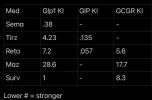
I saw this on a website a long time ago, I don't remember where, i also don't remember if it's accurate anymore. Since i settled on Reta, i stopped bothering, because there really isn't much in the upcoming pipeline. Maybe you can update it or find the updated version and share it, and highlight which is on mouse, in vitro or in humans.

bananafeet
Member
I just started Mazdutide. I'm just curious more than anything else....Are you going down the rabbit hole trying to look for ways to justify the use of Maz? The best way to evaluate, is to test it yourself. I've pulled the numbers before, decided the information was rubbish and ended up with Reta.
The issue with comparing these numbers, is that some are evaluated in vitro, mouse, humans or are inconsistently reported between different websites. Good luck finding a source for the info too. Alot of chemical websites report different numbers, which you cannot find a source for. You can't really compare these GLPs simply based off these. It also depends on how you react to them and so on.
I saw this on a website a long time ago, I don't remember where, i also don't remember if it's accurate anymore. Since i settled on Reta, i stopped bothering, because there really isn't much in the upcoming pipeline. Maybe you can update it or find the updated version and share it, and highlight which is on mouse, in vitro or in humans.
View attachment 341189
Photon
Member
I just started Mazdutide. I'm just curious more than anything else....
It's alot weaker according to that table, and given how the dosing is lesser too, I'd expect lesser sides too.
I have veins on my abdomen, isn't working my ass. eating 300g of protein is a retarded way to supress appetite and barely even effective. Would be cheaper and healthier to up the Tirzepatide or add a low dose of Metformin or Cagrilintide.Ah okay. Stick with what isn't working then.
Super high protein intake is just a good way to damage your health and longevity for no benefit. Over 1g/lbs of bodyweight is useless, unless you are on a lot of AAS and HGH, in that case you might benefit from up to 1.25-1.35g/lb. But then again it's a shitty trade off.
probably won't be very steong running it alone. Manye here stack it on top of their Sema/Tiz/RetaI just started Mazdutide. I'm just curious more than anything else....
bananafeet
Member
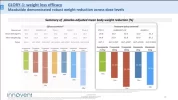
I've started on the 2mg dose. Seems to be working fine at the moment. The clinical doses used 4 and 6mg so it must be pretty strong.probably won't be very steong running it alone. Manye here stack it on top of their Sema/Tiz/Reta
Source:
oh wow. pretty close to tirz. I didn't think so. You know I might look into it as well, see if it's worth stacking on the 10mg Tirz I takeI've started on the 2mg dose. Seems to be working fine at the moment. The clinical doses used 4 and 6mg so it must be pretty strong.
View attachment 341198
Source:
Reta has stronger GIP than Tirzepatide? I tought it was mainly GLP1. I have a chart that's a bit differentAre you going down the rabbit hole trying to look for ways to justify the use of Maz? The best way to evaluate, is to test it yourself. I've pulled the numbers before, decided the information was rubbish and ended up with Reta.
The issue with comparing these numbers, is that some are evaluated in vitro, mouse, humans or are inconsistently reported between different websites. Good luck finding a source for the info too. Alot of chemical websites report different numbers, which you cannot find a source for. You can't really compare these GLPs simply based off these. It also depends on how you react to them and so on.
I saw this on a website a long time ago, I don't remember where, i also don't remember if it's accurate anymore. Since i settled on Reta, i stopped bothering, because there really isn't much in the upcoming pipeline. Maybe you can update it or find the updated version and share it, and highlight which is on mouse, in vitro or in humans.
View attachment 341189

Ghoul
Member
Reta has stronger GIP than Tirzepatide? I tought it was mainly GLP1. I have a chart that's a bit different
Yes, the stronger GIP in reta is there to balance Glucagon. Other glucagon drugs were pulled from human trials because they cause hyperglycemia.
That's why "stacking" with something like Tirz, with much weaker, more natural GIP is a mistake.
bananafeet
Member
Like Ghoul said I wouldn't stack similar GLP1s. Maybe a bit of semaglutide is ok.oh wow. pretty close to tirz. I didn't think so. You know I might look into it as well, see if it's worth stacking on the 10mg Tirz I take
It would be better to increase the dose or add a compound with a different pathway.
I've started testing my blood sugar with a pin prick test because I'm concerned stacking HGH and with a GCCR drug might give me diabetes lol
The high level of GIP and low level of GLP1 in Retatrutide makes sense, because people can still eat but generally don't want to. Semaglutide at higher doses almost stopped my stomach so eating was a physical impossibility....

dinfar1337
Member
every glp drug will in the end lower your bloodsugar more than it raises it even if its a gccr agonist. you seriously need to do better researchI've started testing my blood sugar with a pin prick test because I'm concerned stacking HGH and with a GCCR drug might give me diabetes lol
its a drug for diabetics
I did a few months of maz. It was okay. I thought I liked it. But the source I got it from disappeared and no one else was selling it. So I went back to tirz and forgot how much better tirz was.I just started Mazdutide. I'm just curious more than anything else....
bananafeet
Member
Oh shit really? Thanks budevery glp drug will in the end lower your bloodsugar more than it raises it even if its a gccr agonist. you seriously need to do better research
its a drug for diabetics
dinfar1337
Member
yes just search mazdutide glucose or mazdutide bloodsugar, theres plenty of useful info or graphs you will find pretty fast.Oh shit really? Thanks bud
glp is hack for hgh to not turn diabetic
tirz and retrarutide are top dawgs for blood sugar control and insulin secretion

Liter O' Test
Member
tirz and tren had me lose 3lbs this week, need to increase calories
you don't need more calories, you need more tren. food is for pussiestirz and tren had me lose 3lbs this week, need to increase calories
Liter O' Test
Member
Anyone have an opinion on higher dose GLPs blunting insulin release so much it could affect anabolism?
Like youre more insulin sensitive so you barely need any insulin i think is how it works
Like youre more insulin sensitive so you barely need any insulin i think is how it works
bananafeet
Member
From my reading of it bro they stimulate glucose dependent insulin release. So basically they increase how much insulin you produce when you eat.Anyone have an opinion on higher dose GLPs blunting insulin release so much it could affect anabolism?
Like youre more insulin sensitive so you barely need any insulin i think is how it works
The insulin sensitivity probably comes from the reduction in food intake.
So they should make you more anabolic or make the effects of your native insulin more effective.
Chase Irons was sorta the first guy to float year round glp1 use. In bulking to maintain insulin sensitivity and during cutting to lose weight.
That being said I'm not sure how GCCR (glucagon receptor agonists) effect this balance.
Maybe Ghoul has some input on it.
Ghoul
Member
Anyone have an opinion on higher dose GLPs blunting insulin release so much it could affect anabolism?
Like youre more insulin sensitive so you barely need any insulin i think is how it works
No it won't inhibit anabolism.
Insulin release isn't being blunted, insulin sensitivity is being increased. so less insulin is required to achieve the same effect that required more insulin before the GLP, ie muscle nutrient uptake and inhibition of catabolism.
That's why insulin release is lowered. It's a response to improved sensitivity.
We know this in part because weight loss induced by max dose GLPs is biased toward fat vs lean mass. If anabolism was being inhibited the opposite would occur.
Liter O' Test
Member
thank you, ive been going back and forth about increasing my dose from 2mg. I'm eating 3k calories just fine on my ~2nd week of serum at 2mg dose. Just trying to convince myself to up it. I'll probably do 3mg next weekNo it won't inhibit anabolism.
Insulin release isn't being blunted, insulin sensitivity is being increased. so less insulin is required to achieve the same effect that required more insulin before the GLP, ie muscle nutrient uptake and inhibition of catabolism.
That's why insulin release is lowered. It's a response to improved sensitivity.
We know this in part because weight loss induced by max dose GLPs is biased toward fat vs lean mass. If anabolism was being inhibited the opposite would occur.
Similar threads


- Replies
- 8
- Views
- 441
- Replies
- 14
- Views
- 409

- Replies
- 10
- Views
- 119
- Question
- Replies
- 7
- Views
- 562

