Taking Vytorin 10/20 since I was 35. Total cholesterol was over 300. This is eating clean, working out religiously, and still completely natural. Hereditary can’t be beatHave you looked into a statin or PCSK9 inhibitor?

MESO-Rx
Anabolic Steroids

Navigation
Install the app
How to install the app on iOS
Follow along with the video below to see how to install our site as a web app on your home screen.
Note: This feature may not be available in some browsers.
More options
Style variation
Guest viewing limit reached
- You have reached the maximum number of guest views allowed
- Please register below to remove this limitation
- Already a member? Click here to login
You are using an out of date browser. It may not display this or other websites correctly.
You should upgrade or use an alternative browser.
You should upgrade or use an alternative browser.
Is there any steroid that’s lipid friendly?
- Thread starter Nemesis RR
- Start date

I have familial hypercholesterolemia. 10mg Rosuvastatin ED to start and now EOD increased my HDL and lowered my LDL/Trigs/TC significantly. I've heard combining it with Repatha is extremely good as well.Taking Vytorin 10/20 since I was 35. Total cholesterol was over 300. This is eating clean, working out religiously, and still completely natural. Hereditary can’t be beat

mae_geri
Member
No! But there are Heart-Safe Anabolics like Primo and maybe Anavar.Is there any steroid that won’t raise LDL or perhaps not as much as others?
Primo has a minimal impact on the lipid panel (cholesterol), and it does not affect blood pressure, heart rate or cause cardiac hypertrophy if used correctly.
In fact, many men safely use it for months if not years on end in conjunction with their TRT.

That's a bit of an overstatement. Maybe minimizing impact or largely avoiding side effects. But to call it 'safe' gives users a false sense of security.But there are Heart-Safe Anabolics
mae_geri
Member
Yes maybe the wrong word......That's a bit of an overstatement. Maybe minimizing impact or largely avoiding side effects. But to call it 'safe' gives users a false sense of security.

Greenbay68
Member
Also, as mild as Anavar is, it’s still a 17aa oral steroid, which makes two passes through the liver and stresses it, whereas injectables do not.Yes maybe the wrong word......
While the liver itself regenerates, damage is not really the concern with (uncrazy dosed) orals. The liver is responsible for cholesterol profile and even light orals tend to skew HDL and LDL.
I’d say primobolan and proviron (non 17aa) are the least harmful.
If I was pushed to pick a couple more, I’d choose low dose masteron or low dose nandrolone. These would be more aggressive, but still mild compared to the remaining AAS. Nandrolone has older studies showing that it’s specifically bad for arterial health, but I’m convinced it’s because they did not have the test subjects on TRT, and that arterial damage is due to low estrogen. This is also why I’m against AI with TRT. Playing with fire!
No matter what AAS you use, Blood Pressure is by far the #1 killer. If your BP is high for extended periods of time, the cascading effects are massive.
egruberman
Member
How much further did bempedoic acid improve your LDL? I'm in the same spot except I'm im only using 5mg rosuvastatin + 10mg ezetimibe. Planning to add bemp acid in. I've considered Repatha but I don't like the idea of super long half life in case the sides suck.
LDL went down by 10%, which frankly was less than I expected based on their marketing material. I also escalated PEDs a bit between tests. I think I was on 160mg/wk test on the first test and 250/250 test and primo for the last.
LDL on the last test was 56mg/dL. ApoB was 60mg/dL. Since then I've added Repatha. There were no sides that I noticed for the bempedoic acid or the Repatha.
I know this sounds like throwing the kitchen sink at one's lipids, but the mechanism of action for statins, ezetimibe, bempedoic acid, and PCSK9 inhibitors are all complementary. My insurance seems to be happy to cover this approach as well and so I'm going to take advantage. I'm keen to keep lipids as low as possible as I found a little calcified plaque in a CT-CAC a couple years back and there's a little evidence that keeping LDL below 60mg/dL will cause regression of calcified plaque.
Finally, for anyone considering Repatha as an adjunct or even an alternative to statins, I got a tip on meso that they have a copay card. I applied for it on the Repatha site and it was approved. They didn't consider income or health conditions or anything. Once I had that, and began to use it only then did I discover that my health insurance fully covers it without pre-auth.
Last edited:

jdubzzz44
Member
Repatha was my doctors first choice but insurance denied it I believe they wanted a ldl over 300 and proof a statin first didn’t helpLDL went down by 10%, which frankly was less than I expected based on their marketing material. I also escalated PEDs a bit between tests. I think I was on 160mg/wk test on the first test and 250/250 test and primo for the last.
LDL on the last test was 56mg/dL. ApoB was 60mg/dL. Since then I've added Repatha. There were no sides that I noticed for the bempedoic acid or the Repatha.
I know this sounds like throwing the kitchen sink at one's lipids, but the mechanism of action for statins, ezetimibe, bempedoic acid, and PCSK9 inhibitors are all complementary. My insurance seems to be happy to cover this approach as well and so I'm going to take advantage. I'm keen to keep lipids as low as possible as I found a little calcified plaque in a CT-CAC a couple years back and there's a little evidence that keeping LDL below 60mg/dL will cause regression of calcified plaque.
Finally, for anyone considering Repatha as an adjunct or even an alternative to statins, I got a tip on meso that they have a copay card. I applied for it on the Repatha site and it was approved. They didn't consider income or health conditions or anything. Once I had that, and began to use it only then did I discover that my health insurance fully covers it without pre-auth.
Greenbay68
Member
What was your CAC score (the highest artery)?LDL went down by 10%, which frankly was less than I expected based on their marketing material. I also escalated PEDs a bit between tests. I think I was on 160mg/wk test on the first test and 250/250 test and primo for the last.
LDL on the last test was 56mg/dL. ApoB was 60mg/dL. Since then I've added Repatha. There were no sides that I noticed for the bempedoic acid or the Repatha.
I know this sounds like throwing the kitchen sink at one's lipids, but the mechanism of action for statins, ezetimibe, bempedoic acid, and PCSK9 inhibitors are all complementary. My insurance seems to be happy to cover this approach as well and so I'm going to take advantage. I'm keen to keep lipids as low as possible as I found a little calcified plaque in a CT-CAC a couple years back and there's a little evidence that keeping LDL below 60mg/dL will cause regression of calcified plaque.
Finally, for anyone considering Repatha as an adjunct or even an alternative to statins, I got a tip on meso that they have a copay card. I applied for it on the Repatha site and it was approved. They didn't consider income or health conditions or anything. Once I had that, and began to use it only then did I discover that my health insurance fully covers it without pre-auth.
I wholly disagree with the approach of lowering LDL that low unless you’ve already had a heart attack. We don’t have to agree of course, just wanted to share.
I’ve heard of calcification reversal with aggressive vitamin K2 therapy. My wife’s HRT doc has a stroke survivor as a patient who regressed 30% of the calcification on her affected artery in 12 months with Vitamin balance 5:5:1 of ADK2. I’ve read 2 books on it, I “think” this is the one: Amazon book
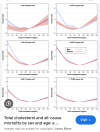
For the LDL again, I’ve also come to the conclusion in part by the ‘bell curve’ that total cholesterol and all cause mortality studies show. More people die with too low of cholesterol than too high:
egruberman
Member
Repatha was my doctors first choice but insurance denied it I believe they wanted a ldl over 300 and proof a statin first didn’t help
Try this: Amgen® SupportPlus Enrollment | Repatha® (evolocumab)
egruberman
Member
What was your CAC score (the highest artery)?
LAD was 39.9, total was 43.9.
We will have to disagree on this approach as it's something I've spent years working on following the guidance of folks like Allan Sniderman and Tom Dayspring. The latter recommends managing ApoB to something below 60mg/dL for those with various risk factors like established ASCVD and 80mg/dL for all others. Here I'm using LDL as it's what folks are most familiar with, but I've been measuring and managing against ApoB for a couple years now.
Greenbay68
Member
Keep us postedLAD was 39.9, total was 43.9.
We will have to disagree on this approach as it's something I've spent years working on following the guidance of folks like Allan Sniderman and Tom Dayspring. The latter recommends managing ApoB to something below 60mg/dL for those with various risk factors like established ASCVD and 80mg/dL for all others. Here I'm using LDL as it's what folks are most familiar with, but I've been measuring and managing against ApoB for a couple years now.
Edit: what’s your age, avg bodyfat % and fasting glucose, out of curiousity?
Last edited:
Weren’t the studies on Nandrolone being not artery healthy based on very high dosages?Also, as mild as Anavar is, it’s still a 17aa oral steroid, which makes two passes through the liver and stresses it, whereas injectables do not.
While the liver itself regenerates, damage is not really the concern with (uncrazy dosed) orals. The liver is responsible for cholesterol profile and even light orals tend to skew HDL and LDL.
I’d say primobolan and proviron (non 17aa) are the least harmful.
If I was pushed to pick a couple more, I’d choose low dose masteron or low dose nandrolone. These would be more aggressive, but still mild compared to the remaining AAS. Nandrolone has older studies showing that it’s specifically bad for arterial health, but I’m convinced it’s because they did not have the test subjects on TRT, and that arterial damage is due to low estrogen. This is also why I’m against AI with TRT. Playing with fire!
No matter what AAS you use, Blood Pressure is by far the #1 killer. If your BP is high for extended periods of time, the cascading effects are massive.
For example there was a rat study that said Nandrolone had many health risk but the dosage would have equaled me taking over 1400 milligrams a week.
How do you manage ApoB?LAD was 39.9, total was 43.9.
We will have to disagree on this approach as it's something I've spent years working on following the guidance of folks like Allan Sniderman and Tom Dayspring. The latter recommends managing ApoB to something below 60mg/dL for those with various risk factors like established ASCVD and 80mg/dL for all others. Here I'm using LDL as it's what folks are most familiar with, but I've been measuring and managing against ApoB for a couple years now.
Have you had follow up CAC scores?
May I ask your age?
jdubzzz44
Member
Anytime I’ve lowered my LDL (with a statin) it lowers my ApoB as well. So to make it simple you manage ApoB the same way you manage LDLHow do you manage ApoB?
Have you had follow up CAC scores?
May I ask your age?
Greenbay68
Member
Yes! I don’t remember how high of dosages though. The old studies didn’t give people testosterone replacement as well. Thats a major flaw. You have someone one Deca, which shuts them down, then give them a supraphysiological androgen dosage, but only aromatizes between 0 and 20% based on which study you read.Weren’t the studies on Nandrolone being not artery healthy based on very high dosages?
For example there was a rat study that said Nandrolone had many health risk but the dosage would have equaled me taking over 1400 milligrams a week.
so my thought (and I’m not alone) is that low e2 was responsible for those effects in the study. Those are the very same effects that happen when e2 is low, we know.
Knowing that deca is pretty anabolic vs androgenic (37/125 rating, where test is 100/100) I just don’t see any other reason why nandrolone is the only steroid that would be harmful in this way.
It just makes sense to me! What do you think?
egruberman
Member
How do you manage ApoB?
Have you had follow up CAC scores?
May I ask your age?
As was already stated, I manage ApoB the same as LDL, it's just that some things move ApoB more or less than LDL, but not by a huge margin.
I haven't had a follow up CAC. There's some radiation exposure inherent in the process so it's not something one wants to do often. I had it done at 48yo and presently I'm 52yo. I've been doing the cocktail of lipid lowering drugs the past two years having just added bempedoic acid and Repatha this past year.
My rough plan is to get a CTCA (coronary angiogram) at 55yo and pay out of pocket to do so if necessary. Insurance wouldn't cover it and a couple years ago, it was over $1k. These days it's closer to $500.
egruberman
Member
Keep us posted
Edit: what’s your age, avg bodyfat % and fasting glucose, out of curiousity?
52yo, 10.7% by dexa last week. No metabolic syndrome to speak of, though I was tremendously obese through my early thirties and led a pretty terrible lifestyle until I was in my 40s and so the CAC score is no surprise.
Currently HbA1c is around 4.9 and fasting glucose in the 80s, I believe.
Greenbay68
Member
Very admirable to get in shape after a decade or more like that.52yo, 10.7% by dexa last week. No metabolic syndrome to speak of, though I was tremendously obese through my early thirties and led a pretty terrible lifestyle until I was in my 40s and so the CAC score is no surprise.
Currently HbA1c is around 4.9 and fasting glucose in the 80s, I believe.
Similar threads

- Replies
- 29
- Views
- 843


- Replies
- 23
- Views
- 1K

