Optimal carbohydrate intake during endurance events

Millard

Member
Staff member
10+ Year Member
20+ Year Member

View: https://twitter.com/Jeukendrup/status/1351484577328599041?s=20


The case for high carbohydrate intake during long races

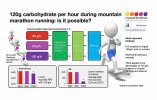
A few years ago it was concluded that carbohydrate intake should not be more than 60g/h because we would not be able to oxidise more than this. Now we know we can use more if the right combinations of carbohydrate are used but it is still often questioned whether 90 g/h is even possible in race conditions. In the previous blog we saw that marathon mountain runners were able to ingest 90 g/h and even 120 g/h without any problems. The results also suggested that 120 g/h resulted in some benefits compared to 60 or 90 g/h.

Source: High carbohydrate intake during long races

@Gundog , @$BlackBeard , @yannick67 , @OldSmice , @Rocks Off

higher-carbs-endurance-events.jpg
 

Effects of 120 g/h of Carbohydrates Intake during a Mountain Marathon on Exercise-Induced Muscle Damage in Elite Runners​

by Aitor Viribay, Soledad Arribalzaga, Juan Mielgo-Ayuso, Arkaitz Castañeda-Babarro , Jesús Seco-Calvo andAritz Urdampilleta

Nutrients 2020, 12(5), 1367; Effects of 120 g/h of Carbohydrates Intake during a Mountain Marathon on Exercise-Induced Muscle Damage in Elite Runners
Received: 16 April 2020 / Revised: 7 May 2020 / Accepted: 9 May 2020 / Published: 11 May 2020
(This article belongs to the Special Issue Nutrition and Muscle Recovery)

Abstract​

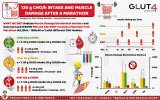
Background—exercise-induced muscle damage (EIMD) and internal exercise load are increased after competing in ultraendurance events such as mountain marathons. Adequate carbohydrate (CHO) intake during exercise optimizes athletic performance and could limit EIMD, reduce internal exercise load and, thus, improve recovery. Therefore, the aim of this study was to research into and compare the effects of high CHO intake (120 g/h) in terms of CHO intake recommendation (90 g/h) and regular CHO intake performed by ultraendurance athletes (60 g/h) during a mountain marathon, on exercise load and EIMD markers (creatine kinase (CK), lactate dehydrogenase (LDH), glutamic oxaloacetic transaminase (GOT), urea and creatinine). Materials and Methods—a randomized trial was carried out on 20 male elite runners who had previously undertaken nutritional and gut training, and who consumed different CHO dosages according to experimental (EXP—120 g/h), control (CON—90 g/h) and low CHO intake (LOW—60 g/h) groups during a ~4000 m cumulative slope mountain marathon. EIMD markers were analyzed before the race and 24 h afterwards. Internal exercise load was calculated based on rate of perceived exertion (RPE) during and after the marathon event. Results—internal exercise load during the mountain marathon was significantly lower (p = 0.019; η2p = 0.471) in EXP (3805 ± 281 AU) compared to LOW (4688 ± 705 AU) and CON (4692 ± 716 AU). Moreover, results revealed that the EXP group evidenced significantly lower CK (p = 0.019; η2p = 0.373), LDH (p < 0.001; η2p = 0.615) and GOT (p = 0.003; η2p = 0.500) values 24 h after the mountain marathon race compared to LOW and CON. Along these lines, EIMD and exercise load evidenced a close correlation (R = 0.742; p < 0.001). Conclusion: High CHO intake (120 g/h) during a mountain marathon could limit the EIMD observed by CK, LDH and GOT and internal exercise load compared to CHO ingestion of 60 and 90 g/h.

120g-carbs-hour.jpg
 

Attachments

120 grams of Carbohydrates per hour During Exercise Improve Recovery​

13-07-2020
By Aitor Viribay
Our new study has been published
Source: 120 grams of Carbohydrates per hour During Exercise Improve Recovery - Glut4 Science

Our latest research in the field of Carbohydrates (CHO) has been published this week in Nutrients (Q1). Some weeks ago (in May 2020), we (our researching group) published the first article of our research about the ingestion of higher CHO than currently recommended during exercise and its effects on different outcomes. It was an impressive work from a scientific and practical point of view, as we demonstrated that more than 90 CHO g/h could be ingested during exercise without reporting gastrointestinal problems and improving short-term recovery in a real scenario (Mountain Marathon). Although our results were not expected, the initial goal of this research was to give an answer to the following question:

Which is the definitive carbohydrate (CHO) intake target during endurance exercise like cycling or running? Could 120 g/h intake be possible and beneficial comparing with the current scientific recommendations of 60-90 g/h? Is science far behind the sports practice reality?

Based on what we practice and see in our everyday work with professional cyclists and athletes, we aimed to investigate the effects of a higher CHO intake (up to 120 g/h) in a randomized and well-designed trial. It finally led to a published paper that showed beneficial effects on internal load during exercise and muscle damage biomarkers in the 120 g/h group, when compared with 90 g/h and 60 g/h after running the mountain marathon. It represented a new step and, with that, a new line was already started.

The full paper can be read here: Viribay A, Arribalzaga S, Mielgo-Ayuso J, Castañeda-Babarro A, Seco-Calvo J, Urdampilleta A. Effects of 120 g/h of Carbohydrate Intake during a Mountain Marathon on Exercise-Induced Muscle Damage in Elite Runners. Nutrients. 2020; 12(5): 1367.

hW7tj01HFFNKSKSTxNGj.jpg
ESD_120_EIMD_ENG.jpg
 
Yikes!! Looks like I have some nutritional experimentation ahead. Currently fueling with huma gels every thirty minutes. Depending on the flavors it's only getting my carb intake between 45-50 g/h!
 
My personal N=1 observation is that this is 100% correct.

Unfortunately for me I always return to the bike after an extended period off and I need to loose some weight so I restrict... Which leads to some snacking later in the night when I don't need the carbs.... and skinny fat again :)

Not to mention the performance plateau you reach very quickly.

REALLY trying to do it differently this time. Fuel the work, stop the snacking.
 
Late to the party again, but I absolutely agree. Our team nutritionist would take our input and try and improve upon it. Meaning, for a lot of us that had been riding for years, we already figured out exactly what our guts could stand. We would then slightly experiment with different CHO sources that would metabolize at different times (immediate and extended release) to try and optimize performance.

Nowadays, a product like Maurten is an ideal CHO source as it provides an optimal amount in a small package that is not harsh on the gut. They currently make a 320cal/100CHO drink mix that I love.

Personally, some of my best performances were when I had plenty of support (food intake available to me) and this was most noticeable after racing as I was not completely cooked. I would venture to say I was above 100g/CHO per hour. Contrast to my worst days, they all coincided with improper fueling.
 
If i run for 1 hour, would this apply? How would you do this if you don't want to carry carbs with you? Like having a meal before the run.
Would it be good for many hour walks too (lowering carbs)?

Thanks!
 
As HIGH as the gut can manage. Get a cheap glucose meter and see what combo works best eg fructose, malto, dextrose, vitargo etc. Pro athletes train their gut to take on 1-300g carbs per hour. Glucose monitor will help decide what mix works for you to avoid the spike/crash cycle
 
I used to race mountain bikes as a teenager, and we would absolutely destroy pasta the night before a race. And even then you would get drained halfway into a race and be slamming these packets of sugary substance called "Gu".

I never measured anything out, but it was easily 300-500 grams extra of carbohydrates the day prior to an event
 
Back when I was younger and naturally produced enough testosterone to OD most people, prior to getting kicked in the junk that is, I used to just eat a whole family-sized bucket of KFC and have sex for 10 hours straight. If you really want some energy, there’s tons of carbs in that shit. And fat/protein too.

It’s not the healthiest thing ever, but I burned off the energy during the marathons.

Come to think of it, the last breast I felt was in a bucket of KFC. Extra crispy. With biscuits and butter. Mmm. Then you just gotta keep carbs on you, or next to the bed in case you get hungry.
 
There wasn't written which kind of Maltodextrin was used, there are different types that have around 40% (if im remembering correctly) slower energy release than regular Maltodextrin, like Maltodextrin 6 (slow&steady energy release) and Maltodextrin19 (faster release) i think its kinda depending on the molecular weight how good/fast/effective its absorbed, practical application showed that for example dextrose is likely to increase some kind of fatigue consumed in that amount, if you're actively researching the Krebs Cycle in vitro there are objective better outcomes with mixes of carbs that can induce better conversion to ATP. That mitochondrial output could be even increased by using enough Q10 and PQQ that would lead to an overall better mobilization of cytocological energy and conversionrate that the runner could actively use more carbs in a shorter period of time (requires ofc that the glucose/carbs are hydrolyzed in the first place)

Very interesting topic in general i would love to see the research going further.
 

Sponsors

Back
Top