Save your unusable raws Guaranteed.

Just dissolving the compound and separating the cut and weighing it, Will tell you exactly the purity of it... I used to wash a particular compound in acetone, because it's not soluble in it, but it just so happens that just about everything else is. Then you would just filter it and let the acetone evaporate and weigh what was on the plate, and subtract that from how much you started with, say it was a gram that you started with, but after you washed it you only had 800 mg left, then the stuff you had was 80% pure, to start with, but obviously 100% pure when you were done. You just need to figure out the right solvents man , and the rest will come right together. The tren is going to be the easiest one to figure out, because you already found the finaplix process, so that one's pretty much already figured out and will be your easiest one, I actually did that whole process a few times because I am old and I do remember when things were a little bit harder to get a hold of, lol they were never as difficult though as everybody keeps portraying, I was getting 100 grams of test for 130$ or $600 kilograms almost 20 years ago, The only thing different was you paid with Western Union instead of Bitcoin.
 
Last edited:
Just dissolving the compound and separating the cut and weighing it, Will tell you exactly the purity of it... I used to wash a particular compound in acetone, because it's not soluble in it, but it just so happens that just about everything else is. Then you would just filter it and let the acetone evaporate and weigh what was on the plate, and subtract that from how much you started with, say it was a gram that you started with, but after you washed it you only had 800 mg left, then the stuff you had was 80% pure, to start with, but obviously 100% pure when you were done. You just need to figure out the right solvents man , and the rest will come right together. The tren is going to be the easiest one to figure out, because you already found the finaplix process, so that one's pretty much already figured out and will be your easiest one, I actually did that whole process a few times because I am old and I do remember when things were a little bit harder to get a hold of, lol they were never as difficult though as everybody keeps portraying, I was getting 100 grams of test for 130$ or $600 kilograms almost 20 years ago, The only thing different was you paid with Western Union instead of Bitcoin.
One thing I’ve learned while dialing in my own purification workflow is that not all solvents are created equal, and the choice heavily depends on both the compound and the impurities you’re dealing with.

For example: based on what I've learned so far

Acetone is great for things like tren ace because it won’t dissolve the raw.. but it absolutely eats through dyes, sugars, binders, and carrier oils. However, it's too aggressive for some of the longer esters like undecanoate.. they can get a little soft in it, especially if there's heat involved.

Ethanol works for a broad range, but it can hold onto moisture unless you’re using high-grade 200-proof, and that makes things tricky with powders that are sensitive to hydrolysis.

Toluene is a beast at separating heavy organics and oily cuts, but it’s also pretty nasty to handle indoors and needs serious ventilation.

Ethyl acetate is amazing for precision work but tends to co-dissolve a bit too much if you’re trying to isolate the main compound via crash-out alone.

And with hexane or petroleum ether, you really need to know the polarity of what you’re targeting... great for flushing out waxes or lipids, but not always the best for full recrystallization unless paired properly.
 
Just dissolving the compound and separating the cut and weighing it, Will tell you exactly the purity of it... I used to wash a particular compound in acetone, because it's not soluble in it, but it just so happens that just about everything else is. Then you would just filter it and let the acetone evaporate and weigh what was on the plate, and subtract that from how much you started with, say it was a gram that you started with, but after you washed it you only had 800 mg left, then the stuff you had was 80% pure, to start with, but obviously 100% pure when you were done. You just need to figure out the right solvents man , and the rest will come right together. The tren is going to be the easiest one to figure out, because you already found the finaplix process, so that one's pretty much already figured out and will be your easiest one, I actually did that whole process a few times because I am old and I do remember when things were a little bit harder to get a hold of, lol they were never as difficult though as everybody keeps portraying, I was getting 100 grams of test for 130$ or $600 kilograms almost 20 years ago, The only thing different was you paid with Western Union instead of Bitcoin.
You had to start with dry acetone though, not the kind from the hardware store.
 
You had to start with dry acetone though, not the kind from the hardware store.
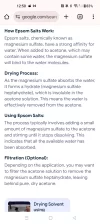
I used the stuff from the hardware store, I just used a drying agent to remove the moisture. There's several ways to do it,Epson salts, molecular sieves, distillation,etc .. it's WAY cheaper that way, I used to source a lot of my chemicals from the hardware store, toulene,xylene,naptha,etc. I had a vacuum distillation setup outside, to deal with the fumes, when I was making some things that were considered rather dangerous like fuming red nitric acid.
 
Last edited:
I used the stuff from the hardware store, I just used a drying agent to remove the moisture. There's several ways to do it,Epson salts, molecular sieves, distillation,etc .. it's WAY cheaper that way, I used to source a lot of my chemicals from the hardware store, toulene,xylene,naptha,etc. I had a vacuum distillation setup outside, to deal with the fumes, when I was making some things that were considered rather dangerous like fuming red nitric acid.
Can you send me a bit more info on this? That was the one thing that I was wondering. Couldn't I use hardware's grade and then make it good myself? That's a very interesting method you just mentioned. I'd rather use lab grade just to be safe. even ACS grade is good enough.


But I didn't think dehydrating it like you just mentioned would be so efficient. I'll research this.
 
Here's one method that is used quite a bit and has been around for a very long time
 

Attachments

  • Screenshot_2025-04-19-12-50-03-98_40deb401b9ffe8e1df2f1cc5ba480b12.webp
    Screenshot_2025-04-19-12-50-03-98_40deb401b9ffe8e1df2f1cc5ba480b12.webp
    167 KB · Views: 84
Molecular sieves are more application specific,they come in different pore sizes and they will pull water out of all kinds of things, including oil,and can be heated in a oven and reactivated ,and used over and over,just like activated alumina which is something I have used for years with printer filament and storage of raws . You need to read up on them, refinerys use them to remove moisture from hydrocarbons,oils, and fuels,they are very useful to have a few lbs of in every small lab.
 
Molecular sieves are more application specific,they come in different pore sizes and they will pull water out of all kinds of things, including oil,and can be heated in a oven and reactivated ,and used over and over,just like activated alumina which is something I have used for years with printer filament and storage of raws . You need to read up on them, refinerys use them to remove moisture from hydrocarbons,oils, and fuels,they are very useful to have a few lbs of in every small lab.
That's one thing I have been looking into a lot too, those sieves

They seem key for what I want to be doing.

How im going to start out is starting with a sample size of 5 grams of tren. I know this tren is good. But its not pure. So using a small sample to get a feel of the process should be smart.
 
That's one thing I have been looking into a lot too, those sieves

They seem key for what I want to be doing.

How im going to start out is starting with a sample size of 5 grams of tren. I know this tren is good. But its not pure. So using a small sample to get a feel of the process should be smart.

 
I'm out of here,I put a request in to delete my account,there is seriously unhealthy conspiracy vibe that's getting more and more out of control by the day. China is taking AAS's completely off the map , people huddling around in terror, thinking they have the last bag of raw test that's ever going to be manufactured in the world,I never read so much nonsense...I feel like I'm stuck watching MSNBC and CBS on repeat, waiting for this massive conspiracy of complete world domination by the left. People need to get a grip on life and pull themselves together......
 
This is one of those things that sounds cool but then when the average buyer attempts it without the proper supplies and a step by step walkthrough with every little thing you need they end up ruining their raws or go from 1kilo to 300 grams
I have laid out all the things needed to make it hard to ruin. You would be surprised how simple this actually is. I just got done doing 10 grams of tren ace using this method for a trial run and it worked beautifully. The raws are now a beautiful light yellow with zero smell.

Here's a video videos to give you an idea


View: https://youtu.be/04HWovMzkAk


View: https://youtu.be/uVA0rK_VITY


View: https://youtu.be/czX8lF1IscE


This video here is the most important one of all for the use of acetone and tren


This one is optional but it's not mandatory and if you wanna be crazy do it. I'll do it next time gotta get the little glass extractor.


My recommendation for people who would like to experiment. Do small batches. 3 grams. Try it out. It's surprisingly simple and cool to watch as the crystals form!
 

Sponsors

Latest posts

Back
Top