Science on muscle growth

  • Thread starter Thread starter Deleted member 123722
  • Start date Start date
D

Deleted member 123722

Guest
Wanted to know whether or not we have the science to prove that, for example, a SLDL can build hamstrings even though they do not put the hams in a ROM at all, rather, it is obvious a static contraction. Do static contractions build muscle? If so, how much or how little? This question applies to deadlifts building back, even thought they don't put the back through any ROM.

Does heavy weight alone build more muscle than lighter weight with full ROM? I.E. will a heavy close grip press build more tissue than cable press downs, even those cable press downs provide full ROM?

I was just listening to a podcast with Dr. Eric Helms, who said we can actually focus on certain areas of a muscle and hypertrophy that part. I was under the impression that muscles fire all or nothing, that we can't focus on a specific head or whatever, unless that muscle has a different insertion. For example, you can focus more on biceps brachialis, but you can't isolate each triceps head, because they all attach to the same elbow tendon, and your wrist position does not nor cannot make a difference. But because the biceps have two heads and two insertions, you can. However, he said there is research that shows that you can cause more growth putting tension in specific areas.

Here's Helms talking about regional hypertrophy (time stamped)
View: https://youtu.be/5q9clCkmnl4?t=2917

I'm always trying to learn more and improve my understanding of hypertrophy.
 
Do static contractions build muscle? If so, how much or how little?

Of course they do. There are 3 factors to growing muscle:

1. Mechanical Tension (i.e progressive overload / adding more weight)
2. Damage (go to failure every one in a while)
3. Metabolic Stress (static contractions / isometrics)

I think the large majority of research shows that mechanical tension / progressive overload is the best way to build muscle. In this article Can We Predict Muscle Growth? • Stronger by Science they claim effective reps / sets is the best predictor. Aka all sets should be RPE 8 or 9 essentially and increase the weight when they aren't.

Here is a blog post on building muscle and strength using isometrics Isometrics For Strength & Hypertrophy (Exercise Examples) - Lift Big Eat Big. The key take away are the effects are better at longer muscle lengths, but any strength gains might not actually transfer to dynamic movements that don't require the hold.

Sci-Hub | Isometric training and long-term adaptations; effects of muscle length, intensity and intent: A systematic review. Scandinavian Journal of Medicine & Science in Sports | 10.1111/sms.13375 this review on isometrics says while isometrics build muscle, they provide less neuromuscular activation (mind muscle connection I am guessing?) and rapid force production vs explosive movements.

Does heavy weight alone build more muscle than lighter weight with full ROM? I.E. will a heavy close grip press build more tissue than cable press downs, even those cable press downs provide full ROM?

Hard to compare these two. My guess is heavy close grip bench press with build more OVERALL tissue than cable press downs, but less tricep tissue.

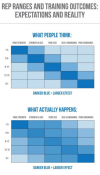
As for light vs heavy weights here is a nice heatmap by Greg Nuckols:

1637947857013.png

What I see there is really barely any difference. Unless you are a TOP TIER competitor I doubt the number of reps you do will make a huge difference.

I was under the impression that muscles fire all or nothing, that we can't focus on a specific head or whatever, unless that muscle has a different insertion.
You can definitely focus on a specific head, that doesn't mean the entire muscle doesn't fire, just more of one portion of it is doing the work.

An example for your triceps case.... Exercise selection as well as grip make a huge difference. This blog has some nice pics to explain it 6 Exercises You Need To Train All Three Triceps Heads (Proven Tips) - Anabolic Bodies™. Essentially skull crushers for the long head, pronated grip push downs for lateral head, supinated grip push downs for medial head.
 
Of course they do. There are 3 factors to growing muscle:

1. Mechanical Tension (i.e progressive overload / adding more weight)
2. Damage (go to failure every one in a while)
3. Metabolic Stress (static contractions / isometrics)

I think the large majority of research shows that mechanical tension / progressive overload is the best way to build muscle. In this article Can We Predict Muscle Growth? • Stronger by Science they claim effective reps / sets is the best predictor. Aka all sets should be RPE 8 or 9 essentially and increase the weight when they aren't.

Here is a blog post on building muscle and strength using isometrics Isometrics For Strength & Hypertrophy (Exercise Examples) - Lift Big Eat Big. The key take away are the effects are better at longer muscle lengths, but any strength gains might not actually transfer to dynamic movements that don't require the hold.

Sci-Hub | Isometric training and long-term adaptations; effects of muscle length, intensity and intent: A systematic review. Scandinavian Journal of Medicine & Science in Sports | 10.1111/sms.13375 this review on isometrics says while isometrics build muscle, they provide less neuromuscular activation (mind muscle connection I am guessing?) and rapid force production vs explosive movements.


Hard to compare these two. My guess is heavy close grip bench press with build more OVERALL tissue than cable press downs, but less tricep tissue.

As for light vs heavy weights here is a nice heatmap by Greg Nuckols:

View attachment 156845

What I see there is really barely any difference. Unless you are a TOP TIER competitor I doubt the number of reps you do will make a huge difference.


You can definitely focus on a specific head, that doesn't mean the entire muscle doesn't fire, just more of one portion of it is doing the work.

An example for your triceps case.... Exercise selection as well as grip make a huge difference. This blog has some nice pics to explain it 6 Exercises You Need To Train All Three Triceps Heads (Proven Tips) - Anabolic Bodies™. Essentially skull crushers for the long head, pronated grip push downs for lateral head, supinated grip push downs for medial head.
Thanks for the articles.

One thing that still doesn't make sense is changing grip for triceps: try it now yourself, flex your triceps out and twist your hand however you want, and you'll notice nothing happens to your triceps, and that's because they have nothing to do with your hand position, unlike biceps, which does.

Another thing, kick backs are the WORST triceps exercise. Literally half of the movement is neutral with no resistance; people use momentum to swing up and then challenge the muscle at its shortest (weakest point).
 
Last edited by a moderator:
One thing that still doesn't make sense is changing grip for triceps: try it now yourself, flex your triceps out and twist your hand however you want, and you'll notice nothing happens to your triceps, and that's because they have nothing to do with your hand position, unlike biceps, which does.
I tried this, as well as googled it looking for EMG readings of the different tricep heads with relation to grip. Couldn't find anything. Both positions do just extend the elbow the same way. Could just be "bro science" that switching grips hits one head or the other more.

kick backs are the WORST triceps exercise.
For people to use any actual amount of weight of this they use way too much momentum. Increasing the weight is super difficult with good form so little to no chance of progressive overload. I agree it's a terrible exercise.
 
Depending on how you perform kick backs, they can range from mediocre (torso horizontal on bench) for the lateral part and medial head to great (incline bench and retroversion) for the long head.
 
One thing that still doesn't make sense is changing grip for triceps: try it now yourself, flex your triceps out and twist your hand however you want, and you'll notice nothing happens to your triceps, and that's because they have nothing to do with your hand position, unlike biceps, which does.
Im not going to pretend to understand all of the kinesiology of the triceps, BUT nature and evolution are not stupid or frivolous. If we have 3 heads in the triceps it is because we evolved to have them, which mean they all have a specific use as it relates to your anatomy.

What I’m trying to say is that each one of the three heads was developed for a certain reason, which contributes to greater strength or mobility depending on which position your hand or arm is in. So, one could argue based on on body/limb/hand position, one head contributes more than the other two, meaning there are certainly exercises that emphasize one or two head(s) over the other.
 
Im not going to pretend to understand all of the kinesiology of the triceps, BUT nature and evolution are not stupid or frivolous. If we have 3 heads in the triceps it is because we evolved to have them, which mean they all have a specific use as it relates to your anatomy.

What I’m trying to say is that each one of the three heads was developed for a certain reason, which contributes to greater strength or mobility depending on which position your hand or arm is in. So, one could argue based on on body/limb/hand position, one head contributes more than the other two, meaning there are certainly exercises that emphasize one or two head(s) over the other.
He’s simply saying that because the triceps do not cross the elbow joint (connective to the radius and ulna independently) the rotation at the wrist under which you extend the Tricep is most irrelevant. He is correct. Grip for Tricep movements should largely be for comfort. HOWEVER, grip on compounds that target triceps (IE close grip bench) should be optimized for alignment and ROM of that specific joint, in this case the elbow, not the shoulder.

Targeting or biasing a specific head of the triceps is dependent on angle from the body. The grip needed to comfortably facilitate movement in a certain plane is just that, facilitating, not causing, the biased stimulus as the tricep.

The triceps (one head) DOES however cross the shoulder and therefore the position of your arm relative to its attachment across the shoulder can change the stimulus.
757AE1A1-B490-4772-BABF-A5E5AD001106.jpeg

EDIT: the primary goal for training triceps should be to get reps in multiple planes with ALIGNED joints. That means weight pulling in the same plane as the elbow is articulating in with the shoulder in a safe position. Excusing overload injuries where you’re doing something stupid weight wise, I’m betting 90% of lifting injuries result from repetitive improper alignment under load.
 
Last edited:
He’s simply saying that because the triceps do not cross the elbow joint (connective to the radius and ulna independently) the rotation at the wrist under which you extend the Tricep is most irrelevant. He is correct. Grip for Tricep movements should largely be for comfort. HOWEVER, grip on compounds that target triceps (IE close grip bench) should be optimized for alignment and ROM of that specific joint, in this case the elbow, not the shoulder.

Targeting or biasing a specific head of the triceps is dependent on angle from the body. The grip needed to comfortably facilitate movement in a certain plane is just that, facilitating, not causing, the biased stimulus as the tricep.

The triceps (one head) DOES however cross the shoulder and therefore the position of your arm relative to its attachment across the shoulder can change the stimulus.
View attachment 156889

EDIT: the primary goal for training triceps should be to get reps in multiple planes with ALIGNED joints. That means weight pulling in the same plane as the elbow is articulating in with the shoulder in a safe position. Excusing overload injuries where you’re doing something stupid weight wise, I’m betting 90% of lifting injuries result from repetitive improper alignment under load.
Yea I hadn’t considered the fact that it wasn’t crossing the elbow joint. As I mentioned, I’m certainly not an expert in kinesiology.

Hand placement will affect the angle at which your arm is rotated. So it is still a secondary driver of how the triceps is worked
 
Of course they do. There are 3 factors to growing muscle:

1. Mechanical Tension (i.e progressive overload / adding more weight)
2. Damage (go to failure every one in a while)
3. Metabolic Stress (static contractions / isometrics)

I think the large majority of research shows that mechanical tension / progressive overload is the best way to build muscle. In this article Can We Predict Muscle Growth? • Stronger by Science they claim effective reps / sets is the best predictor. Aka all sets should be RPE 8 or 9 essentially and increase the weight when they aren't.

Here is a blog post on building muscle and strength using isometrics Isometrics For Strength & Hypertrophy (Exercise Examples) - Lift Big Eat Big. The key take away are the effects are better at longer muscle lengths, but any strength gains might not actually transfer to dynamic movements that don't require the hold.

Sci-Hub | Isometric training and long-term adaptations; effects of muscle length, intensity and intent: A systematic review. Scandinavian Journal of Medicine & Science in Sports | 10.1111/sms.13375 this review on isometrics says while isometrics build muscle, they provide less neuromuscular activation (mind muscle connection I am guessing?) and rapid force production vs explosive movements.


Hard to compare these two. My guess is heavy close grip bench press with build more OVERALL tissue than cable press downs, but less tricep tissue.

As for light vs heavy weights here is a nice heatmap by Greg Nuckols:

View attachment 156845

What I see there is really barely any difference. Unless you are a TOP TIER competitor I doubt the number of reps you do will make a huge difference.


You can definitely focus on a specific head, that doesn't mean the entire muscle doesn't fire, just more of one portion of it is doing the work.

An example for your triceps case.... Exercise selection as well as grip make a huge difference. This blog has some nice pics to explain it 6 Exercises You Need To Train All Three Triceps Heads (Proven Tips) - Anabolic Bodies™. Essentially skull crushers for the long head, pronated grip push downs for lateral head, supinated grip push downs for medial head.
Thanks for the triceps article.

For me, I find kneeling overhead triceps extension with a rope and one arm cable triceps pushdowns work best: lots of reps w medium weight.

If I go too heavy on 2 arm triceps pushdowns (for me 2 45lb and 2 35lb plates) I work too much chest - which may be why my chest continues to grow even though I don't train it.

It's certainly interesting seeing what works an what doesn't in my early 50's.
In my 20's it didn't matter what I did or how I did it: everything grew.
 
Indeed. I know I've been shilling Doug Brignole a lot lately, because I have noticed positive things after training four months his way, but I feel like there is much more than physics models, although his 16 parameters for exercise selection seem on point. Doug does not believe in "angles" being worked, unless the muscle has different fibers, as he argues muscles fire all or nothing, but I sent him Helm's video via DM and he did not respond, when he usually does.

As I mentioned in another post today, I decided to do rope push downs yesterday and I felt WAY more tension in my triceps than I do with single arm cable. As Mike Israetel would say "raw stimulus magnitude." Now, I come from the Blood and Guts camp, so I'm no stranger to heavy shit lol, but doing four months of Brignole certainly eliminated joint pain, and my legs have improved without doing a single squat, focusing mostly on extensions and curls, and doing only one-legged presses (which he doesn't advise) but I feel something is missing, so I will be incorporating at least one compound movement per muscle group that is that matches the most natural path of our bodies.

I was watching this guy the other day for triceps, and he talked about getting that stretch because of the shoulder.
View: https://www.youtube.com/watch?v=Ua6Qcm1CEcQ&ab_channel=WYCKEDTRAINING
 
Last edited by a moderator:
He’s simply saying that because the triceps do not cross the elbow joint (connective to the radius and ulna independently) the rotation at the wrist under which you extend the Tricep is most irrelevant. He is correct. Grip for Tricep movements should largely be for comfort. HOWEVER, grip on compounds that target triceps (IE close grip bench) should be optimized for alignment and ROM of that specific joint, in this case the elbow, not the shoulder.

Targeting or biasing a specific head of the triceps is dependent on angle from the body. The grip needed to comfortably facilitate movement in a certain plane is just that, facilitating, not causing, the biased stimulus as the tricep.

The triceps (one head) DOES however cross the shoulder and therefore the position of your arm relative to its attachment across the shoulder can change the stimulus.
View attachment 156889

EDIT: the primary goal for training triceps should be to get reps in multiple planes with ALIGNED joints. That means weight pulling in the same plane as the elbow is articulating in with the shoulder in a safe position. Excusing overload injuries where you’re doing something stupid weight wise, I’m betting 90% of lifting injuries result from repetitive improper alignment under load.
So elbows flared vs elbows close to body? Is in the realm of what this means?
 
Back
Top