Training to Failure?

When I was in my 20s I used to train to failure every set. I used to train to failure and then jump up whip off a couple of plates and train again to failure as quick as poss. It did seem to work very quick in building mass.

Just my 2 cents.
 
Well thats part of the issue.

Volume guys dont ever have an answer. How much volume is required? Their must be a more scientific approach then just random B.S. about being sore or not. Cuz lets face it. Soreness is not a prerequisite to growth either.

At least with HIT their is a very clear definition of a successful workout. Train to momentary failure. Thats it. Its not like some one could confuse that. In this method. Jones believed that adapting the muscle thru the painful final seemingly impossible rep was the only way to grow and cause sufficient stimulation. Ive always believed this.

Some body tell me where this goes wrong?
 
I don't think its fitting that certain routines or training styles get referred to as 'volume training'. Volume isn't a training style or philosophy or routine, its a variable. I've stated before that total volume relative to intensity (percentage of 1RM) is probably one of the most important factors in a routines success or effectiveness.

I've never really felt that failure leads to more hypertrophy, I actually believe that the benefit of taking a set to failure comes from the fact that effort needed to complete the set is higher. Which means higher motor unit recruitment and will promote faster / quicker adaptions in strength. But obviously this would be impractical for most movements unless you train with a partner. In most cases its not necessary, even for bb'ing imo.

Plus it creates more challenges for programming. Managing all the fatigue and stresses caused by taking your main lifts to failure would be a real headache. That's why most 'failure oriented' routines take a single set approach. I am not a fan of SingleSetTraining routines, the only one that interests me is DC training because it takes a dual factor approach to periodization, which is far more fitting for guys who are already further along in their development.

You raise good questions though Trukk. How much volume is needed? And you are absolutely correct, soreness is a piss poor indicator of a workouts effectiveness.

If a guy is doing only 50 total reps of Back Squat a week, with a 10RM, and another guy is doing 100 total reps per week, I would say in most instances, assuming fatigue is being managed properly and both routines are properly programmed, that the guy doing 100 total reps per week is going to make faster progress. He will get stronger faster and his physique is going to reflect the new poundage's he is capable of pushing.

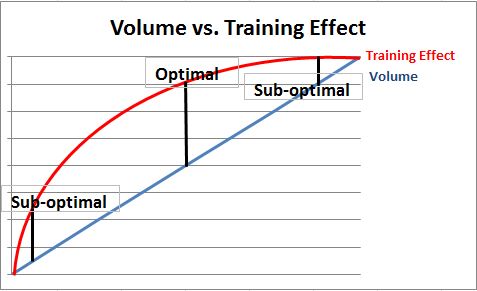
Is it going to be twice the amount of progress? No, obviously not, and at a certain point the return on investment starts to drop dramatically - like shown in this graph

Volume-Vs-Training-Effect.jpg


Personally I believe lifters should take advantage of their capacity to do work, and continue to take advantage of it as their capacity to do work increases.

 
Last edited:
@weighted chinup glad to see you here. Well get this thing figured out lol :)

I will say post workout soreness often leads to new growth BUT is not required. On cycle I rarely get sore yet I GROW! Why? Has to be the increased anabolic pathways. Still not very scientific but its true
 
I too have spent countless hours looking at the current literature on this same topic. Personally I've found that not training until failure has actually worked better for me. Training to failure every single workout was so taxing on my CNS that it made recovery harder, and confirmation bias aside, I found I had an increase in appetite when I stopped training to failure. I would do the same number of total reps in a work out but stop short of failure.

Instead of going all out on working sets, I work to about 1 rep short of failure and then rack the weight. If I want to do more total reps I'll wait until I feel good and then do a few more. I have wondered how much of a difference there is between a set where I did 10 reps until failure or I did 2 sets (1 set of 8 reps followed by 1 set of 2 reps with the same weight). The total work is still the same but the CNS is not so stressed, or at least thats how it feels.

As for you guys who are asking for a more scientific approach Charles Poliquin has some articles on this subjects, as well as Bryan Haycock.
 
It seems if you are of great genetic ability training in any manner would yield results. For the sake of argument id like to not refer to these individuals. I also dont necessarily believe different training styles work for different people? I mean if there's any rhyme or reason to it there must be a cause and effect. That means we should all react to the same training principles. Assuming diet is on point of course
 
Im not talking about specific training routines. The thought that training to failure is what im talking about.

The stress hormone cortisol becomes active when you train to failure. Cortisol lowers protein synthesis and prevents the rebuilding process from getting started.

The idea to the contrary would be train in a manner that allows you to place ample stress on the muscle via volume without going to failure.

There's nothing wrong with acute cortisol elevations. It's a physiologic part of the stress and adaptation system the body goes through during training. There are methods to test the effectiveness of a given program simply by measuring the cortisol response. The higher the cortisol the more intense the training. The greater the supercompensation effect from training provided you have adequate rest and nutrition. Cortisol is needed in the anti-inflammatory process, it helps in maintaining BP, and in the short term mobilizes fatty acids from fat cells for oxidation.
 
With myself, it all comes down to units of work. I define units of work as time under tension and the level of muscular contraction. Take a crossfit workout for example. On a scale of 1-10 a crossfitter may be hitting a 2 on level of muscular contraction on each rep. A bodybuilder may be hitting a 9 on each rep in one given set. So 1 set of a high intensity workout may exceed numerous sets of someone elses routine, where the only marker for total units of work is number of sets and reps, not degree of muscular contractions and time of constant contraction.

So sets are really irrelevant to me for the most part. As an advanced athlete who has a much greater degree of muscular , results and overall power output should not be solely defined by sets. Its really like comparing a 6 cyl car to a drag racer
 
Back
Top