Filtration System

gabrielc

New Member
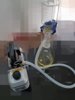
Good evening, I'm on a millipore filtration system, use with a 3cfm electric vacuum pump and use a nylon membrane with a porosity of 0.45. The problem is that the filtration is very slow. I wonder if it's normal or you have something to do to speed up the filtration process. For more system information I'm using, I can send private photos. Thank you and sorry for my English!

 
I tried with the hot oil to see if the process would become easier, but did not feel much difference. I have no leaks. Is the nylon membrane the correct one to use?
 
Nylon is fine.
Double check for leaks and I'd even go as far as wrapping the joints with cling wrap to eliminate that factor.

Exactly how quickly is it filtering? Filtering isn't instant. And if this is your first run it may seem very slow to you.

Other than leaks and cool oil I'm not sure what else could be wrong.
Someone else will chime in with advice.
 
Nylon is fine.
Double check for leaks and I'd even go as far as wrapping the joints with cling wrap to eliminate that factor.

Exactly how quickly is it filtering? Filtering isn't instant. And if this is your first run it may seem very slow to you.

Other than leaks and cool oil I'm not sure what else could be wrong.
Someone else will chime in with advice.
I did not notice leaks. Filtration is a slow drip.
 
Honestly PTEF or PVDF are going to be your best option. After prolonged exposure, Nylon and PES membranes (the two most commonly used/purchased) will deteriorate with a slightly higher content of solvents such as BB and EO. You really should be using a .22 as stated, since you're not in a clean room or lab environment, the safer the better.

That being said, how slow is what you are calling "slow?" With the Nylon membranes, you're not going to get much more than a drip at a time, assuming you aren't over pressuring your vacuum pump.

Are you using a glass media bottle or a plastic container to filter into?
 
Honestly PTEF or PVDF are going to be your best option. After prolonged exposure, Nylon and PES membranes (the two most commonly used/purchased) will deteriorate with a slightly higher content of solvents such as BB and EO. You really should be using a .22 as stated, since you're not in a clean room or lab environment, the safer the better.

That being said, how slow is what you are calling "slow?" With the Nylon membranes, you're not going to get much more than a drip at a time, assuming you aren't over pressuring your vacuum pump.

Are you using a glass media bottle or a plastic container to filter into?
My filtration system is glass whole.
If it's one drip at a time, then it's correct, I thought it was something faster. The way to be patient and wait for hours. How many cfm pumps is right? I bought a 3cfm, but I'm not sure if it was a good choice.
 
My filtration system is glass whole.
If it's one drip at a time, then it's correct, I thought it was something faster. The way to be patient and wait for hours. How many cfm pumps is right? I bought a 3cfm, but I'm not sure if it was a good choice.
The real factor with vacuum filtration is the amount of constant pressure being applied, meaning you really need a regulator and a gauge so that you can control that factor while in the filtration process. Most guides and advice you're going to find will explain your advised pressure in either PSI or HG.

CFM stands for cubic feet per minute, which is a measurement of maximum flow potential at a certain PSI (determined by the design of your pump)

You want to control the amount of pressure, rather than the potential flow. That's where the regulator/gauge will come into play. This will make it MUCH easier to avoid potential breakage/tearing issues with the membranes as well as allow you to see if you are losing vacuum during the process.

With a glass media bottle as a receiver, the nylon membranes you are using will sustain a slow but efficient filtration flow without breaking at or below approximately 19-20psi. Anything beyond that, you are asking for some problems.

I don't know meso's rules regarding links, but to learn more about the differences in flow/pressure/etc measurements, you can visit cejn.com and view the articles and guides regarding the measurements and conversions of various measurements of pressure.
 
I have a very similar setup although I use .22 filter papers. If you have a gauge put it on the end of your hose to see how much vacuum you are actually getting. You may have a bad pump odds are its probably fine but looking at your setup i would definitly check that. Then do as @JackSmooth suggested and wrap joints in seran wrap and get .22 filters. Then I would put a lid on top of the buchner filter (less air space).
 
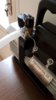
realized that I was losing a vacuum through the hose. I put clamps on the exits and the problem was solved and the filtration started to get faster. Soon I realized a loss of vacuum in the gasket of the filtration system.
 

Attachments

  • IMG-20170812-WA0005.jpeg
    IMG-20170812-WA0005.jpeg
    256.4 KB · Views: 99
  • IMG-20170812-WA0003.jpeg
    IMG-20170812-WA0003.jpeg
    175 KB · Views: 95
realized that I was losing a vacuum through the hose. I put clamps on the exits and the problem was solved and the filtration started to get faster. Soon I realized a loss of vacuum in the gasket of the filtration system.
Ahh I told you to watch those joints!
Glad to see you got it working man.
 
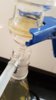
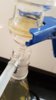
The problem is here, I was stirring the joint and when it was well positioned, the filtration was super fast. But soon it lost force and returned to drip, I realized the loss of vacuum in the joint and the same trickles a little oil. So one realizes that it is not prohibiting 100%. I await opinions so that I can resolve this issue. I hope you can understand English. Thank you!
 

Attachments

  • IMG-20170812-WA0007.jpeg
    IMG-20170812-WA0007.jpeg
    182.5 KB · Views: 91
Simple fix. You have sevwral options that I can think of.
#1 get another gasket
#2 wrap the joint on seran wrap (cling wrap)
#3 get some high temp silacone gasket material (the sheet not the caulk) cut your own gasket alittle thicker if necessary, steralize it prior to use
#4 if you are able to adjust your clamp do so
I am sure others have some ideas that will work as well
 
Is it normal or too slow? Because I witnessed a much faster filtration than that. That's why I think it's escaping vacuum. I uploaded a video for you to see better. If you can not watch, let me know.
 

Attachments

Back
Top