Qingdao Sigma Chemical Co., Ltd (International, US, EU, Canada and Australia domestic

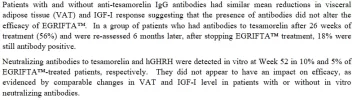
Wow this is quite interesting! Because I have read just as your quoted study states, that there are higher amounts of immunogenicity in Tesa, I suppose I haven't seen the latter of your comment on the affect on efficacy, but if this is true then that is pretty remarkable.

Where was this study? Thanks man
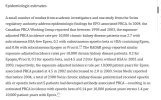
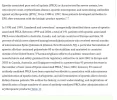
It's in the Egrifta document itself on page 8
 

Attachments

Last edited:
It's in the Egrifta document itself
Great read. Came with receipts. Thanks man. Not sure if it matters, but I wonder if there is any variability if this is applied to UGL Tesa. Obviously, no way to for sure know since there are no studies on the matter for UGL. But that was a nice document to skim through on the immunogenicity heading.
 
Great read. Came with receipts. Thanks man. Not sure if it matters, but I wonder if there is any variability if this is applied to UGL Tesa. Obviously, no way to for sure know since there are no studies on the matter for UGL. But that was a nice document to skim through on the immunogenicity heading.
It may or may not be applicable. Then again the paients trialed on Egrifta weren't healthy either. There is a Tesamorelin study on healthy individuals but they did not assess for immunogenicity
 
[
So I only have a undergrad biochem degree, and I don't claim to be an expert at all but I am seeing some possible glaring flaws in your theories of aggregation esp with suggesting filtering as a solution. If aggregates are readily forming from peptides or peptide blends they should be interfering with any optical based analytic technique unless said aggregates just so happen to have the same absorbances of the targeted substances(incredibly unlikely). This should be very easy for some one like Jano to test for. Love to hear him chime in on this.

Secondly, If these aggregates are large enough that filtering them would be remotely effective then you should also be able to "see" them visually with the naked eye by shinning a laser through the solution and looking for observable light scattering. We used this technique in a lab course to detect the presence of nanoparticles.

food for thought.

You will certainly make friends among the know-nothings here who'll latch onto your post, They're not arguing based on facts. have done no research, and have a personal beef with me.

I'll dismantle your commentary piece by piece. In individual posts.

Let me start by saying aggregates inducing immunogenicity is not my "theory". That claim alone demonstrates the lack of effort on your part.

I'll document everything I say. Will you?

IMG_9546.webpIMG_9532.webp
 

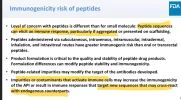
Detection of particles has a probabilistic nature. No single cut-off size can be defined to be visible to the human eye. Many factors can influence the probability of detecting a particle. The detectable size by the human eye ranges from near 0 %, 40 % and 95 % probability of detection to 50, 100, and 200 µm, respectively, under the standard conditions (Mathonet et al., 2016; Perez et al., 2017). As a single-size estimate, the 150-µm threshold has been proposed to be a best-case threshold for human visual identification of particles in injectable DPs (Bukofzer et al., 2015).

Compare length scales above vs 5 um or 0.2 um filter.
 
More...

For SVPs ranging in size from 10 µm to the visible threshold, the limits are harmonized in the USP, EP, and JP at 6,000 and 600 per container for ≥10 µm and ≥25 µm particles, respectively, in 100 mL containers. For containers larger than 100 mL, limits are 25 per mL and 3 per mL for particles of ≥10 µm and ≥25 µm, respectively (Ishii-Watabe et al., 2015, Perez et al., 2016). For particles <10 µm, no compendial limits would be applicable, presumably this correlates to the approximate size of a human erythrocyte suggesting that particles smaller than an erythrocyte are of less concern because they are unlikely to embolize.
 
Wow this is quite interesting! Because I have read just as your quoted study states, that there are higher amounts of immunogenicity in Tesa, I suppose I haven't seen the latter of your comment on the affect on efficacy, but if this is true then that is pretty remarkable.

Where was this study? Thanks man

It may or may not be applicable. Then again the paients trialed on Egrifta weren't healthy either. There is a Tesamorelin study on healthy individuals but they did not assess for immunogenicity

1739502851686.webp
 
Yep. I don't usually like posting things like this, so as not to make people slack up on their precautions regarding filtering. not all immunogenicity is the same. Not all users of peptides are the same. Not all therapeutic proteins are the same.
Very true. Safe side is definitely filtering. Each filter is only $0.50 anyways haha, just a minute more in the grand scheme of the reconstitution process. Not too bad IMO
 
Like when you consider that a rate of grievous immune reaction of 0.5 in 10,000 will absolutely cause a drug to be discarded.. It puts a lot of things into perspective. You don't wanna be that 0.5 group, but that rate means if 7 people are going through something on a forum like meso for example, it is unlikely to be that thing. Hence my common things occur commonly mantra.
 
It may or may not be applicable. Then again the paients trialed on Egrifta weren't healthy either. There is a Tesamorelin study on healthy individuals but they did not assess for immunogenicity

This is common "knuckle dragger" logic and reveals the sheer ignorance on the topic.

"This immunogenicity stuff impacts the sick and weak, not us strong healthy bodybuilders."

Immunogenicity is more pronounced in healthy people with a vigorous immune system.

Read that again and think about it.

A healthy immune system reacts, and develops immunity to neutralize perceived "threats" far more strongly and effectively than those with a weakened immune system.

Who's going to have a stronger immune response? A healthy person, or the fucking immunocompromised AIDS patients in the Egrifta trial?


Again, I need to emphasize this because it's the point where any rational person would determine anyone with such a lack of basic understanding has no credibility on this topic. None. How could they?

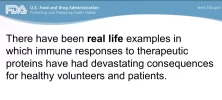
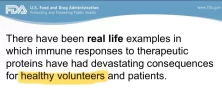
The greatest risk from severe immunogenic reactions. the ones that go beyond merely reducing efficacy of a drug into life threatening reactions are HEALTHY VOLUNTEERS in clinical trials. Several of these incidents prompted the FDA to require far more immunogenicity testing before a peptide could be injected into any human volunteers.

IMG_9546.webp
 
This is common "knuckle dragger" logic and reveals the sheer ignorance on the topic.

"This immunogenicity stuff impacts the sick and weak, not us strong healthy bodybuilders."

Immunogenicity is more pronounced in healthy people with a vigorous immune system.

Read that again and think about it.

A healthy immune system reacts, and develops immunity to neutralize perceived "threats" far more strongly and effectively than those with a weakened immune system.

Who's going to have a stronger immune response? A healthy person, or the fucking immunocompromised AIDS patients in the Egrifta trial?


Again, I need to emphasize this because it's the point where any rational person would determine anyone with such a lack of basic understanding has no credibility on this topic. None. How could they?

The greatest risk from severe immunogenic reactions. the ones that go beyond merely reducing efficacy of a drug into life threatening reactions are HEALTHY VOLUNTEERS in clinical trials. Several of these incidents prompted the FDA to require far more immunogenicity testing before a peptide could be injected into any human volunteers.

View attachment 316447
Bruh.. Because i restrained myself from calling out the exagerration and fiction you posted about Erythropoetin alpha the other day..

You just went and googled up stuff without doing proper research and winged it. I let it be because It was of no value to that discussion, but you overestimate your grasp of some of these things and grossly underestimate the competence of others.
:)
 
Yep. I don't usually like posting things like this, so as not to make people slack up on their precautions regarding filtering. not all immunogenicity is the same. Not all users of peptides are the same. Not all therapeutic proteins are the same.

It's always good to have other sides of the argument and alternate opinions presented.

Otherwise some might see the implications relating filtering peptides to preventing mad cow disease or autoimmunity. When the end point can simply be no change in efficacy.
 
Another famous (among the pharma peptide community) case was Erythropoietin.

People developed immunity to proteins critical to production of red blood
cells, resulting in severe, life threatening immunity,

This wasn't discovered until they'd been using it for years, because at the clinical level, no one can check for antibodies like this. Only the trials were monitoring for immunogenicity, since it's expensive and complex.

It took over a decade to figure out what happened. The manufacturer of prefilled syringes started using tungsten pins to make holes in the syringe. This left behind atomic level traces of tungsten particles. The particles caused the protein to aggregate, and the immune system responded to these aggregates, developing an immunity to them, which unfortunately, looked very similar to the natural protein critical to red blood cell production.

View attachment 316046

1739504474675.webp
Those are your outstanding rates bro.
1.4 cases/year for ever 10,000 persons using it.
the peak was 4.5 people for ever 10,000 people with chronic kidney disease.

of course this is a disaster. Drugs are not supposed to worsen a disease, but come on bro!

Common things occur commonly!!!

1739504739576.webp

Should we worry about immunogenicity, of course. This is a harm reduction forum, but please, some of us know what the fuck we are talking about.
191 cases world wide. 59 cases since 2002-2009 (world wide)
 
Bruh.. Because i restrained myself from calling out the exagerration and fiction you posted about Erythropoetin alpha the other day..

You just went and googled up stuff without doing proper research and winged it. I let it be because It was of no value to that discussion, but you overestimate your grasp of some of these things and grossly underestimate the competence of others.
:)

You can't have a healthy discussion or disagreement with some people. He calls people low IQ retards all the time (eg, 1 & 2).

Microsoft Study Finds AI Makes Human Cognition “Atrophied and Unprepared”
 
I use Call-on-Doc for bloodwork. Literally copy and paste all the labcorp labs I want; like 33 tests I think; hand over those lab codes to Call-on-Doc; give some very vague list of symptoms (poor sleep, hormonal support, low sex drive, etc.) to tie to the labs requested, pay the $39 consultation fee; Call-on-Doc then submits the request to my insurance. My insurance barely covers anything for preventative blood work, but they cover 100% of diagnostic based bloodwork. They don't say a word or push back on anything I submit; just need it to be relevant to the diagnostic code/symptoms.

So I end up getting about $500-$600 of super fancy panels and labs for $39. I do this multiple times a year. Granted not everyone's insurance may do that, so you have to call your insurance up and ask how they deal with diagnostic vs preventative labs. FYI, I just have an average BCBS PPO plan. It does not go against my deductible. It's just covered.

$39 for over $500 worth of labs if I was cash pay? I haven't seen any deal beat that yet.
 
Last edited:
It's always good to have other sides of the argument and alternate opinions presented.

Otherwise some might see the implications relating filtering peptides to preventing mad cow disease or autoimmunity. When the end point can simply be no change in efficacy.
Healthy people will react differently. They may have stronger immunity, but they may also have better clearance of the tesamorelin antibody. My specific mention of Healthy people is that we don't know if healthy people will have cross reactivity with growth hormone releasing hormone. But the study have performed on healthy individuals showed efficacy of Tesa in healthy people over a year. I just figured that if immunogenicity and neutralizing antibody was stronger, efficacy will be affected and this will skew results between AD and Placebo groups or at least affect P values regarding efficacy? That of course is extrapolation on my part, but reasonable. Which is why added no immunologic tests were performed on that group
 
Back
Top