Common things occur commonly, uncommon thing, uncommonly.The reports are mainly in children with genetic deficiencies (some already predisposed to immune disorders). Not generally healthy adults [or bodybuilders].


MESO-Rx
Anabolic Steroids

Follow along with the video below to see how to install our site as a web app on your home screen.
Note: This feature may not be available in some browsers.
Common things occur commonly, uncommon thing, uncommonly.The reports are mainly in children with genetic deficiencies (some already predisposed to immune disorders). Not generally healthy adults [or bodybuilders].
LoL, I was confused. You gave it a thumbs-downYeah agree best panel
Don't mix them. It's a marathon, not a sprint for the most noticeable results, 6 months. Results most similar to low dose GH, for anti aging rather than bodybuilder results. Lower risks than GH and should be sustainable indefinately with very minor, if any sides. We know there are daily users of Egrifta 10 years+, under medical care, without anything troubling in the data.
Easier to manage as well because of its indirect effect and physiological levels, pretty much any time of day is fine, as long as it's consistant,
Tesa also seems to result in ongoing higher levels of GH after use is stopped, fwiw.
Given the already high rate of immunogenicity with the pharma Tesa, this, perhaps more than any other peptide should be filtered IMO.
I got it and it feels the same as his 10mg I've gotten before.Anyone else here got the 50mg Tirz from QSC? I'm finding the effects are significantly weaker than say Mounjaro, anyone else finding this?

When you say don't mix them do you mean don't run a cycle of both at the same time, or don't administer both in the same injection?

Not Ghoul, but I am assuming he means not both in same injection/syringe. He has mentioned before that mixing peptides in the same syringe or even vial, basically mixing of diff peptide solutions, can create aggregates of the proteins which leads to less efficacy or worse outcomes.When you say don't mix them do you mean don't run a cycle of both at the same time, or don't administer both in the same injection?
There are a few communities you can join now that have solved this problem through group testing. You voluntarily join a group that wants to test a specific product and all contributors get access to the tests. I've done a few this year and the most expensive one was $10.But why should I pay for testing, and publish testing for vendors and members alike to use for their benefit and ZERO cost to them? How does that benefit me? Because Meso is about harm reduction?

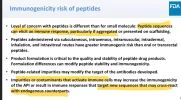
Just so you know, Tesa resulted in immunogenicity in roughly half of people that took it in the trial stage (anti tesa antibodies). Of the half that had immunogenic rxn, 85% developed neutralizing antibodies. Of that 85%, Almost a third (60%) developed cross reaction to natural growth hormone releasing hormone.When you say don't mix them do you mean don't run a cycle of both at the same time, or don't administer both in the same injection?

So I only have a undergrad biochem degree, and I don't claim to be an expert at all but I am seeing some possible glaring flaws in your theories of aggregation esp with suggesting filtering as a solution. If aggregates are readily forming from peptides or peptide blends they should be interfering with any optical based analytic technique unless said aggregates just so happen to have the same absorbances of the targeted substances(incredibly unlikely). This should be very easy for some one like Jano to test for. Love to hear him chime in on this.Don't mix them in the same vial or syringe.
It's a good idea if injecting them at the same time to use sites on opposite sides. Tesa is highly immunogenic, almost everyone experiences site reactions. You don't want another peptide in the same area the immune system is responding to.
Vaccines, proteins engineered to maximize immunogenicity, will sometimes use another compound or particulate that causes a strong immune reaction to induce a stronger response to the vaccine than would ordinarily happen. This is the opposite of what we want to occur with the peptides/proteins we don't want to build an immunity to.
BTW: these "immune stimulators" are called adjuvants. Particulate trash like glass and rubber particles in cheap Chinese vials act as adjuvants, as do aggregated proteins. Filtration removes these, lessening the overall immune response to peptides.
Immunologic adjuvant - Wikipedia
en.m.wikipedia.org
Wow this is quite interesting! Because I have read just as your quoted study states, that there are higher amounts of immunogenicity in Tesa, I suppose I haven't seen the latter of your comment on the affect on efficacy, but if this is true then that is pretty remarkable.Just so you know, Tesa resulted in immunogenicity in roughly half of people that took it in the trial stage (anti tesa antibodies). Of the half that had immunogenic rxn, 85% developed neutralizing antibodies. Of that 85%, Almost a third (60%) developed cross reaction to natural growth hormone releasing hormone.
In the end, It didn't mean anything, as this did not affect efficacy. Turns out that the antibodies may be binding to nonfunctional parts of the peptide.
Just another useless contribution from me

But why should I pay for testing, and publish testing for vendors and members alike to use for their benefit and ZERO cost to them? How does that benefit me? Because Meso is about harm reduction? Really?

He gives me thumbs down sometimes so i do it to himLoL, I was confused. You gave it a thumbs-down
Just so you know, Tesa resulted in immunogenicity in roughly half of people that took it in the trial stage (anti tesa antibodies). Of the half that had immunogenic rxn, 85% developed neutralizing antibodies. Of that 85%, Almost a third (60%) developed cross reaction to natural growth hormone releasing hormone.
In the end, It didn't mean anything, as this did not affect efficacy. Turns out that the antibodies may be binding to nonfunctional parts of the peptide.
Just another useless contribution from me
It's in the Egrifta document itself on page 8Wow this is quite interesting! Because I have read just as your quoted study states, that there are higher amounts of immunogenicity in Tesa, I suppose I haven't seen the latter of your comment on the affect on efficacy, but if this is true then that is pretty remarkable.
Where was this study? Thanks man
Great read. Came with receipts. Thanks man. Not sure if it matters, but I wonder if there is any variability if this is applied to UGL Tesa. Obviously, no way to for sure know since there are no studies on the matter for UGL. But that was a nice document to skim through on the immunogenicity heading.It's in the Egrifta document itself
It may or may not be applicable. Then again the paients trialed on Egrifta weren't healthy either. There is a Tesamorelin study on healthy individuals but they did not assess for immunogenicityGreat read. Came with receipts. Thanks man. Not sure if it matters, but I wonder if there is any variability if this is applied to UGL Tesa. Obviously, no way to for sure know since there are no studies on the matter for UGL. But that was a nice document to skim through on the immunogenicity heading.
So I only have a undergrad biochem degree, and I don't claim to be an expert at all but I am seeing some possible glaring flaws in your theories of aggregation esp with suggesting filtering as a solution. If aggregates are readily forming from peptides or peptide blends they should be interfering with any optical based analytic technique unless said aggregates just so happen to have the same absorbances of the targeted substances(incredibly unlikely). This should be very easy for some one like Jano to test for. Love to hear him chime in on this.
Secondly, If these aggregates are large enough that filtering them would be remotely effective then you should also be able to "see" them visually with the naked eye by shinning a laser through the solution and looking for observable light scattering. We used this technique in a lab course to detect the presence of nanoparticles.
food for thought.
Detection of particles has a probabilistic nature. No single cut-off size can be defined to be visible to the human eye. Many factors can influence the probability of detecting a particle. The detectable size by the human eye ranges from near 0 %, 40 % and 95 % probability of detection to 50, 100, and 200 µm, respectively, under the standard conditions (Mathonet et al., 2016; Perez et al., 2017). As a single-size estimate, the 150-µm threshold has been proposed to be a best-case threshold for human visual identification of particles in injectable DPs (Bukofzer et al., 2015).
For SVPs ranging in size from 10 µm to the visible threshold, the limits are harmonized in the USP, EP, and JP at 6,000 and 600 per container for ≥10 µm and ≥25 µm particles, respectively, in 100 mL containers. For containers larger than 100 mL, limits are 25 per mL and 3 per mL for particles of ≥10 µm and ≥25 µm, respectively (Ishii-Watabe et al., 2015, Perez et al., 2016). For particles <10 µm, no compendial limits would be applicable, presumably this correlates to the approximate size of a human erythrocyte suggesting that particles smaller than an erythrocyte are of less concern because they are unlikely to embolize.


