Personally I wouldn't add a med at that RHR. It's in the high normal range. Maybe just get some to keep on hand in case it goes over 90.
You mentioned high stress, and Nebiv's beta blocker "side effect" of relieving it, I'll just bring something to your attention since you're going to be ordering India pharma.
I'm not sure where your BP is, you're obviously taking an ARB / BB for it, or if you have any reason to avoid CCBs (which are almost always prescribed before a BB, often the last choice by docs), but you may want to consider Cilnidipine if there's "room" for BP to go down slightly more.
You know beta blockers prevent noradrenaline from binding to receptors attenuating the physical stress response, especially in the heart. It's a limited set of beta receptors, depending on which BB is being used, so not everything impacted by stress will get relief.
Cilnidipine's unique addition of "Calcium N channel" blocking to the usual CCB "L channel" block stops noradrenaline from being released by sympathetic nerves.
So this combo of less noradrenaline being released systemically (which does keep everything more relaxed when psychological stress tries to "tighten" up muscles and arteries), and Nebiv able to more effectively block the reduced amount of noradrenaline, has patients reporting feeling "loose" during stressful situations where they'd usually be tensing up, BP increasing, tension headaches, face turning red, etc.
I can tell you from first hand experience I've noticed this effect since switching to Ciln. When your body stops physically reacting to stress, it breaks the vicious cycle and your mind stays chill too, so you cool off a lot faster.
This happens without the sedation / dizziness of increasing the beta blocker dose.
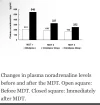
MDT is a "Mirror drawing test" designed to be frustrating to induce stress. You can see an almost 40% drop in the high stress state noradrenaline blood levels from using just a 10mg dose. (MDT 1 is really "baseline", since nifedipine doesn't do anything to noradrenaline)
View attachment 334028
You'd be looking at an additional 8-10 drop in systolic. and 5-7 in diastolic.
Systolic down to 100 is still safe and in normal range, diastolic should be kept above 60.
So if after that additional drop you'd still be above 100/60, you have room to consider adding it and see if it works to keep the physical reaction to stress down even better than Nebiv is now.
You'll also see a slight drop in RHR, around 3-4.