
MESO-Rx
Anabolic Steroids

Navigation
Install the app
How to install the app on iOS
Follow along with the video below to see how to install our site as a web app on your home screen.
Note: This feature may not be available in some browsers.
More options
Style variation
Guest viewing is limited
- You have a limited number of page views remaining
- 1 guest views remaining
- Register now to remove this limitation
- Already a member? Click here to login
You are using an out of date browser. It may not display this or other websites correctly.
You should upgrade or use an alternative browser.
You should upgrade or use an alternative browser.
Giant Semaglutide Thread (and other GLP-1 / GIP agonists)
- Thread starter Doodle
- Start date

TheBeast1
Member
Yes, it's 120/70 typically. Only other drugs I'm taking are test C at 200mg p/w. No beta blockers or arbs.Have you checked your BP around these events? Do you have low BP normally?
Hypotension isn't really a thing with GLP's, but hypoglycemia can mimic the effects, though that's pretty rare too unless the GLP is being used with other things that interact with glucose control.
What other drugs are you taking?
Reddit apparently talks a lot about this. Reta acts as a diuretic and moves water as well as electrolytes. I supplement magnesium at night but recently added potassium and more salt in my food.
I may just start popping a small amount of baking soda I have in tablets to boost my salt intake. My egg and cheese grits this morning were so salty it kind of burned but no POTS events.
SnowyMiami
Member
Chase Irons is mixing cagri and reta together and calling it omegatide. Meanwhile, Novo Nordisk will not mix Sema and Cagri in one vial.Big thanks to @readalot for his comments on the danger of cagrilinitide.
Just searched it up and looked into the fibrilis. Crazy stuff

bananafeet
Member
He says his "lab" is doing it. But it's just a popular UGL blend lolChase Irons is mixing cagri and reta together and calling it omegatide. Meanwhile, Novo Nordisk will not mix Sema and Cagri in one vial.
TheBeast1
Member
Apologies, I just rechecked it and my blood pressure was 113/72 so much lower. Heart rate is a high in the 100s though.Have you checked your BP around these events? Do you have low BP normally?
Hypotension isn't really a thing with GLP's, but hypoglycemia can mimic the effects, though that's pretty rare too unless the GLP is being used with other things that interact with glucose control.
What other drugs are you taking?
fit2beking
New Member
From what I’ve seen, cagrilinitide reduces fibrils and is designed to do so. But I also see that pramlintide has caused this to happen in lab tests. Very interesting topic indeed. I tried searching @readalot comments and can’t seem to find his post concerning cagri and fibrilis. Do you mind linking it? Thanks!Big thanks to @readalot for his comments on the danger of cagrilinitide.
Just searched it up and looked into the fibrilis. Crazy stuff
bananafeet
Member
From what I’ve seen, cagrilinitide reduces fibrils and is designed to do so. But I also see that pramlintide has caused this to happen in lab tests. Very interesting topic indeed. I tried searching @readalot comments and can’t seem to find his post concerning cagri and fibrilis. Do you mind linking it? Thanks!
It's kinda sad, because it would've been a wake up call about the unseen hazards of UGL produced peptides, the limits of "purity" tests, and the false reassurance those who don't understand those limits take from the results.
We've just recently seen an example of those limits coming to light with the peptide damaging / mildly toxic antimicrobial excipients found in a couple of SRYs products. More than just being about those two products, it pulled back the curtain in what we don't know, since excipients are routinely identified and removed from purity calculations, but aren't...
- readalot

I don't know how to link a post sorry.
In Novo’s Own Words: Degradation of Amylin Analogs Such as Cagrilintide (and How to Test For It)
In Novo’s Own Words: Degradation of Amylin Analogs Such as Cagrilintide (and How to Test For It) “A hallmark of the pancreatic hormone amylin is its high propensity toward the formation of amyloid fibrils, which makes it a challenging drug design effort.” So begins Novo Nordisk’s excellent...
 glp1forum.com
R
readalot
Guest
You did a helluva job.It's kinda sad, because it would've been a wake up call about the unseen hazards of UGL produced peptides, the limits of "purity" tests, and the false reassurance those who don't understand those limits take from the results.
We've just recently seen an example of those limits coming to light with the peptide damaging / mildly toxic antimicrobial excipients found in a couple of SRYs products. More than just being about those two products, it pulled back the curtain in what we don't know, since excipients are routinely identified and removed from purity calculations, but aren't...
- readalot
I don't know how to link a post sorry.
In Novo’s Own Words: Degradation of Amylin Analogs Such as Cagrilintide (and How to Test For It)
In Novo’s Own Words: Degradation of Amylin Analogs Such as Cagrilintide (and How to Test For It) “A hallmark of the pancreatic hormone amylin is its high propensity toward the formation of amyloid fibrils, which makes it a challenging drug design effort.” So begins Novo Nordisk’s excellent...

Ghoul
Member
Apologies, I just rechecked it and my blood pressure was 113/72 so much lower. Heart rate is a high in the 100s though.
That's a great BP (from a longevity and health perspective).
Not sure if you track how much you drink, but GLPs reduce thirst as much as and sometimes more than appetite, You could be dehydrated, which reduces blood volume and orthostatic hypotension could result. Just another possibility...
bananafeet
Member
I've been talking to Gemini about the issue with cagrilinitide. From my understanding LCMS testing will prove that the structural changes needed to differentiate it from IAPP and to reduce the likelihood of fribils have been made.You did a helluva job.
However it said that you'd need fibril assays to ensure that it did behave as intended.
It seems like this kind of risk will become more prominent with peptides as people use them more often and as peptides are combined.
Interesting to note that the fibrils formed by IAPP are found in the pancreas of diabetics:
Interesting to note that a vendor selling cagri and cagri blends is now selling Pamrilnitide a short acting amylin analog.
Ghoul
Member
I've been talking to Gemini about the issue with cagrilinitide. From my understanding LCMS testing will prove that the structural changes needed to differentiate it from IAPP and to reduce the likelihood of fribils have been made.
However it said that you'd need fibril assays to ensure that it did behave as intended.
It seems like this kind of risk will become more prominent with peptides as people use them more often and as peptides are combined.
Interesting to note that the fibrils formed by IAPP are found in the pancreas of diabetics:
Interesting to note that a vendor selling cagri and cagri blends is now selling Pamrilnitide a short acting amylin analog.
Things will be really interesting 10, 20, 30 years after the initiation of this cheap, widespread, underground peptide era.
Was just reading about how Sema, unlike Tirz and Reta, crosses the blood brain barrier stimulating BDNF, a brain growth factor. That's (generally) a very good thing in terms of cognition, increasing brain mass, etc. Even metabolic function controlled by the brain likely improves in a long lasting way. On the other hand, many experimental peptides are Sema size or smaller, and also enter the brain.
bananafeet
Member
I'm trying to look into the following points but I've got nowhere:Things will be really interesting 10, 20, 30 years after the initiation of this cheap, widespread, underground peptide era.
Was just reading about how Sema, unlike Tirz and Reta, crosses the blood brain barrier stimulating BDNF, a brain growth factor. That's (generally) a very good thing in terms of cognition, increasing brain mass, etc. Even metabolic function controlled by the brain likely improves in a long lasting way. On the other hand, many experimental peptides are Sema size or smaller, and also enter the brain.
1. How many fibrils/aggregates are systematically absorbed from the injections site
2. Do oligomers pose more of a threat than fibrils/aggregates
3. Are aggregates likely to form in other tissues
The general rule is larger peptides cause more issues with aggregation. But that's really only an issue if they are circulated systemically vs trapped in the injection site.
Interesting stuff.
Re: sema. That makes sense. Semaglutide had a massive food noise cancelling effect.
Ghoul
Member
I'm trying to look into the following points but I've got nowhere:
1. How many fibrils/aggregates are systematically absorbed from the injections site
2. Do oligomers pose more of a threat than fibrils/aggregates
3. Are aggregates likely to form in other tissues
10-10,000 nm (.1-100um) are the highest risk. Above 1000nm being the most likely to provoke an immune response. Below 100nm almost all are absorbed. As they get larger than 100nm the chances increase of them getting trapped in tissue or clogging blood vessels, so fewer get absorbed. 10,000nm (100um) is the visible threshold for aggregates. The ones you can see are the least dangerous.
Oligomers are minuscule, usually under 5nm. They rarely provoke an immune response, but their presence is an indicator something is wrong with the peptide manufacturing, formula, or storage and likely to cause larger aggregates to form.
The body stores some endogenous peptides as highly organized aggregates, like stacks of sheets, and through a chemical disaggregation process can pull off "sheets" as they're needed. GH is stored in the pituitary like this. This is nothing like the random, chaotic aggregates we're concerned with. It's that randomness that makes them so risky. With billions of unique aggregate molecules forming, eventually it's likely something bad will be created by this randomness,
Exogenous peptides are only prone to aggregation at the injection site, where a change in PH in the depot, caused by body fluid, can cause rapid aggregation. Pharma uses excipients (buffers and others) to prevent this, ensuring the peptide stays in monomer form so it can be properly absorbed.
“Aggregated protein formulations often result in decreased bioavailability due to reduced absorption from the injection site. Protein aggregates tend to remain localized at the administration site, leading to slower clearance and lower systemic exposure compared to monomeric forms.”
The other problem is that a high concentration of aggregates in the same subcutaneous depot greatly increases the risk of immune response:
Influence of Aggregation and Route of Injection on the Biodistribution of Mouse Serum Albumin
Protein aggregates are a major risk factor for immunogenicity. Until now most studies on aggregate-driven immunogenicity have focused on linking physicochemical features of the aggregates to the formation of anti-drug antibodies. Lacking is however, basic knowledge on the effect of aggregation...
Anyway, until vendors start talking excipient formulas seriously, all you can do to lower aggregation risk of UGL protein drugs is reconstitute to the highest dilution you reasonably can (with pharma BAC), minimize agitation, keep cold, and filter with .22um PES as close to the time of injection as practical.
bananafeet
Member
Thanks for the detailed response.10-10,000 nm (.1-100um) are the highest risk. Above 1000nm being the most likely to provoke an immune response. Below 100nm almost all are absorbed. As they get larger than 100nm the chances increase of them getting trapped in tissue or clogging blood vessels, so fewer get absorbed. 10,000nm (100um) is the visible threshold for aggregates. The ones you can see are the least dangerous.
Oligomers are minuscule, usually under 5nm. They rarely provoke an immune response, but their presence is an indicator something is wrong with the peptide manufacturing, formula, or storage and likely to cause larger aggregates to form.
The body stores some endogenous peptides as highly organized aggregates, like stacks of sheets, and through a chemical disaggregation process can pull off "sheets" as they're needed. GH is stored in the pituitary like this. This is nothing like the random, chaotic aggregates we're concerned with. It's that randomness that makes them so risky. With billions of unique aggregate molecules forming, eventually it's likely something bad will be created by this randomness,
Exogenous peptides are only prone to aggregation at the injection site, where a change in PH in the depot, caused by body fluid, can cause rapid aggregation. Pharma uses excipients (buffers and others) to prevent this, ensuring the peptide stays in monomer form so it can be properly absorbed.
“Aggregated protein formulations often result in decreased bioavailability due to reduced absorption from the injection site. Protein aggregates tend to remain localized at the administration site, leading to slower clearance and lower systemic exposure compared to monomeric forms.”
The other problem is that a high concentration of aggregates in the same subcutaneous depot greatly increases the risk of immune response:
View attachment 338284

Influence of Aggregation and Route of Injection on the Biodistribution of Mouse Serum Albumin
Protein aggregates are a major risk factor for immunogenicity. Until now most studies on aggregate-driven immunogenicity have focused on linking physicochemical features of the aggregates to the formation of anti-drug antibodies. Lacking is however, basic knowledge on the effect of aggregation...journals.plos.org
Anyway, until vendors start talking excipient formulas seriously, all you can do to lower aggregation risk of UGL protein drugs is reconstitute to the highest dilution you reasonably can (with pharma BAC), minimize agitation, keep cold, and filter with .22um PES as close to the time of injection as practical.
I've been making my own bacteriostatic water using BA and water for my CPAP (specialised distilled water).
I also use insulin coolers set to 2c. For HGH I use cartridges to remove the headspace and AWI.
I think that's about as good as I can get. I'll have a look into getting more syringe filters in bulk. I currently only filter oils and my bac water.
Cheers bro. I'm not sure I'm keen on pharma excipients like poloxamer however lol
Ghoul
Member
Thanks for the detailed response.
I've been making my own bacteriostatic water using BA and water for my CPAP (specialised distilled water).
I also use insulin coolers set to 2c. For HGH I use cartridges to remove the headspace and AWI.
I think that's about as good as I can get. I'll have a look into getting more syringe filters in bulk. I currently only filter oils and my bac water.
Cheers bro. I'm not sure I'm keen on pharma excipients like poloxamer however lol
Try to get Sterilized Water for Injection to make your BAC, if possible.
Sterile Water for Inhalation is a lower standard than for injection.
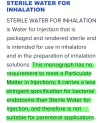

STERILE WATER FOR INHALATION
 www.pharmaceuticalguideline.com
bananafeet
Member
Cheers mate. I usually make my bac water by putting the BA and 10ml of water in a 10ml syringe. Then push it through a .22um syringe filter into a sterile vial. Then I push another 10ml through the filter to make sure all the BA has gone through.Try to get Sterilized Water for Injection to make your BAC, if possible.
Sterile Water for Inhalation is a lower standard than for injection.
View attachment 338289
STERILE WATER FOR INHALATION
I'll see if I can track some down. But anything drug related is heavily controlled here. Bac water can't be easily purchased, nor can SWI.
Anyone feel with insomnia on Tirz. A day after injection I wake up around 12-1 and toss and turn/state at the ceiling all night. It's absolutely awful. Had to load up on unisom just to get some sleep.
Thinking about moving to Reta, stopped the Tirz for now but dang eating cookies and ice cream on a bulk lol.
Hoping to not get this side from Reta. I know it's not a common site but when searching on places like Reddit it comes up a good bit.
Thinking about moving to Reta, stopped the Tirz for now but dang eating cookies and ice cream on a bulk lol.
Hoping to not get this side from Reta. I know it's not a common site but when searching on places like Reddit it comes up a good bit.

Eddie.
Member
Hoping to not get this side from Reta. I know it's not a common site but when searching on places like Reddit it comes up a good bit.
From what I've read this is more common with reta than any other GLP. You could try it but be prepared. I'm thinking moving to tirz and try it out just for for the sleep issues I'm having with reta.
I was wondering why my t4 was like 5% over range of my lab test they use interesting stuff, also someone knows why i wake up and have isane urge to pee on reta during night like every2 hours ? Saw a Lot of people with this expierence but no solutions just that the glucagon probably does that ? So i switched from reta to trizz and also my heartbeat went from like 90-95 to 70-80 withen a week
Dont think anything will change for better since reta is almost the same stuff with glucagon on top of itAnyone feel with insomnia on Tirz. A day after injection I wake up around 12-1 and toss and turn/state at the ceiling all night. It's absolutely awful. Had to load up on unisom just to get some sleep.
Thinking about moving to Reta, stopped the Tirz for now but dang eating cookies and ice cream on a bulk lol.
Hoping to not get this side from Reta. I know it's not a common site but when searching on places like Reddit it comes up a good bit.
I actually would welcome some insomnia. It's my second try with tirz and while I really like the effects it has, I'm literally dragging ass. I fall asleep almost immediately when I sit down. I plan to switch to reta after holiday and hopefully it will get better with itAnyone feel with insomnia on Tirz. A day after injection I wake up around 12-1 and toss and turn/state at the ceiling all night. It's absolutely awful. Had to load up on unisom just to get some sleep.
Thinking about moving to Reta, stopped the Tirz for now but dang eating cookies and ice cream on a bulk lol.
Hoping to not get this side from Reta. I know it's not a common site but when searching on places like Reddit it comes up a good bit.
Similar threads


- Replies
- 8
- Views
- 379

- Replies
- 10
- Views
- 97
- Question
- Replies
- 7
- Views
- 513

- Replies
- 7
- Views
- 603
A
