Earthquake

Winner of proof the media is in meltdown mode comes from Fox News. It won't be on their front page long but here is what it says:

URGENT: Diplomat says nuke fallout has reached California but readings indicate it's not at threatening level

Of course, the word URGENT is in red. Now read the rest. In light of what we know today about Chernobyl, what we are seeing here is a replay of that as far as the obvious - that radiation levels fall of rapidly with distance by being dispersed. There are thousands of miles between us an Japan and, believe it or not, the earth is a really big place and the volume of the atmosphere is really big too. It does not take a genius to figure that out. So after URGENT we learn that nuclear fallout has reached California!!! Egads! But wait, it is not at a threatening level. It's like going to the doctors, hearing you have cancer, and then the doc says, "Wait, sorry old chap, your fine. Wrong chart". There is nothing URGENT about the announcement at all. In fact, it is rather boring by now for those who understand the threat to the U.S. is a non-threat to the U.S.

Yawn. Urgent my ass. I have a more urgent need to take a piss right now.
 
Experts knock notion of burying Japanese reactors
http://online.wsj.com/article/APb7ea676a45ce4415a1e88d9eb6f75136.html

MARCH 18, 2011

Why not just bury them?

The idea of smothering and sealing Japan's overheated nuclear reactors in sand or concrete to stop the crisis is appealing. But experts say that it's too early for something that desperate and that it could be a big mistake that could make matters worse.

Most urge continuing the current efforts to cool the radioactive material, and at least one suggested massive spraying to hold down radioactive dust.

Fires, explosions or partial meltdowns have struck four of the six reactor units at the Fukushima Dai-ichi power plant. There are few options for stopping the dangerous overheating of nuclear materials there. Military fire trucks sprayed tons of water Friday, and workers hope to restart cooling systems once a new power line is installed.

Reporters in Japan raised the notion Friday of sealing the reactors and fuel rods in concrete as an emergency measure. But officials with Japan's nuclear safety agency and the plant's operator did not embrace the idea.

"We believe it is not a realistic option," said Hidehiko Nishiyama of the Nuclear and Industrial Safety Agency. And Teruaki Kobayashi, a manager at the Tokyo Electric Power Co., said the utility would not rule out entombing the reactors but thinks the probability is low.

It's true that concrete tombs may someday stand at the troubled nuclear complex, one expert said, but only as a long-term strategy once the radiation has cooled.

The entombment idea has been touted on American television by Michio Kaku, a physics professor at the City College of New York and a television host on the Science Channel. He has talked about dumping a combination of boric acid to dampen the nuclear fission, sand and eventually concrete to seal off the nuclear material.

Such a massive effort would take days if not weeks to plan, so he argues preparation should start now in case it becomes necessary. He envisioned an armada of helicopters and workers to dump sand and then concrete to smother the spent-fuel pool and other damaged nuclear material.

But experts see risk. For one thing, the structures that confine the radioactivity now could be damaged if heavy loads of material are dumped on them, opening new avenues for the hazard to escape.

"When you drop tons of material from hundreds of feet in a helicopter, you're going to do some damage," said Alex Sich, a nuclear engineer at Franciscan University in Ohio. "It could be a bad idea. ... I would ask them to stop and think three times before they do any dumping of heavy materials."

Sich, who has lived in Chernobyl and published research on the disaster there, noted that Russian authorities dumped some 5,000 tons of sand, clay and other materials from helicopters in an attempt to smother that dangerous reactor.

The Japanese situation is different, he said. The Japanese reactors are surrounded by multiple barriers designed to contain radiation from the reactor cores. If a heavy dumping cracked the inner vessels and exposed the reactor cores, "that would be absurdity," he said.

Other risks focus on the spent fuel rods, which are a key source of concern. While pouring tons of sand on the rods would block radiation from escaping, it would also insulate them and make them heat up faster. The heat could decompose the concrete floor, allowing the rods to fall through, which could complicate efforts to contain the radiation, said Elmer Lewis of Northwestern University.

Sich suggested it might be better to spray the reactor with dust-suppressing materials from helicopters, as was done at Chernobyl. Dust is one way for radioactivity to spread great distances.

Maybe sprayers could be installed to continuously tamp down dust, he said, while acknowledging the installation would further expose workers to radiation.

Lewis, who has consulted frequently on nuclear reactor issues for U.S. national labs, said the time for concrete tombs might come once the radioactive materials have cooled — a process that could take years.

At that point, it might prove too expensive to safely remove the building materials and bury them, he said. It might make more sense to cover the remains with concrete or some other material to seal in the lingering radiation, he said.

But as for now, he and others said, the idea of massive sand dumps looks too risky.

"If you thought all was lost, perhaps in that instance it might make sense," said Travis Knight, acting director of the nuclear engineering program at the University of South Carolina. "I don't see it coming to that at all."

David Lochbaum, nuclear safety director at the Union of Concerned Scientists and often a critic and watchdog on nuclear energy, also called the idea of sealing in the reactors or fuel pool something to be done "only when hope runs out."

And he believes there is still hope.
 
You seem confident that there is no risk. I cant help but note many that are technically inclined are steadily spewing how this ordeal is no big deal.!?!?? Perhaps you could provide some information and detail why you think this is so over rated. It would certainly help me sleep better if you could.

I think many of the confident this is overhyped are discounting the randoms.
(1) One good explosion in #3 unit and we may see some real nasty come over.
(2) No one really knows what they had cooking, or stored for that matter.
(3) If they mess around too long and the reactors burn through the concrete cast/barrier, there will be massive burn and smoke as it enters the earth. This irradiated smoke WILL make it and all over the US.
(4) If a single unit gets out of control, they are likely to loos control off all the units in the area.
(5) What if there is another quake, stronger, or after shock?

Personally I do think that when it happens there wont be any time to sit around and argue it. We will be one of those "washed away" as they were. Which really makes this sickening as what it we actually watched it happen this slowly....

This thing is one missed step away from a mega disaster. I think Period. The only thing they are correct about is that this is nothing like Chernobyl. Thats not neccessarily a good thing.... Statistics are being used like cheap whores at this point. I saw a quote comparing a certain level with a chest xray. They fail to mention the exposure is all in one tiny area and not spread throughout the torso. They talk about safe limits regarding statistical releases. Do YOU want a single particle of Plutonium in your chest?!!!??

Not to be obstinent, negative, or confrontational really. I would just like some releaf from this. If these get to the point that they have to pour the cement, the north portion of the country could possibly rendered wasted. Are you going to buy anything from Japan again without a geigercounter? Food. One single particle of Plutonium with a 25K year half-life says enough. The world is in a sad state. I dont want to eat the Tuna, that ate the fish, that ate the bottom feeder, that ate the plutonium. Do you eat out? Consider where your soft drinks are made, wheat is harvested, what country are the cows graizing in that your steak was cut from. I just cant say enough about the OBVIOUS Severity and you seem to be promoting to common rhetoric propaganda "that nothing has been done wrong".

Do you really think people died of cancer 400 years ago?? NOT....

Winner of proof the media is in meltdown mode comes from Fox News. It won't be on their front page long but here is what it says:


Of course, the word URGENT is in red. Now read the rest. In light of what we know today about Chernobyl, what we are seeing here is a replay of that as far as the obvious - that radiation levels fall of rapidly with distance by being dispersed. There are thousands of miles between us an Japan and, believe it or not, the earth is a really big place and the volume of the atmosphere is really big too. It does not take a genius to figure that out. So after URGENT we learn that nuclear fallout has reached California!!! Egads! But wait, it is not at a threatening level. It's like going to the doctors, hearing you have cancer, and then the doc says, "Wait, sorry old chap, your fine. Wrong chart". There is nothing URGENT about the announcement at all. In fact, it is rather boring by now for those who understand the threat to the U.S. is a non-threat to the U.S.

Yawn. Urgent my ass. I have a more urgent need to take a piss right now.
 
Last edited:
The moment nuclear plant chief WEPT as Japanese finally admit that radiation leak is serious enough to kill people
Nuclear plant chief weeps as Japanese finally admit that radiation leak is serious enough to kill people | Mail Online


9041


Boiled dry: This shot shows of the inside of reactor number four at the Fukushima nuclear plant before the disaster. The spent fuel storage pool is seen at the front of the shot. The rods are at the bottom of the pool, which has now boiled dry


9043


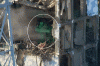
Exposed: this shots shows a gaping hole in the building of reactor number four. The green crane, circled, is normally used to move spent fuel rods into a 45ft deep storage pond, just out of shot. But the pool has now boiled dry and the spent rods are heating up and releasing radiation
 

Attachments

  • PRE-REACTOR 4.jpg
    PRE-REACTOR 4.jpg
    99.9 KB · Views: 14
  • REACTOR-4.gif
    REACTOR-4.gif
    254.3 KB · Views: 14
Six Ways Fukushima is Not Chernobyl
http://tpmlivewire.talkingpointsmemo.com/2011/03/six-ways-fukushima-is-not-chernobyl.php?ref=fpb
 
Japan Confirms High Radiation in Spinach and Milk Near Nuclear Plant
http://www.nytimes.com/2011/03/20/world/asia/20japan.html?_r=1&hp

By KEN BELSON and HIROKO TABUCHI
Published: March 19, 2011

TOKYO — The government said Saturday that it had found higher than normal levels of radioactive materials in spinach and milk at farms near the ravaged nuclear power plants, the first confirmation by officials that the nuclear crisis unfolding at power plants nearby has affected the nation’s food supply.

While officials downplayed the immediate risks to consumers, the findings are likely to further unsettle a nation worried about the long-term effects of the damaged nuclear power plants. The crisis, which has entered its second week, has caused alarm in some countries that fallout from Japan might reach their shores.

Tokyo Electric Power Company, with help from the Japan Self-Defense Force, police and firefighters, continued efforts to cool the damaged reactors on Saturday. About 500 workers from the utility connected a transmission line almost a mile long to Reactor No. 2 at the Fukushima Daiichi Power Station. They hope to restart a cooling system there on Sunday.

Restoring power at the reactor could provide a glimmer of hope after days of increasingly dire news that now includes contaminated food. Yukio Edano, the chief cabinet secretary, said that spinach and milk were the only two products that were found with abnormally high levels of radioactive materials. The newly discovered radioactivity contained in the average amount of spinach and milk consumed during an entire year would be equal to the amount received in a single CAT scan.

“These levels do not pose an immediate threat to your health,” Mr. Edano said, adding that the Health, Labor and Welfare Ministry would provide additional details. “Please stay calm.”

The government is considering conducting more comprehensive tests of agricultural products from areas further away from the damaged reactors to address public anxiety about the country’s food supply, he said.

Food safety inspectors said that the amount of iodine-131 found in the tested milk was five times higher than levels deemed safe. They said that the iodine found in the spinach was more than seven times higher. The spinach also contained slightly higher amounts of cesium-137.

Iodine-131 and cesium-137 are two of the more dangerous elements that are feared to have been released from the plants in Fukushima. Iodine-131 can be dangerous to human health, especially if absorbed through milk and milk products, because it can accumulate in the thyroid and cause cancer. Cesium-137 can damage cells and lead to an increased risk of cancer.

Health inspectors are still trying to determine whether any spinach had been shipped from the six farms in Ibaraki Prefecture where the contaminated produce was found, according to Taku Ohara, an official in the food safety division of the Health, Labor and Welfare Ministry. No contaminated milk had been shipped from the three farms where higher than normal radioactive levels had been detected.

Mr. Ohara said that Japan is particularly strict in determining what constitutes safe radioactive levels. It is also fastidious in inspecting food imported from China and other countries. Leafy spinach is especially susceptible to absorbing radioactive material, Mr. Ohara said.

Asparagus, cucumbers, radish, tomatoes and other vegetables are also grown in Fukushima, but have not been found to be contaminated. However, only a small number of farms have been tested because officials have been overwhelmed in the wake of the earthquake, tsunami and the nuclear crisis that followed, Mr. Ohara said.

The government has not banned shipments of milk or spinach from the affected areas, but it would further study the issue, Mr. Edano said. The milk that contained higher levels of radioactive material was tested at farms about 19 miles from the hobbled nuclear plants in Fukushima Prefecture. The spinach was found in Ibaraki Prefecture farther south.

Though land-poor Japan imports much of the fruit, grain and soybeans that it consumes, 79 percent of the vegetables eaten here are grown domestically. Japan is the largest net importer of food in the world.

A handful of vegetable shop owners in Tokyo interviewed on Saturday said they were concerned about the impact of the nuclear crisis on their supplies, but they continued to sell vegetables from Fukushima and Ibaraki because they have not been told otherwise.

However, the news of the contamination had an immediate impact on consumers. Katsuko Sato, 76, said she would stop buying spinach and, after watching Mr. Edano’s news conference, she called her family and friends to urge them not to, either.

“Everything that we are going through now is a lot scarier than the bombing attacks during World War II,” she said. “I’m not going to believe the government because I don’t think only spinach from Ibaraki will be affected.”

There have been no reports of contaminated fish or meat.

Many of the ports, fleets and processing facilities in Tohoku, the area most affected by the tsunami and nuclear crisis, were so badly damaged that no fish or seafood has reached Tsukiji market in central Tokyo, according to the market’s general manager, Tsutomo Kosaka. The market handles 90 percent of the seafood for about 40 million consumers in the greater Tokyo area.

Japan’s leading producers of premium beef, including the world-famous Kobe brand, said Saturday that they had not yet tested their cattle or feed. But they were nervous about the possible spread of radiation from Fukushima.

“Even though the government hasn’t mentioned the possibility of contamination of beef, we should start testing to convince people the beef is safe,” said Hiroshi Uchida, a former professor of agriculture who is director of the national cattle museum in Iwate Prefecture, about 150 miles north of the damaged reactors in Fukushima. “We need scientific proof and hard data to protect the beef brand.”

While only spinach and milk were found to have radioactive materials above established limits, some countries have been testing food imports from Japan since the day after the quake and tsunami. In Hong Kong, for instance, 216 Japanese products passed food-quality screenings, including meat, fish, fruits and vegetables.

In Japan, the damage to the reactors has reduced the electricity supply in the greater Tokyo region, leading to rolling blackouts that have slowed business activity.

The government is rushing to find a way to cool the damaged reactors in Fukushima to prevent a full-scale meltdown. In a news conference on Saturday, Defense Minister Toshimi Kitazawa said that temperatures outside the four hobbled nuclear reactors in Fukushima were lower than expected, but he was unable to confirm how hot it was inside the damaged buildings, leaving open the possibility that nuclear fuel may still be overheating.

Temperatures were below 212 degrees Fahrenheit based on readings taken by firefighters from the Self-Defense Force that drove trucks with water cannons to within about 60 feet of the No. 3 reactor on Friday.

Mr. Kitazawa said that the temperature readings had increased hopes that the nuclear fuel could be kept cool through further efforts to spray the reactors with water, while technicians worked on restoring power to the cooling systems.

“What we are ultimately working toward is getting to a point where water is continuously pouring into the reactors,” he said, adding that engineers were also working to find a way to assess water levels inside the reactors, which were currently unapproachable by workers because of high levels of radiation.

The National Police Agency said on Saturday that there were nearly 7,200 confirmed deaths so far because of the earthquake and tsunami last week, and nearly 11,000 people remained missing. Authorities have said they expect the final death toll to exceed 10,000.
 
Last edited:
Special Report: Radiation fears may be greatly exaggerated
http://www.reuters.com/article/2011/03/18/us-japan-quake-radiation-health-idUSTRE72H6IZ20110318


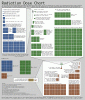
Radiation Dose Chart
http://xkcd.com/radiation/

9045
 

Attachments

  • radiation.gif
    radiation.gif
    216.3 KB · Views: 15
Last edited:
Ladies and Gentlemen, the meltdown that never occurred is over, and all it took was - not a few experts being interviewed in the news media - but a few bombs being dropped in Libya. The whole thing was a media meltdown, just like Global Warming is a science meltdown. BS all over the place with plenty to go around: Japan: whatever happened to the nuclear meltdown? – Telegraph Blogs

Read the whole story. I should wake you up. The media machine and political machine have hijacked real science and turned it into a sideshow filled with idiots telling other idiots what they want to hear.
 
Spent Fuel Hampers Efforts at Japanese Nuclear Plant
http://www.nytimes.com/2011/03/23/world/asia/23japan.html?hp

By HIROKO TABUCHI, DAVID JOLLY and KEVIN DREW
Published: March 22, 2011

TOKYO — Workers at Japan’s ravaged nuclear power plant on Tuesday renewed a bid to bring its command center back online and restore electricity to vital cooling systems but an overheating spent fuel pool hampered efforts and raised the threat of further radiation leaks.

The storage pool at Fukushima Daiichi Power Station’s No. 2 Reactor, which holds spent nuclear fuel rods, was spewing steam late Tuesday, forcing workers to divert their attention to dousing the reactor building with water. If unchecked the water in the pool could boil away, exposing the fuel rods and releasing large amounts of radiation into the air.
 
Tokyo water unsafe for infants after high radiation levels detected
Japanese capital's water supply contains twice the safe level of radioactive iodine for young children, say the authorities
Tokyo water unsafe for infants after high radiation levels detected | World news | guardian.co.uk

Tests conducted by the Tokyo metropolitan government identified 210 becquerels of iodine-131 per 1kg of tap water in the city, more than twice the limit of 100 becquerels considered safe for infants.

Tokyo's water bureau said babies and infants under the age of one should not be given tap water, but added that radiation levels did not pose an immediate risk to adults. "This is without doubt, an effect of the Fukushima Daiichi plant," a metropolitan government official said.
 
Reactor Core At Japan's Fukushima Dai-ichi Nuclear Plant May Have Been Breached

TOKYO -- Japanese nuclear safety officials said Friday that they suspect that the reactor core at one unit of the troubled Fukushima Dai-ichi nuclear power plant may have breached, raising the possibility of more severe contamination to the environment.

"It is possible that somewhere at the reactor may have been damaged," said Hidehiko Nishiyama, a spokesman for the nuclear safety agency. But he added that "our data suggest the reactor retains certain containment functions," implying that the damage may have occurred in Unit 3's reactor core but that it was limited.

Officials say the damage could instead have happened in other equipment, including piping or the spent fuel pool.

Operators have been struggling to keep cool water around radioactive fuel rods in the reactor's core after the March 11 earthquake and tsunami cut off power supply to the plant and its cooling system.

Damage could have been done to the core when a March 14 hydrogen explosion blew apart Unit 3's outer containment building.

This reactor, perhaps the most troubled at the six-unit site, holds 170 tons of radioactive fuel in its core. Previous radioactive emissions have come from intentional efforts to vent small amounts of steam through valves to prevent the core from bursting. However, releases from a breach could allow uncontrolled quantities of radioactive contaminants to escape into the surrounding ground or air.

Operators stopped work Friday at units 1 through 3 to check on radiation levels.


Japan urges more evacuations as Prime Minister Kan addresses nation
Japan urges more evacuations as Prime Minister Kan addresses nation - The Washington Post

TOKYO-Japan on Friday expanded the evacuation zone around the crippled Fukushima Daiichi nuclear power plant, urging residents living within 19 miles of the facility to leave and saying radiation fears make it increasingly difficult to bring in basic supplies.
 
Last edited:
Japan Radiation Map Roundup
Japan Radiation Map Roundup - ScienceInsider


There are now hundreds of radiation-related feeds from Japan on Pachube, monitoring conditions in realtime and underpinning more than half a dozen incredibly valuable applications built by people around the world. They combine 'official' data, 'unofficial' official data, and, most importantly to us, realtime networked geiger counter measurements contributed by concerned citizens. Pachube - data infrastructure for the Internet of Things - Listing feeds
 
Countering Radiation Fears With Just the Facts
http://www.nytimes.com/2011/03/29/science/earth/29brenner.html

By DENISE GRADY
Published: March 26, 2011


As soon as David J. Brenner heard about the undersea earthquake and subsequent tsunami that devastated northern Japan on March 11, he checked a map of the region’s nuclear power plants. One, because of its coastal location and reactor design, looked particularly vulnerable: Fukushima Daiichi. He hoped he was wrong.

Less than a day later, ominous reports of failed cooling systems and radiation leaks at that plant began to emerge. Dr. Brenner, director of the Center for Radiological Research at Columbia University — the oldest and largest such center in the world — found himself called on repeatedly to explain what was happening with the failed reactors and to assess the radiation risk to public health, both in Japan and around the world.

Dr. Brenner, 57, a native of Liverpool, England, is a physicist who has spent his career studying the effects of radiation on human health. He has published research showing that CT scans increase the cancer risk in children, and he recently testified before Congress, saying that the widespread use of whole-body X-ray scanners at airports would produce 100 extra cases of cancer each year in the United States.

He thinks CT scanners and the people who use them need more regulation to make sure the scans are medically needed and the doses of radiation as low as possible. He believes that even low doses increase the risk of cancer, and that there is no “safe” level or threshold below which the risk does not rise — even if that risk cannot be measured statistically.

But for all his concern about potential harm from radiation, he does not foresee a public health disaster resulting from the crisis at Fukushima Daiichi.

From the start, he has spoken with a scientist’s caution, respect for facts and numbers, and keen appreciation of how much is simply not known or, at this point, even knowable. The situation changes constantly, and the path to the truth can be dicey, twisting through parties with passionate agendas for or against nuclear power, information meted out by government and industry, and public fears of radiation that many scientists consider wildly exaggerated.

How to explain the facts without scaring people needlessly? How to reassure without seeming to sugar-coat or patronize? The last thing people want, Dr. Brenner said, is a guy like him in a white coat on TV smugly telling them everything is fine.

“People are very worried, which is not surprising,” he said. “We want people to be able to make some kind of realistic assessment.”

In the week or so after the earthquake, he did about 30 interviews with reporters, he said, “some good, some dreadful.”

Some interviewers tried to push him to say the danger was much greater than he believed it to be. He resisted, and canceled one appearance when he realized that the host group had a strong anti-nuclear agenda.

“I try to keep my political views separate from my academic life,” he said.

Asked whether he was for or against nuclear power, he paused, then said, “I think there is a role for safe nuclear power.”

From the beginning of the troubles at Fukushima Daiichi, he has said that the Japanese plant is not, and will not become, Chernobyl. The Soviet reactor, which had no real containment structure, blew up in 1986 and spewed its contents far and wide. The Japanese reactors, though damaged, do have containment vessels, and the government acted quickly to evacuate people from the areas around the plant.

But he thinks the events in Japan should be a call to action for the United States. “This country and Japan have a fleet of aging nuclear reactors,” he said.

Early on, Dr. Brenner said that Fukushima Daiichi would probably turn out to be similar to the 1979 Three Mile Island accident in the United States, which has never been found to have effects on public health. As conditions deteriorated at the Japanese plant, he said he thought the outcome would be somewhat worse than that at Three Mile Island, but not much worse.

But he expects cases of radiation sickness among the workers at the contaminated plant, and, he added, “I fear there will be fatalities.”

He said it was possible that there would be some cases of thyroid cancer — probably too few to prove a connection statistically — years from now among people exposed as children to milk, water or produce contaminated with radioactive iodine.

So far, it seems unlikely that the accident will create a vast uninhabitable zone in Japan like the one that Chernobyl left in what is now Ukraine, Dr. Brenner said. Extensive fallout of radioactive cesium occurred at Chernobyl, and it takes many years to decay to safe levels. That kind of fallout has not occurred in Japan.

Over all, he said he thought the Japanese government was doing a good job of providing reliable information to the public — but that it has not always done so. At first, there was a delay in releasing radiation readings around the plant. And when officials announced that radioactive iodine had been found in milk and vegetables, and yet initially declared them safe, Dr. Brenner said, he “screamed loud” and spoke out to reporters about it. There was simply no reason to risk consuming them, he said.

Radioactive iodine is taken up by the thyroid gland, particularly in children, and a vast majority of the 6,000 cases of thyroid cancer caused by the Chernobyl accident occurred because people were not told to stop giving their children local milk. The milk was contaminated because it was produced by cows grazing on grass coated with fallout.

Potassium iodide pills are widely recommended to protect the thyroid gland from radioactive iodine, but Dr. Brenner said it was better just to stop drinking milk until the threat had passed.

His message changed, however, when radioactive iodine turned up in tap water in Tokyo. Though the public was advised that babies, children and pregnant women should not drink the water, Dr. Brenner conceded that some exposure might still be hard to avoid, and that using potassium iodide was a reasonable precaution.

“I’ve been maybe a little overstrong in saying that potassium iodide doesn’t have a role to play,” he said. “But usually the problem is milk. To me, the levels in water came as a surprise.”

In recent years Dr. Brenner’s research has focused on responses to terrorism. He finds himself in the odd position of having directed the development of a machine that he hopes will never be used, the Rapid Automated Biodosimetry Tool, or Rabit. Its purpose is to test blood samples — up to 30,000 a day — for signs that people have been exposed to a significant dose of radiation.

The Rabit was meant to be used in the event of a terrorist attack — a dirty bomb, for instance — in which large numbers of people fearing they had been exposed to radiation might overwhelm clinics and emergency rooms. Small blood samples could be drawn at many locations and sent to the Rabit; people with signs of exposure could be monitored and treated if necessary.

The radiation releases in Japan so far have been much lower than what the Rabit was designed for.

He may have inherited his knack for industrial design from his maternal grandfather, a mechanical engineer who was one of the inventors of the Kit Kat candy bar and the machinery to mass-produce it.

His office holds two prized possessions: a 1961 photograph of John Lennon and George Harrison with Stuart Sutcliffe, the Beatles’ original bass player; and the desk used by the first director of the Columbia radiological center, in 1915. It came with a drawerful of tobacco pipes.

On a recent afternoon, the venerable desk was strewn with maps and graphs of radiation levels around the Fukushima plant. Unable to find the one he wanted, Dr. Brenner accused a colleague of having made off with it, and was cheerfully rebuffed. Television interviews were scheduled and a photographer was on the way; he winced and said that lately he had had no time for a haircut.

 
Radiation in Mass. rainwater likely from Japan [As in Boston, Massachusetts.]
Radiation in Mass. rainwater likely from Japan

BOSTON — Health officials said Sunday that one sample of Massachusetts rainwater has registered very low concentrations of radiation, most likely from the Japanese nuclear power plant damaged earlier this month by an earthquake and tsunami.

John Auerbach, the Massachusetts commissioner of public health, said that radioiodine-131 found in the sample – one of more than 100 that have been taken around the country – has a short life of only eight days. He said the drinking water supply in the state was unaffected and officials do not expect any health concerns.

Nevada and other Western states also have reported minuscule amounts of radiation, but scientists say those presented no health risks.

The Massachusetts Department of Public Health said the in-state sample was taken in the past week, but they did not say where. The testing is part of a U.S. Environmental Protection Agency network that monitors for radioactivity.

State officials said similar testing was done in California, Pennsylvania, Washington and other states, and showed comparable levels of I-131 in rain.

Massachusetts testing last week of samples from the Quabbin and Wachusett reservoirs showed no detectable levels of I-131, health officials said.

Energy and Environmental Affairs Secretary Richard K. Sullivan Jr. directed the Department of Environmental Protection to collect additional samples for testing from several water bodies across Massachusetts. Results will be available over the next several days.

In Japan, mounting problems, including miscalculated radiation figures and inadequate storage tanks for huge amounts of contaminated water, stymied emergency workers Sunday as they struggled to bring the country's nuclear complex back from the edge of disaster. Workers were trying to remove radioactive water from the nuclear compound and restart the regular cooling systems for the dangerously hot fuel.
 
Back
Top