eating raw eggs

This is the most reasonable argument I've seen offered on this thread. The truth is that people are unhealthy because they are too fat, and they don't exercise enough.

IMO, exercise is more important than exactly what the percentages of carb / fat / protein are. If you are getting enough exercise, and you don't over eat, you'll probably never get type II diabetes or heart disease unless you've got really bad genetics, regardless of whether you follow a low fat diet, a low carb diet, or whatever other fad pops up. If you don't get enough exercise, then it becomes much more important to watch where your calories come from (I'd go as far as saying that anyone that doesn't get a decent amount of daily exercise should be on a low-carb diet --- if you're not exercising, why do you need the glycogen stores anyway?)

I agree with you on the increased importance of macronutrient ratios for sedentary individuals but not necessarily that exercise is the solution for poor dietary habits in a eucaloric state.

I think too many people exercise so that they can eat poorly. I'm not sure this can prevent susceptible individuals from suffering from cardiovascular disease, etc
 
I agree with you on the increased importance of macronutrient ratios for sedentary individuals but not necessarily that exercise is the solution for poor dietary habits in a eucaloric state.

I think too many people exercise so that they can eat poorly. I'm not sure this can prevent susceptible individuals from suffering from cardiovascular disease, etc

I don't think that exercise gives you the freedom to eat without consequence either, but I do think that exercise is a great way to maintain insulin sensitivity. If you can maintain insulin sensitivity, then you at least are afforded some protection from type II diabetes, and its health consequences. I don't doubt there are other ways to get CVD, but the metabolic syndrome seems to be a very popular route.

If someone is sedentary, then they can lose insulin sensitivity over the years unless they compensate with their diet, which is why I think that sedentary people should go low-carb.

I have not seen any data that shows the effects of diet on physically well-trained people (other than insulin-sensitivity and workout-recovery studies), but it would certainly help to isolate some variables involving the consequence of diet.
 
I don't think that exercise gives you the freedom to eat without consequence either, but I do think that exercise is a great way to maintain insulin sensitivity. If you can maintain insulin sensitivity, then you at least are afforded some protection from type II diabetes, and its health consequences. I don't doubt there are other ways to get CVD, but the metabolic syndrome seems to be a very popular route.

If someone is sedentary, then they can lose insulin sensitivity over the years unless they compensate with their diet, which is why I think that sedentary people should go low-carb.

I have not seen any data that shows the effects of diet on physically well-trained people (other than insulin-sensitivity and workout-recovery studies), but it would certainly help to isolate some variables involving the consequence of diet.

Definitely. More data would be great i.e. trained individuals on eucaloric diets of various compositions, etc.

I agree that if a person isn't going to optimize nutrition--> at least exercise. If not exercise, then focus on nutrition.

Improving exercise or improving diet can improve insulin sensitivity but combined approach is probably superior to either/or approach.

I think that people who focus heavily on their appearance may have a false sense of security regarding their health. They may actually participate in unhealthy behaviors e.g. eat excessive calories only to "make up for it" with excessive exercise and/or severe caloric restriction. Of course, their primary goal is appearance but appearance often equals health for most people. This was the group I had in mind when discussing exercise to make up for poor eating.
 
Damn, take the weekend off and the world goes to hell and I miss all the fun.
No one here has more at stake in this dietary debate than me.
Ive looked at a lot of evidence and some things are abundantly clear.

Sugar bad- FHCS even worse-NAFLD- raises vldl
Simple carbs bad- wildly fluctuctating insulin or chronically high bad
Complex carbs good- stable insulin
Too much omega 6 FA bad as it shifts the arachadonic acid metabolism toward inflammation
Too much inflammation bad- causes and worsens CVD/ PVD
High TG/VLDL bad - raised by simple carbs
SF good -not per se but halps maintain omega essential FA balance
 
Definitely. More data would be great i.e. trained individuals on eucaloric diets of various compositions, etc.

I agree that if a person isn't going to optimize nutrition--> at least exercise. If not exercise, then focus on nutrition.

Improving exercise or improving diet can improve insulin sensitivity but combined approach is probably superior to either/or approach.

I think that people who focus heavily on their appearance may have a false sense of security regarding their health. They may actually participate in unhealthy behaviors e.g. eat excessive calories only to "make up for it" with excessive exercise and/or severe caloric restriction. Of course, their primary goal is appearance but appearance often equals health for most people. This was the group I had in mind when discussing exercise to make up for poor eating.

I've met plenty of these types as well, so I know where you are coming from when you say some people equate "looking good" with being healthy. And I agree that just like there is such a thing as unhealthy eating, there is such a thing as unhealthy exercise as well --- in a way, going on an "exercise binge" to make up for binge eating is a double insult to the body.

Also, there are those people who regularly practice extreme endurance exercise (i.e. the kind that goes on for hours and hours)... This type of exercise will actually decreases insulin sensitivity in the short term, as paradoxical as that sounds. Not to mention the effects on the immune system, catabolism, inflammation, etc... Sure, they're lean as hell, but on the inside...
 
This is the most reasonable argument I've seen offered on this thread. The truth is that people are unhealthy because they are too fat, and they don't exercise enough.

IMO, exercise is more important than exactly what the percentages of carb / fat / protein are. If you are getting enough exercise, and you don't over eat, you'll probably never get type II diabetes or heart disease unless you've got really bad genetics, regardless of whether you follow a low fat diet, a low carb diet, or whatever other fad pops up. If you don't get enough exercise, then it becomes much more important to watch where your calories come from (I'd go as far as saying that anyone that doesn't get a decent amount of daily exercise should be on a low-carb diet --- if you're not exercising, why do you need the glycogen stores anyway?)

I agree with you on the increased importance of macronutrient ratios for sedentary individuals but not necessarily that exercise is the solution for poor dietary habits in a eucaloric state.

I think too many people exercise so that they can eat poorly. I'm not sure this can prevent susceptible individuals from suffering from cardiovascular disease, etc

I think where people on this thread disagree is whether or not it is even possible for a high-carb / low-fat diet to be healthy. That's what I was trying to get at here --- For people that exercise regularly, I see nothing wrong with the high-carb / low-fat diet. Of course, if you choose your carbs poorly, you can make it unhealthy. However, so long as you choose low glycemic carbs (with the aforementioned exceptions that are made for the post-workout meal), you can do just fine. I certainly don't recommend this type of diet for the sedentary --- due to the causal link between inactivity and insulin resistance, sedentary types should definitely go low-carb.

And while I'm baiting the argument: there are a few more variables in the equation to consider. While it is hard to quantify how a diet "makes you feel," it is a legitimate concern. Taubes himself says he exercises because "it makes me feel good." Given he's the main guy out there saying that exercising is bad for fat people because it makes them eat too much, that says a lot about how exercise makes you feel.

And there are plenty of anecdotes on the web about how diet X makes you feel like shit while diet Y makes you feel like a god. Here's my (admittedly worthless) anecodtal contribution: you can tell if a low-carb diet is working poorly if you have mood swings, fatigue issues, and headaches: all are associated with high cortisol, which can happen if you are going too low-carb. You can tell if your high-carb diet is working poorly if you have mood swings, fatigue issues, and headaches: all are associated with high cortisol, which can happen if your blood sugar swings wildly. My 2 cents.
 
I think where people on this thread disagree is whether or not it is even possible for a high-carb / low-fat diet to be healthy. That's what I was trying to get at here --- For people that exercise regularly, I see nothing wrong with the high-carb / low-fat diet. Of course, if you choose your carbs poorly, you can make it unhealthy. However, so long as you choose low glycemic carbs (with the aforementioned exceptions that are made for the post-workout meal), you can do just fine. I certainly don't recommend this type of diet for the sedentary --- due to the causal link between inactivity and insulin resistance, sedentary types should definitely go low-carb.

And while I'm baiting the argument: there are a few more variables in the equation to consider. While it is hard to quantify how a diet "makes you feel," it is a legitimate concern. Taubes himself says he exercises because "it makes me feel good." Given he's the main guy out there saying that exercising is bad for fat people because it makes them eat too much, that says a lot about how exercise makes you feel.

And there are plenty of anecdotes on the web about how diet X makes you feel like shit while diet Y makes you feel like a god. Here's my (admittedly worthless) anecodtal contribution: you can tell if a low-carb diet is working poorly if you have mood swings, fatigue issues, and headaches: all are associated with high cortisol, which can happen if you are going too low-carb. You can tell if your high-carb diet is working poorly if you have mood swings, fatigue issues, and headaches: all are associated with high cortisol, which can happen if your blood sugar swings wildly. My 2 cents.

My 2 cents FWIW - the only carbs I'me getting now come from the fruits and veggies I'm eating and the small amount that comes from the yogurt, egg yolks and coconut milk - how low the amount is I can't say but it's lower than it once was

My energy levels are fine - I usually work out 4 days in a row than take a 1 day break - cardio EOD - no headaches, mood swings, etc.
 
Also, there are those people who regularly practice extreme endurance exercise (i.e. the kind that goes on for hours and hours)... This type of exercise will actually decreases insulin sensitivity in the short term, as paradoxical as that sounds. Not to mention the effects on the immune system, catabolism, inflammation, etc... Sure, they're lean as hell, but on the inside...

I find this group very interesting. There is no doubt that extreme endurance athletes, like Lance Armstrong and elite pro road cyclists, are highly trained individuals optimized for sport-specific performance. LIke the sport itself, the nutrition that goes along with it is extreme. For example, when anyone regularly creates a 6,000 to 10,000 kcal deficit per day, as may be the case during the Tour de France, the refeeding involves large amount of carbs often high glycemic index binges. How does this type of diet affect various health parameters? Does the extreme exercise and extreme carb loads negate each other to some extent?
 
I think where people on this thread disagree is whether or not it is even possible for a high-carb / low-fat diet to be healthy. That's what I was trying to get at here --- For people that exercise regularly, I see nothing wrong with the high-carb / low-fat diet. Of course, if you choose your carbs poorly, you can make it unhealthy. However, so long as you choose low glycemic carbs (with the aforementioned exceptions that are made for the post-workout meal), you can do just fine. I certainly don't recommend this type of diet for the sedentary --- due to the causal link between inactivity and insulin resistance, sedentary types should definitely go low-carb.

And while I'm baiting the argument: there are a few more variables in the equation to consider. While it is hard to quantify how a diet "makes you feel," it is a legitimate concern. Taubes himself says he exercises because "it makes me feel good." Given he's the main guy out there saying that exercising is bad for fat people because it makes them eat too much, that says a lot about how exercise makes you feel.

And there are plenty of anecdotes on the web about how diet X makes you feel like shit while diet Y makes you feel like a god. Here's my (admittedly worthless) anecodtal contribution: you can tell if a low-carb diet is working poorly if you have mood swings, fatigue issues, and headaches: all are associated with high cortisol, which can happen if you are going too low-carb. You can tell if your high-carb diet is working poorly if you have mood swings, fatigue issues, and headaches: all are associated with high cortisol, which can happen if your blood sugar swings wildly. My 2 cents.

Great (and useful) info/insight - not just here but elsewhere in the forum! Thanks for sharing. :tiphat
 
My 2 cents FWIW - the only carbs I'me getting now come from the fruits and veggies I'm eating and the small amount that comes from the yogurt, egg yolks and coconut milk - how low the amount is I can't say but it's lower than it once was

My energy levels are fine - I usually work out 4 days in a row than take a 1 day break - cardio EOD - no headaches, mood swings, etc.

So many interesting issues diverging from your OP...

I have my fair share of self-experimentation with diet. This once involved consuming raw eggs - not really for the reasons that are motivating you but simply because I am a lazy eater. I barely had time to physically consume all the calories for my bodybuilding goals at the time much less prepare them. So a glass of raw eggs was an efficient way of getting calories and protein!

This worked pretty well for some time. I was aware of the risk of salmonella and like many things in life, I tend to act on probabilities - this was an acceptable risk to me at the time. I can't remember the exact number, but I'm guestimating that I went through several thousand raw eggs without incident... until I was hit with salmonella. This was several years ago and I haven't dared eat raw eggs again.
 
-snip-.
I have not seen any data that shows the effects of diet on physically well-trained people (other than insulin-sensitivity and workout-recovery studies), but it would certainly help to isolate some variables involving the consequence of diet.

Please read "The Paleo Diet for Athletes" By Cordain for "the effects of diet on physically well-trained people"
 
Please read "The Paleo Diet for Athletes" By Cordain for "the effects of diet on physically well-trained people"

Should You Be Eating Like The Cavemen?


Dr. Eaton, a radiologist, and Cordain, an exercise physiologist, are the father and prodigal son of what's being called Paleolithic eating. They believe evolutionary forces dictate that we will live healthiest when we consume a diet similar to what early man ate 2.5 million years ago during the hunter-gatherer days of the Paleolithic Era. This diet included more (low-fat) proteins and (healthy) fats than most of us eat today, and fewer carbohydrates, mainly because Paleo man ate no wheat, rice, or corn whatsoever. These modern grains were not "invented" until 10,000 years ago. In other words, throughout 99.6 percent of our evolutionary history, we ate no bread, pancakes, pasta, or chow mein. As a result, they say, we aren't adapted to process them healthfully.

Cordain has calculated that about 72 percent of the food consumed by you, me, and our friends was utterly unavailable in Paleo times. Here's an even bigger surprise: Paleo runners got 55 percent of their daily calories from meat, and had no trouble covering almost 10 miles a day tracking down their dinner.

A onetime marathoner and current fitness runner, Cordain first learned about Paleo nutrition in 1985 when the New England Journal of Medicine published a "Special Article" by Dr. Eaton and his colleague Melvin Konner. In that article, the authors concluded that the Paleo diet contained vastly more vitamin C, fiber, calcium, iron, folate, and essential fatty acids than our current supermarket-based fare. It also contained far less sugar, salt, and saturated fats. They concluded: "The diet of our remote ancestors may be a reference standard for modern human nutrition and a model for defense against certain 'diseases of civilization.'"
 
Re SF
The key word is "decreased oxidative stress"

*************

Braz J Med Biol Res. 2004 Mar;37(3):311-20. Epub 2004 Mar 3.

Effect of dietary fat saturation on lipid metabolism, arachidonic acid turnover and peritoneal macrophage oxidative stress in mice.
Oliveros LB, Videla AM, Giménez MS.

Laboratorio de Bioquimica Molecular, Departamento de Bioquimica y Ciencias Biologicas, Faculdade de Quimica, Bioquimica y Farmacia, Universidade Nacional de San Luis, San Luis, Argentina. lolive@unsl.edu.ar

Abstract
We investigated the effects of a saturated fat diet on lipid metabolism and arachidonic acid (AA) turnover in mouse resident peritoneal macrophages. The pro-oxidative effect of this diet was also studied. Female C57BL/6 mice were weaned at 21 days of age and assigned to either the experimental diet containing coconut oil (COCO diet), or the control diet containing soybean oil as fat source (10 mice per group). The fat content of each diet was 15% (w/w). Mice were fed for 6 weeks and then sacrificed. The concentration of total lipids, triglycerides, (LDL+VLDL)-cholesterol, thiobarbituric acid-reactive substances (TBARS) and reduced glutathione were increased in the plasma of mice fed the COCO diet, without changes in phospholipid or total cholesterol concentrations compared to control. The concentrations of total cholesterol, free and esterified cholesterol, triglycerides, and TBARS were increased in the macrophages of COCO-fed mice, while the content of total phospholipids did not change. The phospholipid composition showed an increase of phosphatidylcholine and a decrease of phosphatidylethanolamine. The [3H]-AA distribution in the phospholipid classes showed an increase in phosphatidylcholine and phosphatidylethanolamine. Incorporation of [3H]-cholesterol into the macrophages of COCO-fed mice and into the cholesterol ester fraction was increased. The COCO diet did not affect [3H]-AA uptake but induced an increase in [3H]-AA release. The COCO diet also enhanced AA mobilization induced by lipopolysaccharide. These results indicate that the COCO diet, high in saturated fatty acids, alters the lipid metabolism and AA turnover of peritoneal macrophages in female mice and also produces a significant degree of oxidative stress.

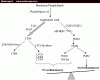
http://img.medscape.com/fullsize/migrated/405/963/ch1185.02.lieb.fig1.gif
 

Attachments

  • ch1185.02.lieb.fig1.gif
    ch1185.02.lieb.fig1.gif
    12.9 KB · Views: 4
Re SF
The key word is "decreased oxidative stress"

*************

Braz J Med Biol Res. 2004 Mar;37(3):311-20. Epub 2004 Mar 3.

Effect of dietary fat saturation on lipid metabolism, arachidonic acid turnover and peritoneal macrophage oxidative stress in mice.
Oliveros LB, Videla AM, Giménez MS.

Laboratorio de Bioquimica Molecular, Departamento de Bioquimica y Ciencias Biologicas, Faculdade de Quimica, Bioquimica y Farmacia, Universidade Nacional de San Luis, San Luis, Argentina. lolive@unsl.edu.ar

Abstract
We investigated the effects of a saturated fat diet on lipid metabolism and arachidonic acid (AA) turnover in mouse resident peritoneal macrophages. The pro-oxidative effect of this diet was also studied. Female C57BL/6 mice were weaned at 21 days of age and assigned to either the experimental diet containing coconut oil (COCO diet), or the control diet containing soybean oil as fat source (10 mice per group). The fat content of each diet was 15% (w/w). Mice were fed for 6 weeks and then sacrificed. The concentration of total lipids, triglycerides, (LDL+VLDL)-cholesterol, thiobarbituric acid-reactive substances (TBARS) and reduced glutathione were increased in the plasma of mice fed the COCO diet, without changes in phospholipid or total cholesterol concentrations compared to control. The concentrations of total cholesterol, free and esterified cholesterol, triglycerides, and TBARS were increased in the macrophages of COCO-fed mice, while the content of total phospholipids did not change. The phospholipid composition showed an increase of phosphatidylcholine and a decrease of phosphatidylethanolamine. The [3H]-AA distribution in the phospholipid classes showed an increase in phosphatidylcholine and phosphatidylethanolamine. Incorporation of [3H]-cholesterol into the macrophages of COCO-fed mice and into the cholesterol ester fraction was increased. The COCO diet did not affect [3H]-AA uptake but induced an increase in [3H]-AA release. The COCO diet also enhanced AA mobilization induced by lipopolysaccharide. These results indicate that the COCO diet, high in saturated fatty acids, alters the lipid metabolism and AA turnover of peritoneal macrophages in female mice and also produces a significant degree of oxidative stress.

http://img.medscape.com/fullsize/migrated/405/963/ch1185.02.lieb.fig1.gif

I love organic coconut milk
 
Re SF
The key word is "decreased oxidative stress"

*************

Abstract
...
The COCO diet also enhanced AA mobilization induced by lipopolysaccharide. These results indicate that the COCO diet, high in saturated fatty acids, alters the lipid metabolism and AA turnover of peritoneal macrophages in female mice and also produces a significant degree of oxidative stress.

I'm a bit confused here. This study seems to indicate that SF increases oxidative stress. Am I missing something?
 
I'm a bit confused here. This study seems to indicate that SF increases oxidative stress. Am I missing something?

'The concentrations of total cholesterol, free and esterified cholesterol, triglycerides, and TBARS were increased in the macrophages of COCO-fed mice, while the content of total phospholipids did not change."
"Incorporation of [3H]-cholesterol into the macrophages of COCO-fed mice and into the cholesterol ester fraction was increased."

I donno yet. They are saying that the SFA diet increases inflammation and implying increased foam cell formation. But the other theory claims that the shift in AA metabolism is in the anti-inflammatory direction. Perhaps the problem with the study is the SFS dstribution. Donno
Ya gotta rely on the metastudies, published on journals or popular lit ,or read them yourself or trust judgement of selected others. This is the sort of thing that makes this a full time job.
I think we ought to refine our conjectures a bit, support our contentions more and achieve something more useful around here that discuss ad-nauseum the best testosterone level.
 
Tell me again...what is it you guys are interested in here?

IIRC, AA can contribute to the production of "bad" prostaglandins, ones that cause inflammation. But prostaglandins that counteract inflammation are also made from AA so it's a double-edged sword.

What I dont remember is in what context either of these results takes place or if it applies in any meaningful way to the paper you're discussing.
 
So many interesting issues diverging from your OP...

I have my fair share of self-experimentation with diet. This once involved consuming raw eggs - not really for the reasons that are motivating you but simply because I am a lazy eater. I barely had time to physically consume all the calories for my bodybuilding goals at the time much less prepare them. So a glass of raw eggs was an efficient way of getting calories and protein!

This worked pretty well for some time. I was aware of the risk of salmonella and like many things in life, I tend to act on probabilities - this was an acceptable risk to me at the time. I can't remember the exact number, but I'm guestimating that I went through several thousand raw eggs without incident... until I was hit with salmonella. This was several years ago and I haven't dared eat raw eggs again.
The above quote is my exact story. And let me tell you, I have heard a few stories just like it too. Now I just try to enjoy my eggs.....scrambled, boiled, in omelet, etc. Just not raw!!!
 
I have learned that the salmonella is on the outside of the eggshell. Putting the eggs down in boiling water for a few seconds eliminates the bacterias.
 

Sponsors

Latest posts

Back
Top

