Increlex?

I wonder if real IGF 1 in combination with HGH could do good stuff for muscle and tendon injuries?

I suppose increlex has been so expensive that no one has really tried to use it for injuries
You may find this info interesting.
 
In fact I don't find anything about insubolic....until recently it was present and available ...
The Insubolic IGF-1 is not on the site because it's out of stock and should be re-stocked in 2 weeks.
The product is relatively new, we've been marketing it since August 2020, had some great feedback when we handed out samples of it 6 month ago. Many people are yet to realize the Insubolic IGF-1 is not a peptide (LR3/DES), but the REAL HUMAN IGF-1.
Logs
 
Many people are yet to realize the Insubolic IGF-1 is not a peptide (LR3/DES), but the REAL HUMAN IGF-1.
Errr bro thats still a peptide. A peptide is just a molecular structure composed of amino acids and bonds. IGF-1 is a peptide, so is HGH.

What your meaning to say is that your Insulbolic is bioidentical human IGF-1, and not a modified structural derivative of IGF-1 such as Long R3 or DES are.

Watchout calling insulbolic not a peptide, because it is, and by saying that its not you run the risk of harming the products credibility, especially in the eyes of chemistry knowledgeable bros. Just some helpful advise bro.

Now.. wheres my free kits for pointing this out???? ;)
 
Errr bro thats still a peptide. A peptide is just a molecular structure composed of amino acids and bonds. IGF-1 is a peptide, so is HGH.

What your meaning to say is that your Insulbolic is bioidentical human IGF-1, and not a modified structural derivative of IGF-1 such as Long R3 or DES are.

Watchout calling insulbolic not a peptide, because it is, and by saying that its not you run the risk of harming the products credibility, especially in the eyes of chemistry knowledgeable bros. Just some helpful advise bro.

Now.. wheres my free kits for pointing this out???? ;)
Hey man

IGF-1, HGH are peptide HORMONES. Let's see the difference between the IGF-1 LR3/DES and IGF-1/HGH. And why I called IGF-1 LR3/DES peptides.

This machine - Peptide Synthesizer is used to create(assemble) peptides from amino acid residue.

libertyblue_product_image_2.png


Proteins (HGH/IGF-1) are not assembled from amino acids residue by a chemical process, but assembled inside the cell or eukaryotes or prokaryotes, which is identical to the proteins created by our own cells.

The manufacturing process of IGF-1/HGH involves cultivation, purification etc, so it becomes identical to our endogenous IGF-1/HGH.

Insubolic (RH-IGF-1) is not a peptide, but a peptide hormone.

RS
 
Hey man

IGF-1, HGH are peptide HORMONES. Let's see the difference between the IGF-1 LR3/DES and IGF-1/HGH. And why I called IGF-1 LR3/DES peptides.

This machine - Peptide Synthesizer is used to create(assemble) peptides from amino acid residue.

libertyblue_product_image_2.png


Proteins (HGH/IGF-1) are not assembled from amino acids residue by a chemical process, but assembled inside the cell or eukaryotes or prokaryotes, which is identical to the proteins created by our own cells.

The manufacturing process of IGF-1/HGH involves cultivation, purification etc, so it becomes identical to our endogenous IGF-1/HGH.

Insubolic (RH-IGF-1) is not a peptide, but a peptide hormone.

RS


Hey i just learned something. So anything over 50aa is no longer called a peptide rather a protein. But then long R3 IGF-1 is a protein not a peptide too, per that naming nomenclature criteria. As long r3 has more aa than bioidentical igf-1. So technically nobody should be calling it a peptide i guess, as its structural complexity makes it classified as a protein. All these years ive called it a peptide, just learned its technically called a protein. I now vow to annoyingly correct everyone i see who calls anything over 50aa a peptide.

Hey bro, can you explain why there is 191aa HGH and why there is 192aa HGH?

Only 191aa is biodentical, so whats with the 192aa, why is there an extra amino acid? Is it something to do with the manufacturing process? Do you know why?
 
Hey i just learned something. So anything over 50aa is no longer called a peptide rather a protein. But then long R3 IGF-1 is a protein not a peptide too, per that naming nomenclature criteria. As long r3 has more aa than bioidentical igf-1. So technically nobody should be calling it a peptide i guess, as its structural complexity makes it classified as a protein. All these years ive called it a peptide, just learned its technically called a protein. I now vow to annoyingly correct everyone i see who calls anything over 50aa a peptide.

Hey bro, can you explain why there is 191aa HGH and why there is 192aa HGH?

Only 191aa is biodentical, so whats with the 192aa, why is there an extra amino acid? Is it something to do with the manufacturing process? Do you know why?

This is true by definition of what is a protein and what is a peptide. The peptide is short, the protein is long. But there is also production technology. Such as cultivation and purification, or a peptide synthesizer from amino acid residues.

Why, then, the "Chinese" who synthesize peptides left and right will not make growth hormone or IGF-1 on the synthesizer? After all, they create LR3/DES on the synthesizer.
 
Last edited:
Hey i just learned something. So anything over 50aa is no longer called a peptide rather a protein. But then long R3 IGF-1 is a protein not a peptide too, per that naming nomenclature criteria. As long r3 has more aa than bioidentical igf-1. So technically nobody should be calling it a peptide i guess, as its structural complexity makes it classified as a protein. All these years ive called it a peptide, just learned its technically called a protein. I now vow to annoyingly correct everyone i see who calls anything over 50aa a peptide.

Hey bro, can you explain why there is 191aa HGH and why there is 192aa HGH?

Only 191aa is biodentical, so whats with the 192aa, why is there an extra amino acid? Is it something to do with the manufacturing process? Do you know why?
192 is different!

It is what was first produced synthetically. It stands a very good chance of having your body develop antibodies.

191 is what your body naturally produces. It is what all big pharma hgh is today, technology having come a long way since the 80s. It is bioidentical. 191 is what pharma has been for a quarter of a century now.

192 is cheaper and easier to produce.

Think carefully about lower cost, non-pharma products. Consider whether you can have them tested to see whether they are 192 instead of 191.
 
Clin Endocrinol (Oxf). 1993 Feb;38(2):137-42.
Five-year follow-up of growth hormone antibodies in growth hormone deficient children treated with recombinant human growth hormone.
Massa G, Vanderschueren-Lodeweyckx M, Bouillon R.
Source

Department of Paediatrics, University of Leuven, Belgium.
Abstract
OBJECTIVE:

The aim was to investigate the long-term evolution of circulating growth hormone antibodies (GH-AB) during and after treatment with methionyl-recombinant human growth hormone (met-rhGH).
DESIGN AND PATIENTS:

The investigation was performed on serum samples of 46 growth hormone deficient children, treated for at least 12 months with met-rhGH. Twenty patients had never been treated with hGH (previously untreated patients, Group I). Twenty-six subjects were previously treated with pituitary extracted hGH (treated patients, Group II).
MEASUREMENTS:

Serum levels of GH-AB were measured by radioimmunoassay using charcoal precipitation of free ligand.
RESULTS:

Fifteen patients (75%) of Group I and three patients (12%) of Group II developed GH-AB. In 15 GH-AB positive patients the antibodies became detectable during the first year of treatment with met-rhGH. In three patients, however, the GH-AB appeared during the second year. Once present, the GH-AB remained detectable throughout the period of treatment with met-rhGH. In six patients in whom treatment with met-rhGH was stopped, GH-AB levels decreased rapidly. In nine patients in whom treatment with met-rhGH was changed to rhGH, the levels of GH-AB decreased and ultimately became undetectable. In two patients GH-AB remained present during administration of rhGH. No effect of GH-AB on the growth-promoting effect of met-rhGH could be documented, either during the first or during the second year of treatment.
CONCLUSIONS:

This study confirms the high immunogenicity of met-rhGH, especially in patients not treated earlier with hGH. Once present, the GH-AB remain detectable throughout the period of treatment with met-rhGH. After stopping met-rhGH treatment or changing to rhGH the GH-AB disappear rapidly in most patients. No effect of GH-AB on the growth-promoting effect of rhGH could be documented.

PMID:
8435894
[PubMed - indexed for MEDLINE]
__________________
 
The Insubolic IGF-1 is not on the site because it's out of stock and should be re-stocked in 2 weeks.
The product is relatively new, we've been marketing it since August 2020, had some great feedback when we handed out samples of it 6 month ago. Many people are yet to realize the Insubolic IGF-1 is not a peptide (LR3/DES), but the REAL HUMAN IGF-1.
Interesting. I'll be following and learning.
 
Neat IGF-1 level charts and clearance rates for healthy (and kidney failure groups) that might help test what is being injected. 80 mcg = 530 ng/ml mean IGF-1 test in healthy volunteers who had a mean baseline of 130
 
Logs
I'll read them all later, but do any of them do blood tests on IGF-1 without taking hgh?

The first guy works his way up to 7 iu of hgh, so there is no way he could do a blood test of this Insubolic.

Again - from a baseline of 130, 80 mcg of IGF-1 should return around 530 ng/ml roughly 5 hours later.

I'll read the other two logs to see if they have anything in them but "feelz."
 
"No effect of GH-AB on the growth-promoting effect of met-rhGH could be documented, either during the first or during the second year of treatment"
 
"No effect of GH-AB on the growth-promoting effect of met-rhGH could be documented, either during the first or during the second year of treatment"
Yep, nobody is saying it won't work. I just can't see putting something in your body that you know your body is going to react negatively to encountering (which is why the antibodies are being produced). Who knows all of the consequences of long term usage of something your body views as a threat?
 
Yep, nobody is saying it won't work. I just can't see putting something in your body that you know your body is going to react negatively to encountering (which is why the antibodies are being produced). Who knows all of the consequences of long term usage of something your body views as a threat?

You mean in regards to long term HGH use?

HRT is pretty common
 
Neat IGF-1 level charts and clearance rates for healthy (and kidney failure groups) that might help test what is being injected. 80 mcg = 530 ng/ml mean IGF-1 test in healthy volunteers who had a mean baseline of 130

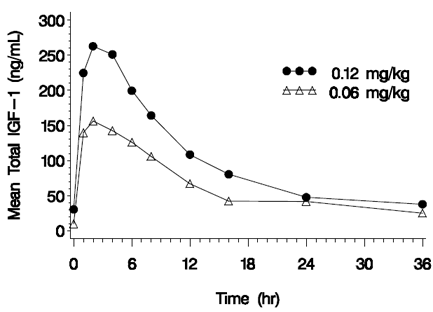
Mean Total IGF-1 Concentration after a Single Subcutaneous Dose of INCRELEX in Children with Severe Primary IGFD (0.06 mg/kg and 0.12 mg/kg, n = 3 per group)
increlex1.gif


Was it 80 mcg/kg? If yes, than it'll a very expensive experiment to conduct. If we run the same test on a 240 lb guy, we'll need 8 mg's of IGF-1.

I did bloodwork a few month ago, was running HGH 2-3 IU's/day and IGF-1 200 mcg/day, my somatomedin c was 438. I don't know my IGF-1 baseline and I'd expect it to be at 350 + on 3 IU's of HGH/day. Blood was drawn 45-60 min after inj.
Here's the thing, we don't have much data on how RH-IGF-1 works if used as PED. As you can see, the chart above doesn't show a great increase in total IGF-1 levels even at 120 mcg/kg, but RH-IGF-1 still helps kids grow and somehow the effective dosages for bodybuilding start at 200 mcg/day. Rich Piana mentioned 400 mcg PWO.

There's another opinion :
"The IGF-1 is mostly free with true rIGF-1 and will be more diverse in effect by probably around 4:1 versus the matrix-bound hGH or rhGH mediated elevation of endogenous IGF-1 levels released by the liver and at paracrine sites during normal conditions."

If someone can add a few drops of IGF-1(Insubolic) into the testing tube with blood sample and get it tested by any lab as you would normally test for IGF-1 level, we can reimburse for such experiment.

RS
 
You mean in regards to long term HGH use?

HRT is pretty common

I think he was meaning long term HRT using 192aa GH or what the authors of that study call met-rhGH.

But in that study they did a 2 year window and seem to have encountered no discernible difference in side effects between rhGH (191aa) and met-rhGH (192aa) despite the presence of antibodies in the met-rhGH group. Interesting study. Seems to indicate 192aa is just as effective as 191aa which begs the question, if they are both equal in benefit, then shouldnt we just be using cheaper 192aa GH? Why pay more for something that is no more effective?

I had always heard the 192aa will cause antibodies (which sounds nefarious), but this is the first time ive seen a study about it and the study seems to suggest 192aa is perfectly ok to use...
 
Do you know why they dont? Cause now im curious to know why.

It actually seems super weird that all the UG labs are only making HGH and then these weird lr3 and des analogues. Considering that the BB market is hugely intrested in REAL IGF 1 (increlex etc), and many sees it like the holy grail, it baffles me that all these labs didn't already make and sell real IGF 1 many many years ago

Is it because it's crazy hard and expensive to make? Or are we missing something here?
 
Back
Top