lowest LDL without using a PCSK9 inhibitor?

I’ve seen people get into the upper 20s, starting from 90-100, using a statin and ezetimibe, or statin+ezetimibe+bemp acid.

Ezetimibe is the main wildcard that can create a much bigger drop than expected. This is because the “transporter” that moves cholesterol from the gut into blood is present in some people at much higher levels than than others. Eze loads this transporter with “blank loads”, so they can’t carry cholesterol. For these folks the LDL drop can be huge.
 
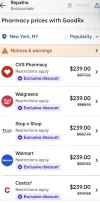
I’ll just mention here if anyone in US does want Repatha, get a prescription from your doctor or telehealth, and get a coupon code from goodRx for your pharmacy.

Amgen lowered the price for cash payers from $700/mo to $239 (lowest in the world). If you DO go through your insurance policy get a “copay card” from Repatha.com and your price will be $15/mo with Repatha picking up the rest. If you’re uninsured, and your household income is less than 3x the poverty level (ie $50k for 1 person, higher for multiple), you can get Repatha for free.

They had been selling direct but decided to work through GoodRx instead.


IMG_3988.webp

As someone pointed out, even if you only use 1, instead of 2 pens a month, you’ll still get most of the benefit at half the cost.

Finally, this is the only way at the moment to put a big dent in Lp(a), dropping it by ~30%.
 
Last edited:
I’ll just mention here if anyone in US does want Repatha, get a prescription from your doctor or telehealth, and get a coupon code from goodRx for your pharmacy.

Amgen lowered the price for cash payers from $700/mo to $239 (lowest in the world). If you DO go through your insurance policy get a “copay card” from Repatha.com and your price will be $15/mo with Repatha picking up the rest. If you’re uninsured, and your household income is less than 3x the poverty level (ie $50k for 1 person, higher for multiple), you can get Repatha for free.

They had been selling direct but decided to work through GoodRx instead.


View attachment 367312

As someone pointed out, even if you only use 1, instead of 2 pens a month, you’ll still get most of the benefit at half the cost.

Finally, this is the only way at the moment to put a big dent in Lp(a), dropping it by ~30%.
Thanks for the great info Ghoul, as always.

what is the process like for getting Repath prescription via telehealth (eg GoodRx or similar)? I could care less if my insurance will cover it (I will pay the $239/m if needed). I take Bemp + Eze combo & Pita 4mg - but not prescribed thru a provider (India Pharma)
 
Thanks for the great info Ghoul, as always.

what is the process like for getting Repath prescription via telehealth (eg GoodRx or similar)? I could care less if my insurance will cover it (I will pay the $239/m if needed). I take Bemp + Eze combo & Pita 4mg - but not prescribed thru a provider (India Pharma)

following on this as well. i didn’t go the doctor route either, yet went with the same stack.
 
Screenshot from 2025-12-13 15-24-24.webp
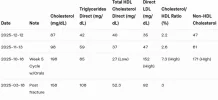
35 this week.

March would be my prior baseline.
October on cycle with orals.
November on cycle but every other day half dosing of Pitavastatin 2mg, Ezetimbe 5mg, and Bempedoic acid 90mg.
December is still on cycle with every day half dosing of the same.
 
View attachment 367323
35 this week.

March would be my prior baseline.
October on cycle with orals.
November on cycle but every other day half dosing of Pitavastatin 2mg, Ezetimbe 5mg, and Bempedoic acid 90mg.
December is still on cycle with every day half dosing of the same.

that’s a really good response though no?

Pitavastatin disproportionately reduces the portion of lipids increased by oral AAS. So it’s not lowering from LDL152, it’s erasing the entire oral AAS impact, then has the “normal” effect you’d expect on the LDL 92 “natural lipid” baseline.
 
Pitavastatin disproportionately reduces the portion of lipids increased by oral AAS. So it’s not lowering from LDL152, it’s erasing the entire oral AAS impact, then has the “normal” effect you’d expect on the LDL 92 “natural lipid” baseline.
That makes sense. And is still awesome.
 
Pitavastatin disproportionately reduces the portion of lipids increased by oral AAS. So it’s not lowering from LDL152, it’s erasing the entire oral AAS impact, then has the “normal” effect you’d expect on the LDL 92 “natural lipid” baseline.

no i calculated it from 92 but still thought it was a great response
 
That makes sense. And is still awesome.
I’d write out the mechanism (I’ve read so many papers on this I have committed to memory), but I’ll cheat and let AI do it, for anyone interested:


1. The AAS-induced LDL fraction was disproportionately reversible.

  • Baseline (off orals): LDL 92
  • On oral AAS, no lipid meds: LDL 152
    → approximately +60 mg/dL attributable to androgen-driven hepatic effects
  • Still on-cycle + partial triple therapy: LDL 47 → 35


LDL did not drift back toward baseline — it overshot far below baseline while androgen exposure continued. That pattern only occurs when the dominant mechanism raising LDL is directly targeted, not merely offset.


The key intervention doing this is pitavastatin.


2) Why pitavastatin is central to this effect


Oral AAS (particularly oxandrolone) raises LDL primarily by reducing liver LDL clearance and altering particle handling, rather than markedly increasing apoB production.

Pitavastatin directly counters this by:

  • Strongly upregulating hepatic LDL receptors, restoring and then exceeding baseline LDL clearance
  • Acting entirely within the liver, the same organ where oral AAS exerts its lipid effects
  • Producing a high LDL-receptor response per milligram, even at low or intermittent dosing

In this context, pitavastatin does not merely “lower LDL” — it neutralizes the specific clearance defect created by the androgen.


That is why the AAS-related LDL increment collapses disproportionately, rather than persisting as a residual elevation.


3) Why LDL fell below baseline despite remaining on-cycle


Once pitavastatin restores LDL clearance:

  • Bempedoic acid amplifies the same hepatic cholesterol-sensing → LDL-receptor pathway
  • Ezetimibe reduces hepatic cholesterol influx, allowing LDL-receptor expression to remain maximally upregulated


However, the initial and decisive correction is pitavastatin’s effect on LDL receptors.


The other agents mainly extend and stabilize that effect.


This explains why:


  • The androgen-driven LDL fraction disappears entirely
  • Total LDL falls below natural baseline
  • This occurs without stopping oral AAS


4) Net observation: lower atherogenic burden on-cycle than off.


Because LDL and non-HDL collapsed to ~35–61 mg/dL, the apoB-containing particle burden is substantially lower on-cycle with pitavastatin-based therapy than it was off-cycle without lipid medication.


This is not paradoxical — it reflects a mechanism-matched intervention overwhelming the androgen effect.


Bottom line


Pitavastatin is the key drug enabling the disproportionate reversal of oral-AAS-induced LDL elevation.

It directly corrects the clearance mechanism responsible for the LDL rise, allowing LDL and non-HDL to fall well below baseline even during ongoing oral AAS exposure.
 
Back
Top