Been getting alot of questions so some brief comments.
Comments on color before and after.
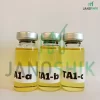
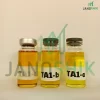
If TRA-a is the same vial in the before and after pics (no heat treatment), then the darkness level (whatever the appropriate visual term) is higher in second photo. Something to keep in mind.
What is striking to me is the color of TRA-c vial (comparatively) after 15 hours at 80-100 deg C. That vial was blasted thermally yet color still lighter than TRA vial I received from another source and clearly lighter than other products floating around out there. So temperature not the big driver by itself. A USP/pharma MCT carrier oil was used for these vials with low peroxide value. Vial had air headspace but no mixing (sealed during heating?).
So a nice raw plus quality carrier oil seems to a make a large difference on color deterioration over time at high temps. Raw quality / color presumably a big factor. No vendor is brewing for 15 hours at 80 degrees C based on folks I have spoken with.
The GCMS data is very very clear. The only components detected for the 3 vials are BA, BB, TRA, and the triglyceride and FFAs of C8 and C10. The carrier oil used was a 60:40 MCT.
Hence, we could not discern chemically what causes the color based on these experiments. Clearly the color wasn't dark enough to detect any degradation impurities by GCMS. This is interesting since
@janoshik has openly stated he has tested alot of "dark" tren and additional peaks besides the tren ester are clearly evident (at least that is how I interpreted his comment). Maybe he will comment. Very nice we were able to start with a clean raw and show heat by itself does not drive degradation of TRA raw in presence of low peroxide value. I have asked
@janoshik for the HPLC chromatograms as well to prove only TRA detected for all three vials.
Finally, vial TRA-c measured higher mg/ml TRA than vial TRA-a. More to come on that but please don't conclude that "higher color tren is stronger tren". Closer examination of the GCMS data suggests the TRA was concentrated by loss of BA and carrier oil during the heating process. Were the stoppers vented? I don't know. But I will share some analysis of the GCMS data (consistent with HPLC data) that shows enrichment of TRA in solution. This is also unexpected since the vapor pressures of BA and n-C8 and n-C10 FFAs are quite low under 100 deg C.
Gear detective is evidently close to a full time job. More to come.




