Oily HGH

ineedhgh878

New Member
I recently received an order of h36 yellow caps from WWB and apon reconstitution, noticed that when injecting hospira BAC into the vial, the drops would sort of slide on the surface of the bac water in the hgh vial before joining with the rest of the water. It’s not visible in the video bc it was quite hard to capture but also it looked oily when injecting water into the vial as seen in the video. Is this normal? It also had tiny bumps and specs all over the vial that went away after throwing it into the fridge for 40 min and then was crystal clear after. Any advice or words would be nice because I’ve searched for this and have no clue what it would be.
 

Attachments

  • IMG_7957.mov
    IMG_7957.mov
    37.4 MB
  • IMG_8728A9B7-13AE-4898-9B37-6D6A32BDF55E.webp
    IMG_8728A9B7-13AE-4898-9B37-6D6A32BDF55E.webp
    686 KB · Views: 11
What was the orientation of the vial when injecting water?

Was it done with easy touch syringe in the video?
All variables were vial was reconstituted with a 5/8in easy touch insulin syringe at a 30 degree angle and during the first ml of bac the needle was against the side of the glass and gently let trickle down the side of the vial not squirted directly on the lipholized puck. The 2nd and 3rd ml of bac was slowly injected into it at an angle as well. Bac was room temp, brand new, never stored in a fridge and was fresh from a reliable and well known source. The gh was about 2 hours outside of the mail- package so room temp.
 
All variables were vial was reconstituted with a 5/8in easy touch insulin syringe at a 30 degree angle and during the first ml of bac the needle was against the side of the glass and gently let trickle down the side of the vial not squirted directly on the lipholized puck. The 2nd and 3rd ml of bac was slowly injected into it at an angle as well. Bac was room temp, brand new, never stored in a fridge and was fresh from a reliable and well known source. The gh was about 2 hours outside of the mail- package so room temp.

One last question. How, *exactly* did you deal with air bubbles after drawing up water from the BAC vial, if you did anything?
 
One last question. How, *exactly* did you deal with air bubbles after drawing up water from the BAC vial, if you did anything?
I inject a ml of air to displace the ml of bac and then draw it up slowly and then pull it out flick it and visually inspect it for air bubbles and then hold it upright and push out any air if any at the tip of the syringe.
 
So I was trying to figure out why the aggregates appeared “globular” in your vial. Also the “wavy” appearance when you swirled it in the video was unusual. I thought they might be silicone contamination droplets, however those are round, and your “specks” had irregular edges like rHGH aggregates, but were translucent instead of the usual white:

When I saw the insulin syringe, and the 3.5ml water it came together.

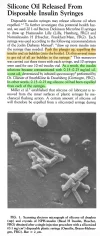
Insulin syringes are notorious for being heavily lubricated with silicone (SO). Multiple strokes increases the amount expelled significantly. With the amount of BAC, I knew that syringe had to be pumped until all the silicone was scraped off the cylinder walls, into the water and out through the needle:

IMG_4140.webp


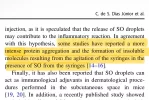
The issue with silicon is it causes proteins to aggregate:


IMG_4141.webp


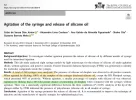
Only one thing can make it much worse, flicking:


IMG_4142.webp


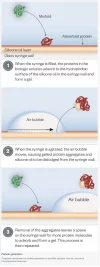
Silicone droplets stick to vial walls, and when rHGH comes onto contact with it, unfolds and forms a “translucent” gel aggregate. Movement knocks the aggregate “jellyfish” loose, and now the spot is available for another rHGH monomer to get stuck, unfold, and the process repeats.

This is how it happens inside a prefilled syringe, but the same process occurs in a vial that’s being swirled, or the impact of just putting it on a hard surface, no flicking needed:


IMG_9907.webp


Suggest you switch to silicone free syringes for reconstituting, or any 3ml syringe so multiple strokes won’t be needed, to avoid this problem.

(The cold made them “disappear” because gelataneous aggregates and silicone droplets get denser in cold, sink to the bottom, and are essentially invisible in the solution. )

 
Back
Top