Pause Squats

I think a thread with this info would be extremely helpful. I spent all last year relearning everything from the ground up, alot of wasted time. Looks like I could possibly be rebuilding my foundation once more. I think alot of guys just go in and lift without understanding whats really going on and therefore not meeting ones full potential. Ill look into getting one of those books, but the links you posted will keep me busy in the mean time. I book marked the post so I can have a reference on my free time.

I'd love to see a thread with such information made as a collaborative effort with all of you guys contributing, I have too much reverence for this board to feel comfortable to take on such a task myself when you consider the amount of far smarter members we have than me on this subject. It's great to see others care about the quality of information in this sub-forum, I will continue to contribute however I can, but I am still learning and have a hell of a lot more to learn.

I will give you some links regarding periodization techniques as I promised to do so.

Periodization simply gives structure to a long term training system and breaks it down into different / separate phases. It is the programmed manipulation of training variables during a training cycle to train different skill sets or training methods.

Linear Periodization is probably the simplest and I guess most popular periodization method and probably what most lifters will turn to once linear progression no longer becomes a viable option at their stage of development. This was originally designed and developed by the Soviets, by Dr Matveyev.

Explanation by Dr Mel Siff below - I recommend reading the full article too as it breaks down the limitations of LP.
Western coaches have been fixated for years on only one periodization (PD) model, that of Dr. Leonid Matveyev. In this model, the volume of general preparation decreases as intensity and emphasis on technical training for specific preparations increase, producing peak performance during a competition phase (see Fig. 1).

onepiece_img_42.gif

Source - http://www.performbetter.com/webapp/wcs/stores/servlet/PBOnePieceView?storeId=10151&catalogId=10751&pagename=82

Another explanation with an example of a routine from Kelly Baggett, one of my favorite writers on training.

An Example

Let's take one exercise, the squat, and look at what a typical set/rep scheme would look like thru the duration of the above 20 week cycle:

Adaptation phase: 3 sets of 12-15 reps twice per week

Hypertrophy phase: 3 sets of 10-12 reps progressing to 4 sets of 6-8 reps twice per week

Maximal strength phase: 5 sets of 5 reps progressing to 6 sets of 1 rep twice per week

Speed strength phase: 5 sets of 5 rep jump squats at 30% of maximal squat twice per week

See how in the max strength phase the volume starts off high and decreases while the intensity starts off low and increases? That's a hallmark of pure linear periodization. Another hallmark of linear periodization is you start with general exercises (squat) and progress towards more specific exercises (jump squat and depth jump). This approach CAN work well. One problem is when this approach is applied too literally the abilities you gain in one phase can be lost in the next. Thus, if applied very strictly most athletes would lose a great deal of their strength/hypertrophy during the speed-strength phase.

Source - http://www.higher-faster-sports.com/periodizationmadesimple.html

Other articles you should take a look at regarding LP, it's limitations, it's advantages, and alternatives.

http://www.bodybuilding.com/fun/maki4.htm

http://breakingmuscle.com/strength-...-which-is-better-for-strength-and-hypertrophy

I'm a bit out of my depth here so if anyone has any corrections or addendum to anything I post, please post it up.

DocD Also mentioned Single Factor and Dual Factor theory, this is personally one of my favorite training / periodization concepts. I believe that advanced lifters should take advantage of a dual factor apporach to periodzation and to their training. Even for bodybuilding. There were actually quite a few bodybuilding routines that made use of DFT but that seems to have fallen out of favor to bro splits or low volume low frequency low intensity high sorcery routines. Can you feel my bitterness?

I posted about DFT a little while ago, I went back and looked to see if there were any real mistakes or fuck ups and I think it held up ok, so I will paste my old post here.

This is where I originally made this post -

https://thinksteroids.com/community/threads/mike-rashid-overtraining.134358045/#post-1092821

Copy of that post below ....

I've always believed that most guys underestimate the amount of weekly work they are capable of doing recovery wise. I've personally never felt like you have to be 100% recovered to train again, especially if your goals are bb'ing oriented, this is why I think taking a 'dual-factor' approach to recovery is actually useful for BB'ers, even though its most commonly used in the strength world.

Your strength levels in any particular lift are pretty much a skill and the more you do something the better you will get at it, and the faster you will make progress. If you are doing too much volume and are overreaching, you take a deload, you either lower volume or intensity for a little bit, and when you come back, a lot of the fatigue and micro trauma you accumulated during your high volume phase will have dissipated, allowing you to come back stronger. This is basically 'dual factor' training. Single factor has you train, recover, then train again, and recover etc). Like a High Intensity style routine.

From Kelly Baggett of Higher Faster Sports, probably the best fucking explanation of DFT I have seen -

Comparing the One-Factor Approach to the 2-Factor Approach

Let's start off by comparing a "one-factor" training approach to a "2-factor" approach. We have 2 four week training schemes. One we'll call "A" and will be the one factor approach. The other we'll call "B" and is the 2-factor approach. Here's what they look like.

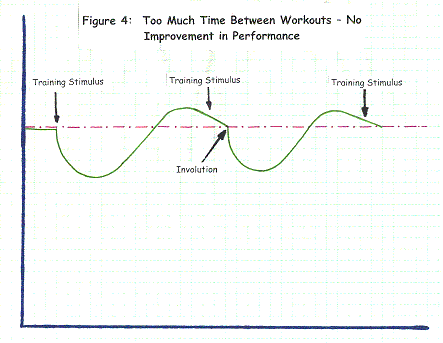
A: Here we train according to the traditional supercompensation curve. We train then fully recover, train then fully recover etc. Let's say we train once every 4-5 days and recover completely between workouts for 4-weeks.

B: Here we train hard for the first 3 weeks three times per week so that we never ever are completely recovered from any workouts. Then, on the 4th week we train only once or twice the entire week at a low intensity and low volume. During the 4th week we're allowing fatigue to dissipate so that we can display the fitness we've gained from the previous 3 week's of training. During this low intensity/low frequency week, the physiological indicators we've stimulate the previous 3 weeks "rebound" back up and above where they were before.

Ok. Now if you were to compare those 2 schemes we would find that version B will actually bring about greater gains particularly for intermediate and advanced athletes - That is providing the athletes are in a well rested state prior to initiating the 4 week block of training. Homeostasis is disrupted and prolonged during the 3 week loading period. Although we won't see a whole lot of progress during this 3 week phase itself, when we pull back on the volume during the reduced loading period the functional indicators will then rebound back above baseline. The ultimate "rebound", or performance increase, in scheme B will be greater then the summation of smaller rebounds from scheme A.

So what we're doing is building up fatigue and fitness by over-reaching slightly and then pulling back on the fatigue by under-reaching. Nothing really complicated about it.

Source - http://www.higher-faster-sports.com/PlannedOvertraining.html

You also have to keep in mind, that just because the athlete is not fully recovered, does NOT mean he isn't getting bigger or stronger.

Correction to this - I am trying to say that gains last longer than fatigue does that has been accumulated in the intensification stage and that fatigue masks fitness.


I don't use a structured load/deload phase, I simply ease up when I feel I am out training my ability to recovery. Not the most sophisticated method, I know..but I enjoy training :)

A lot of routines that utilize 2 factor training have a structured loading / deloading schedule (ie 2 weeks on 1 week reduced / maintenance volume). I prefer to go by instinct. I haven't done a real deload since I started lifting. When recovery is really falling behind, I notice I am not able to train as hard. A few sessions with slightly less balls to the wall intensity, and I am back to training hard.

For those of you guys who train with a lot of volume, if you feel like you have been training really hard and your recovery can't catch up, reduce your volume for a little bit. If you were really overreaching you should come back stronger, if not, work harder next time :)

I think I mentioned in my post that I felt DFT to be superior to Single factor training after I talked about LP.

Why do I feel DFT is superior to single factor training?

Because I am absolutely terrified of this -
rvPi4pl.gif


I will add some more links articles for you later, this just barely scratched the surface, there is still a few more things that need to be mentioned like NLP, Conjugated Periodization, ME, RE , DE, etc, SAID principle, adapation stuff. I will get to it eventually.
 
Last edited:
I rarely spend time in this sub-forum and had no idea there were so many Mark Rippetoe and old school lifting fans here. I second (or third) the book recommendations, especially Starting Strength - everybody should have a copy.

Rippetoe just released these videos on the mechanics of the back squat and uses demonstrations to explain the same points you two are discussing, i.e., hip drive, hamstring reflex, lumbar rounding/relaxation at too great a depth, etc.


Starting Strength was the first training oriented book I got. An ex of mine years ago asked me what I wanted for my birthday and I said just a copy of this book. She got me the first edition in hard print and last year I bought the 3rd edition for the iPad. It's the first book I recommend for almost everyone.
 
My $0.02 to add on to Weighted's comments and some of my own from earlier:

Training works bc the body adapts and likes to remain in homeostasis. Hans Seyle was ahead of his time when he came up with his General Adaptation Syndrome theory. Basically he theorized, based on observations I believe bc he didn't have access to technology we do today, that when you provide the body with a stressor (lifting weights in this case) it will do one of 3 things depending on the stressor and individual in question:

1) if the stress is too little to drive adaptation, no adaptation happens. You provided a stress the body is accustomed to and thus it remains in homeostasis. No need for change.

2) if the stress is just right, the window for just right is large for newbies but narrows tremendously the more advanced one gets, the body will take the stress, recover from it providing nutrition and recovery are good, and supercompensate to be able to handle similar stresses in the future. Thus it reaches a new homeostasis. The dose of stress is enough to drive adaptation whether it's neuromuscular in strength or size.

3) if the dose of stress is too much, he body's recovery abilities are overpowered and too much fatigue sets in. Continued on it leads to overtraining and if taken to an extreme, death. An example of this extreme is rhabdo which can happen from training.

The goal of lifting, regardless if it's size or strength, is to introduce a stimulus or stress that's going to allow super compensation or #2 above. You want to avoid 1 and 3 obviously. Your goal of size or strength will determine which way you get to step 2

Periodization, like WC states, is simply a way organizing your training. It's Not necessarily a specific way but just how you do it for you. There are 3 main types of periodization:

1) linear periodization. This is simply progressing your training in a linear fashion or increasing a fitness goal in a linear fashion. The most common form of this is progressive overload. This template boils down to adding weight to the bar in a linear fashion whether it's every workout like Starting Strength (it's a book and a program) or Greyskull LP or as much as I hate it Strong Lifts, every week like Texas Method, Bill Starr/Madcow 5x5 etc, or some other time frame.

2) undulating periodization refers to changing the training volume snd intensity ss to expose the body to different stressors; so youd use different percentages, rep schemes, set schemes, time between sets, TUT, etc to alter the stress and let the body adapt to everything. Examples of this would be block periodization like, Sheiko, GVT, etc.

3) conjugate periodization refers to changing he lifts to keep adding new stressors. Example would include the west side method, WS4SB, etc. In westside you rotate your main lifts out every 2-3wks so as not to stagnate or stall.

There's also single and dual factor theory where single fsctor theory is like, working out takes gas out of the tank and it's filled with recovery. Dual factor theory takes I to account fitness and fatigue. Fatigue is the stress of training. You want a good dose of stress to cause enough fatigue that you adapt and not enough that you over train. Fitness is your ability to demonstrate your power, strength, acceleration, etc at any given time. When fatigue is high fitness is low and vice versa. This is how PLers peak for a meet. They intentionally increase the fatigue to borderline overtraining. 2-3wks out they deload and fatigue drops while fitness increases. On meet day fitness is supposed to be at it's highest if done right.

There's more to add later.
 
Funnily enough a lot of what you're both talking about I already do without actually knowing the science behind it. Just looking at two books now to start me off Starting Strength 3rd Edition and Practical Programming for Strength Training. Do these two sound like a good starting point?
 
Funnily enough a lot of what you're both talking about I already do without actually knowing the science behind it. Just looking at two books now to start me off Starting Strength 3rd Edition and Practical Programming for Strength Training. Do these two sound like a good starting point?

That is an excellent start.

Practical Programming will teach you plenty about training theories, general training concepts, programming, and SS will give you plenty of technical info about form and the different movements. Both books are readily available for very cheap too.

The books by the Russian authors I suggested earlier are much harder to find sometimes and very expensive.
 
Rippetoe provides a very good explanation of adaptation in layman's terms by using a suntan analogy in this article:


https://www.t-nation.com/training/biggest-training-fallacy-of-all
by Mark Rippetoe | 07/07/11

It's June 15th, and you decide that this is the year you're going to get a suntan – a glorious, beautiful, tropical suntan.

So you decide to go out in the back yard (to spare the neighbors and innocent passersby) to lie out at lunchtime and catch a ray or two. You lie on your back for 15 minutes and flip over to lie on your belly for 15 minutes. Then you get up, come in and eat lunch, and go back to work.

That night, your skin is a little pink, so the next day you just eat lunch, but the following day you're back outside for your 15 minutes per side sunbath. You're faithful to your schedule, spending 30 minutes outside every day that week, because that's the kind of disciplined, determined person you are. At the end of the week, you've turned a more pleasant shade of brown, and, heartened by your results, resolve to maintain your schedule for the rest of the month.

So, here's the critical question: what color is your skin at the end of the month?

If you ask a hundred people this question, ninety-five will tell you that it will be really, really dark, but fact is it will be exactly the same color it was at the end of the first week. Why would it be any darker? Your skin adapts to the stress of the sun exposure by becoming dark enough to prevent itself from burning again. That's the only reason it gets dark, and it adapts exactly and specifically to the stress that burned it.

Your skin doesn't "know" that you want it to get darker; it only "knows" what the sun tells it, and the sun only "talked" to it for 15 minutes. It can't get any darker than the 15 minutes of exposure makes it get, because the 15 minutes is what it's adapting to.

If you just got darker every time you were exposed to the sun we'd all be black – especially those of us who live in sunny areas – since we all get out of the car and walk into the house or work several times a day.

The skin doesn't adapt to total accumulated exposure, but to the longest exposure – the hardest exposure. If you want it to get darker, you have to stay out longer to give the skin more stress than it's already adapted to. The widespread failure to comprehend this pivotal aspect of adaptation is why so few people actually understand exercise programming.

Exercise follows exactly the same principle as getting a tan – a stress is imposed on the body and it adapts to the stress, but only if the stress is designed properly. You wouldn't lay out for two minutes and assume that it would make you brown, because two minutes isn't enough stress to cause an adaptation.

Likewise, only a stupid SOB lays out for an hour on each side the first day, because the stress is so overwhelmingly damaging that it can't be recovered from in a constructive way.

Stress Causes Adaptation

Many trainees come in to the gym and bench 225 every Monday and Friday for years, never even attempting to increase the weight, sets, reps, speed, or pace between sets. Some don't care, but many are genuinely puzzled that their bench doesn't go up, even though they haven't asked it to.

And some bench press once every three or four weeks, or maybe even more rarely than that, using some arbitrary number like their own bodyweight for 10 reps, then 9, then 8, 7, 6, 5, 4, 3, 2, and finally 1 rep, and wonder why their bench doesn't go up, or why they're sore for days after.

Your bench press strength doesn't adapt to the total number of times you've been to the gym to bench or your sincerest hope that it will improve. It adapts to the stress imposed on it by the work done with the barbell.

Furthermore, it adapts to exactly the kind of stress imposed on it. If you do sets of 20, you get good at doing 20's. If you do heavy singles, you get better at doing those. But singles and 20's are very different, and you don't get better at doing one by practicing the other.

The muscles and nervous system function differently when doing these two things and they require two different sets of physiologic capacities, and thus cause the body to adapt differently. The adaptation occurs in response to the stress, and specifically to that stress, because the stress is what causes the adaptation.

This is why calluses form on the hand where the barbell rubs, and not on the other parts of the hand, or on your face, or all over your body. It can obviously be no other way.

Furthermore, the stress must be something you can recover from. Like the two hours of sun the first day or the 55 bench reps once a month, the stress must be appropriate for the trainee receiving it. If the stress is so overwhelming that it can't be recovered from in time to apply more of it in a timeframe that permits accumulated adaptation, it's useless.
 
Rippetoe provides a very good explanation of adaptation in layman's terms by using a suntan analogy in this article:


https://www.t-nation.com/training/biggest-training-fallacy-of-all
by Mark Rippetoe | 07/07/11

It's June 15th, and you decide that this is the year you're going to get a suntan – a glorious, beautiful, tropical suntan.

So you decide to go out in the back yard (to spare the neighbors and innocent passersby) to lie out at lunchtime and catch a ray or two. You lie on your back for 15 minutes and flip over to lie on your belly for 15 minutes. Then you get up, come in and eat lunch, and go back to work.

That night, your skin is a little pink, so the next day you just eat lunch, but the following day you're back outside for your 15 minutes per side sunbath. You're faithful to your schedule, spending 30 minutes outside every day that week, because that's the kind of disciplined, determined person you are. At the end of the week, you've turned a more pleasant shade of brown, and, heartened by your results, resolve to maintain your schedule for the rest of the month.

So, here's the critical question: what color is your skin at the end of the month?

If you ask a hundred people this question, ninety-five will tell you that it will be really, really dark, but fact is it will be exactly the same color it was at the end of the first week. Why would it be any darker? Your skin adapts to the stress of the sun exposure by becoming dark enough to prevent itself from burning again. That's the only reason it gets dark, and it adapts exactly and specifically to the stress that burned it.

Your skin doesn't "know" that you want it to get darker; it only "knows" what the sun tells it, and the sun only "talked" to it for 15 minutes. It can't get any darker than the 15 minutes of exposure makes it get, because the 15 minutes is what it's adapting to.

If you just got darker every time you were exposed to the sun we'd all be black – especially those of us who live in sunny areas – since we all get out of the car and walk into the house or work several times a day.

The skin doesn't adapt to total accumulated exposure, but to the longest exposure – the hardest exposure. If you want it to get darker, you have to stay out longer to give the skin more stress than it's already adapted to. The widespread failure to comprehend this pivotal aspect of adaptation is why so few people actually understand exercise programming.

Exercise follows exactly the same principle as getting a tan – a stress is imposed on the body and it adapts to the stress, but only if the stress is designed properly. You wouldn't lay out for two minutes and assume that it would make you brown, because two minutes isn't enough stress to cause an adaptation.

Likewise, only a stupid SOB lays out for an hour on each side the first day, because the stress is so overwhelmingly damaging that it can't be recovered from in a constructive way.

Stress Causes Adaptation

Many trainees come in to the gym and bench 225 every Monday and Friday for years, never even attempting to increase the weight, sets, reps, speed, or pace between sets. Some don't care, but many are genuinely puzzled that their bench doesn't go up, even though they haven't asked it to.

And some bench press once every three or four weeks, or maybe even more rarely than that, using some arbitrary number like their own bodyweight for 10 reps, then 9, then 8, 7, 6, 5, 4, 3, 2, and finally 1 rep, and wonder why their bench doesn't go up, or why they're sore for days after.

Your bench press strength doesn't adapt to the total number of times you've been to the gym to bench or your sincerest hope that it will improve. It adapts to the stress imposed on it by the work done with the barbell.

Furthermore, it adapts to exactly the kind of stress imposed on it. If you do sets of 20, you get good at doing 20's. If you do heavy singles, you get better at doing those. But singles and 20's are very different, and you don't get better at doing one by practicing the other.

The muscles and nervous system function differently when doing these two things and they require two different sets of physiologic capacities, and thus cause the body to adapt differently. The adaptation occurs in response to the stress, and specifically to that stress, because the stress is what causes the adaptation.

This is why calluses form on the hand where the barbell rubs, and not on the other parts of the hand, or on your face, or all over your body. It can obviously be no other way.

Furthermore, the stress must be something you can recover from. Like the two hours of sun the first day or the 55 bench reps once a month, the stress must be appropriate for the trainee receiving it. If the stress is so overwhelming that it can't be recovered from in time to apply more of it in a timeframe that permits accumulated adaptation, it's useless.

This is an excellent article.

It really explains S.A.I.D / Specific Adaption for Imposed Demand principle nicely and shows why S.A.I.D principle ALWAYS applies to everything you do in the gym.

Good read, and one of the better articles I have seen on the subject.
 
Back
Top