malfeasance
Member
I am a low responder, anyway, compared to others here.

MESO-Rx
Anabolic Steroids

Follow along with the video below to see how to install our site as a web app on your home screen.
Note: This feature may not be available in some browsers.

Using that chart, though, you could be at around 400 until you are 40, but 30 I too high when you are 60?
That does not seem to make much sense.
Risk in situations like these is always relative. If it's about risk regarding injecting GH and side effects or raised IGF, we already have the more urgent and immediate risks like insulin resistance and water retention issues among other things.Which extrapolation carries greater risk?
Being guided by the IGF levels clinicians use to diagnose acromegally, and set the limits of growth hormone replacement in GH deficient adults, or one that arbitrarily disconnects elevated IGF levels from risks because they're induced by exogenous GH?
Also, reducing GH isn't the treatment end target for excess secretion, reducing IGF is.
Pegvisomant dropping IGF into normal range is considered treatment success, and sufficient to prevent acromegaly and other sides from excess secretion, even through GH stays where it was. That seems to be a clear indicator all the problems stem from too much IGF, not directly by GH or some other substance being secreted.


well i would say thats pretty good increase,,Natty, 5/30: 227
3iu SQ AM, 7/25: 400
@AlexDavis43 for the spreadsheet! How’d I do?
This is off the order I tested blind with the 93.6%, 0.2% vial.
Risk in situations like these is always relative. If it's about risk regarding injecting GH and side effects or raised IGF, we already have the more urgent and immediate risks like insulin resistance and water retention issues among other things.
Using a chart for those with a chronically raised IGF to ward of acromegaly is indeed extrapolation as IGF levels in health is not exactly IGF levels in whatever chronic condition is precipitating the raised IGF.
That is just what I'm pointing at.
That is why those numbers seem perplexing to some.. lol.
"But on MESO they told me I was a great responder!"
It would take 5+ years at that level to develop acromegaly symptoms. By comparison, at 60 it might only take a year. Other risks like faster colon polyp development are elevated, but that's the case with any elevated IGF.
So should I not take 4ius hgh if mines 295 on nothing at allSo what is your IGF-1 level when not injecting any hgh?
I saw this guy complaining about being in the mid-200s, which looked high to me:
IGF-1 level and HGH replacement
TLDR: At what level of IGF-1 would you consider adding in a replacement dose of HGH? I'm almost 40 with a public safety job. I'm beat up. I've been thinking about adding in an HRT dose of 2iu GH to my 150mg TRT. But my last 2 IGF-1's have been 223 and 254 which are towards the top of the...thinksteroids.com
Mine are only 83 (range 50-317 ng/mL, so technically in range and not low, LOL)
What is your natty IGF-1 level?
So should I not take 4ius hgh if mines 295 on nothing at all
Still what I said.. lol. Common things occur commonly. This is a case report cos it is an uncommon scenario. People can read the whole article and come to their own conclusions.
Also Nuance should never be thrown away in the face of information.
I can easily state that Acromegaly remains a rare complication of GH replacement therapy. So rare that case reports are published anytime they are noticed. The nuance here is that they (the cases) are not otherwise healthy individuals injecting themselves. So we cannot extrapolate the rarity of the condition in those getting replacement to the effects in healthy individuals.
That's also why I insisted that extrapolation remains extrapolation.
Just look at this guys scenario. Even with his raised IGF, dude didn't develop impared glucose tolerance.. quite uncommon i would say..


The incidence rate of Iatrogenic Acromegaly is what?rHGH glucose intolerance is based on growth hormone's direct anti-insulin effect, not IGF. At 2iu it's rarely a problem for anyone. In fact, high IGF improves insulin sensitivity.
The only thing unusual in this case was the doctor's failure to do his job, monitor IGF and reduce rHGH to keep IGF in the physiological range. The doctor didn't, and the expected outcome resulted, acromegaly. It's a rare example because it's rare for doctors to make this mistake for years until this happens. If GH replacement therapy routinely doubled IGF rHGH induced acromegaly wouldn't be rare.
Most modern cases of acromegaly happen in otherwise healthy people, late in life, who develop a pituitary tumor without obvious symptoms. No one checks IGF until the patient asks their doc why they've started looking like an ape.
It's easy to dismiss cases not involving a "healthy" subject. And since no researcher will ever get approval to double someone's IGF with rHGH for years to see what happens it's safe to say that "proof" with a perfectly healthy person will never appear. But we can come close.
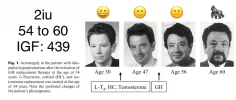
In this example. A 40 year old develops brain cancer. The surgery to remove that tumor inadvertently damages his pituitary, so he's no longer making enough GH. He's put on 3iu / day. No one ever checks his IGF. Almost the same amount of time as our guy above, 6 years later, he wants to know why he's two shoe sizes larger and gotten so ugly. IGF 800+. Higher than the first guy, but since he's younger this is again double the upper limit of normal for his age.
Iatrogenic Acromegaly | BES2002 | 21st Joint Meeting of the British Endocrine Societies | Endocrine Abstracts
www.endocrine-abstracts.org
There's nothing to suggest either of these men were any more prone to developing acromegaly from 2x normal IGF than anyone else, or that somehow, a "healthy" person with the same 2x IGF would be immune to the same problem.
Illicit rHGH users are unlikely to admit use or publish a formal diagnosis, ahem:
View attachment 338658
View attachment 338659
Jawbones don't widen from normal aging.
Bottom line:
The mantra up to now for rHGH use has been "as much as you can afford and tolerate". Clearly price was a limiting factor. Five days on two off was common, to "stretch" precious rHGH.
That's all changed.
Very long term continuous rHGH use as a PED or anti-aging compound has been a rarity, exclusively for pro athletes and the very wealthy, up until the recent massive price drops. It's clear many of us are buying quantities intending to stay on GH for the long term. We have very little to guide safe choices. I think these two documented cases give us some sense of what "crossing the line" looks like. 2x upper IGF limit for more than a couple years seems like it can be reasonably inferred as getting into the danger zone. We also know that up to 1.3x the upper limit of normal IGF seems to be tolerated by doctors, and no cases of acromegaly have been reported in patients after many years at that level. The "many years" IGF safety threshold most likely lies somewhere between 1.3x and below 2x, with the risk growing the closer you get to 2x.
All this has convinced me that staying at 1.3x age adjusted upper limit of normal IGF or below is a reasonable way to keep long term risks low while still benefitting from ongoing GH use.

Which is what I was hinting at. Worry more about messing up your glucose tolerance..Ghoul is right in terms of what the anti aging clinics do with long term hgh use. They’ll keep your z score >2 sitting at the top of the physiological igf1 charts and reduce dose to keep you there. In terms of sports performance it is also basically best in terms of maximum performance with the minimum side effects. Bodybuilding and fat loss are different boats where more is better. I’ve gone up to 8iu and the recovery is next level, but 2.4iu is where I can athletically perform at my prime while maintaining HRV and RHR. The anti aging hgh clinics will start you at 0.9iu with 1.3-1.7iu being average end dose iirc. There’s also a new anti aging trend using hgh to purposefully lower igf1 because low igf1 is associated with longevity.
Think Ghoul is also right about the relative dangers of rocking extremely high igf1 for years at a time. Think we see so few official cases because the only people getting it are people buying underground shit because doctors largely won’t prescribe it at the doses needed to cause it. All that said I think the relative risk of acromegaly is still pretty small, I think declining insulin sensitivity remains the real fear if you FAFO. Which, again, seems to be a relatively small risk especially if you’re lean and exercise a lot.

Which is what I was hinting at. Worry more about messing up your glucose tolerance..
One can easily extrapolate the GH replacement guidelines with what TRT clinics do and UGL lab guys do. While the alarm bells are generally the similar, the goals/what is to be achieved will affect whatever guidelines you place.
Hence all the "TRT clinics are idiots" comments from frustrated people.
People do 4IUs with worsening Glucose tolerance but IGF- 1 within normal limits.
jardiance has really lowered my fbg, i was in the low 90's now im in the high 70's low 80's this lat few weeks, Fasted insulin is 80 , so things are looking better and better,,The good thing is that fasting blood glucose is very easy to monitor
19 almost 20 next monthDepends on age.