Imo a new type of smart is emerging where people who are both smart and using these tools to ask it the right questions become greater than the sum of their parts. The key to getting good answers out of it is already understanding the domain you are querying about so you ask it the right things.
Nailed it.
honestly some of my best use out of it has been refining my people skills at work, like sometimes I get irritated at people or initiatives and I talk to chat gpt about it and it gives me some other perspectives to consider. It also helps with feedback on the way I say things to other people.
The basic 4o model is surprisingly good at this kind of thing. Also, various emotional pathologies and such. I should know, I'm rife with 'em.
Someone posted that "ChatGPT" is outdated which is a funny notion, when I look there are several models to choose from:
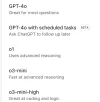
All of these excel at different things. Obviously the reasoning models provide chain of thought and are typically better for things like mathematics, or step by step reasoning.
That said, one can wholly outsource reasoning to these things like they're an encyclopedia. I was just analyzing a bunch of research on a particularly topic and tried a number of different models. Gemini 2.0 Pro gave me an answer I liked and then a citation which was wholly and completely hallucinated.
These things are great thought partners, they can help one refine one's reasoning or help to articulate a thought that is otherwise not well-developed. There are any number of ways to approach this.
For some things, I may prompt something like, "my assertion is that X is true, how do I support that assertion" following which the thing gives me some reasoning and some citations that I can validate. For very specific and particular conclusions, I may come up with a citation, load it into a model or something like notebookLM and have it identify the specific sections that support the assertion.
I recall once getting into an argument with
@Ghoul here around the notion that the frontal lobe is not fully developed until the age of 25, which was my assertion. The implication being that young people may have less than fully developed decision making ability until that time. This notion is commonly held, a google search will reveal that, but a deep dive into the research doesn't support it at all. The frontal lobe does continue to develop typically into the 20s, but the data cuts off around 21 or 22, IIRC. If one extrapolates, that development may continue until around the age of 30 or so, but again, there's no data.




