Save your unusable raws Guaranteed.

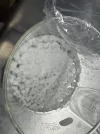
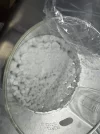
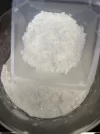
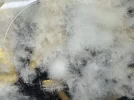
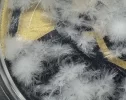
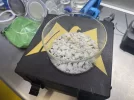
As said by others surface solvents are easy to remove via vacuum and mild heat. But solvent/impurities can and will get trapped in the lattice and amorphous regions if crystals rapid form. This is why we are recrystallizing in the first place. Its the shit that gets trapped behind from yield being more important than quality. Just did recryst on some of the shit TC from AASraw I just got. Off to Jano Monday with before and after samples. MP is good at 101.2 initial and 102 clear. Nice sharp MP. Happy with the result on it. Just ethanol as solvent and carbon wash/filter through celite and slow cool from 60c. Seeded at 40c. MP video starts at 101c 1c/min rate. Out of the bag MP was 90c initial and 100c clear. So both depressed and extended. Powder looked fairly white(light beige)but was yellow as piss once in BB, would not go into dissolution. I ran it up to 250mg/ml in straight BB and up to 150c.


Were you able to figure out where the yellowing came from?
 
Were you able to figure out where the yellowing came from?
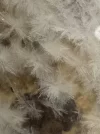
Some non soluble garbage. Maybe oxidation? Crystals all dropped and came out clean. Once filter dried out it looked like dust bunnies on the filter. All the color stayed in mother liquor. Crystals washed. Pretty clean.IMG_6507.webpIMG_6507.webp
 
what is the current tele? just read through the entire thread excited to try this for myself since I just got 92-93 percent purity test prop raws
i do been nuked a few times but each time some hater decides to nuke i grow 10x the size so i consider it a celebration for growth lol last time i was nuked i had 300 then i got 900 i expect 1500 soon
 
how difficult is this to do on a large scale for kilos
by the process itself its already done in LARGE vats at the synthesis labs at least officially. when i made this thread i was reading how industrial purification is done and i simply scaled it down to home use. if you have the time and the lots of energy then yeah it should be pretty easy to process kilos and kilos at a time assuming you got enough solvents....however its better to do it small batches at time instead if you really want to make sure you get the best you can. getting to 97 to 98% pure is the easy part.

getting to 99% and 99,9999% ...yeah thats a vast vast vast effort level there. if you got kilos better to split your batch into 500 to 300 Grams at one time and process it untill you get something clean. then repeat. going all at once will give large error and harder to control

i processed like 500 grams of eq however that was a whole other ball game had to do vacuum distill and liquid to liquid extraction

if you got some AAS raws test just process your stuff in small batches.
 
Hey folks, I just pulled off something cool: un-baking the cake and recovering raw testosterone enanthate from some old homebrew in GSO. With oxidation creeping in over time, I figured why not extract the goods? It was a bit of a pain at first, but once I dialed it in, the process was straightforward. Here’s the step-by-step in case anyone wants to salvage sketchy gear (this should work for MCT oil too).

Step 1: Initial Setup & BA Strip
Chill everything in an ice bath.
Add 30 mL n-heptane to the GSO/test mix—it emulsifies beautifully.
Add 10 mL water to pull out the benzyl alcohol (BA).
Chill again; the water + BA layer sinks, leaving heptane + GSO + test + BB on top.
Syringe out the bottom aqueous layer and discard. Repeat once more.

Step 2: Polar Extraction (Test + BB to Ethanol)
Still cold, transfer the heptane mix to a separatory funnel.
Add a 70/30 ethanol/water blend (start with ~40 mL).
Gently swish (no shaking!) ~20 times.
Pop it in the freezer for 10 min—layers separate like magic:
Bottom: ethanol/water + test + BB
Top: heptane + GSO
Drain the bottom ethanol layer into a beaker; save the oil layer in another.
Return the oil layer to the funnel, add fresh 40 mL ethanol/water, and repeat 3× total to grab every last bit of test. Separation is lightning-fast in the freezer.

Step 3: Dry the Ethanol Extracts
Combine all ethanol pulls.
Add anhydrous magnesium sulfate on a stir plate to soak up the water.
Filter out the MgSO₄.
Step 4: Strip the BB (the tricky part)
BB is stubborn—even under deep vacuum it needs heat.
I set a small electric hot plate under my vacuum chamber; ~1 hour did the trick.
Tip: You might be able to recrystallize with BB present, but I haven’t tested it.

Step 5: Crystallize the Goods
Add just enough ethanol to cover the remaining test gel in the dish.
Freeze overnight—BAM, crystals!

Clean, sparkly test enanthate ready for a fresh brew. Hope this helps anyone sitting on questionable vials!

Is there a way to do this without heptane?
 
i do been nuked a few times but each time some hater decides to nuke i grow 10x the size so i consider it a celebration for growth lol last time i was nuked i had 300 then i got 900 i expect 1500 soon
ah okay, thought i was kicked lol. good you bounced back, be nice to join again if you can point me in the right direction
 
Hey folks, I just pulled off something cool: un-baking the cake and recovering raw testosterone enanthate from some old homebrew in GSO. With oxidation creeping in over time, I figured why not extract the goods? It was a bit of a pain at first, but once I dialed it in, the process was straightforward. Here’s the step-by-step in case anyone wants to salvage sketchy gear (this should work for MCT oil too).

@mongo5165 how much GSO mix did you start with in this recipe?
I had a kit of Test E300 which gives shocking pip and site reaction, then some vendor who shall remain nameless sent me 10 Test E300 vials instead of a couple of DHB. Seems a pity to bin it all if.

 
Has anyone else ran this process through with pre and post purity testing?

It would be interesting to see starting mass with end mass along side initial purity and processed purity.

It looks like photon lost a lot of material with not much purity gain.
 
Has anyone else ran this process through with pre and post purity testing?

It would be interesting to see starting mass with end mass along side initial purity and processed purity.

It looks like photon lost a lot of material with not much purity gain.

You learn by trying stuff out.
On hindsight, I should have used a different solvent.
# 1st round with Acetone
# 2nd round with Ethanol

The Ethanol will wash off the Acetone.
 
Found this Japanese patent: テストステロンの精製法

It goes over how to purify Testosterone. I've translated it with AI, here is the translation (original doc attached):

English Translation of Japanese Patent Publication JP S56-2999 (1981)
Purification of testosterone enanthate

Publication Information
- Publication Number: JP S56-2999 (Kokai - Unexamined Patent Publication)
- Publication Date: January 13, 1981 (Showa 56)
- International Patent Classification: C07J 1/00
- Total Pages: 3

Title of Invention
Purification Method for Testosterone (T8NE)

Applicant
Mitsubishi Chemical Industries, Ltd.
2-5 Marunouchi 2-chome, Chiyoda-ku, Tokyo

Inventors
- Eiji Fujimoto: 16 Nishidairyo-cho, Yahatahigashi-ku, Kitakyushu City
- Natsuki Kano: 3 Higashimagari-cho, Yahatanishi-ku, Kitakyushu City
- Kiyotaka Ito: 7 Nichidari 7-chome, Munakata Town, Munakata County, Fukuoka Prefecture

Patent Claims
1. A purification method for crude testosterone, comprising:
- Dissolving crude testosterone in a solvent primarily composed of a lower aliphatic alcohol;
- Cooling the resulting solution to crystallize the testosterone; and
- Recovering the crystallized testosterone, wherein the crystallization is specifically carried out in a mixed solvent system containing 10–50% by weight of water (preferably 20–30% by weight) relative to the alcohol, at a temperature of 0°C or lower.

Detailed Description of the Invention
This invention relates to a purification method for testosterone (hereinafter abbreviated as "T8NE").

Testosterone has a melting point of approximately 150–155°C and typically is obtained as crude crystals through reaction of testosterone base with acetic anhydride or acetyl chloride in an anhydrous solvent at temperatures of 60–100°C for 1–10 hours. However, conventional recrystallization methods using only alcohols or ethers yield crystals with low bulk density and fine particle size, causing operational difficulties during stirring in crystallization tanks, discharge of crystals, and separation from mother liquor.

Through extensive investigation, the inventors discovered that conducting crystallization in a mixed solvent system of alcohol and water at a specific ratio yields testosterone crystals with high bulk density and excellent properties, leading to the completion of this invention.

Key Features of the Invention:
Crude testosterone is dissolved in a solvent primarily composed of a lower aliphatic alcohol, then the solution is cooled to crystallize and purify the testosterone. The critical feature is that crystallization must be performed in a mixed solvent containing 10–50% by weight (preferably 20–30% by weight) of water relative to the alcohol, at a temperature of 0°C or lower.

Solvent Selection:
Suitable lower aliphatic alcohols include methanol, ethanol, n-propanol, and isopropanol, with ethanol being particularly preferred. The water content is critical—too little water results in low bulk density crystals; optimal water content yields dense, well-formed crystals.

Procedure:
1. Dissolve crude testosterone (typically 98.5% purity) in ethanol at 25°C with stirring until completely dissolved.
2. Cool the solution gradually to -20°C.
3. Add water to achieve 25% by weight water content relative to ethanol while stirring.
4. Maintain at -20°C for 1 hour to complete crystallization.
5. Age the crystals for 10–60 minutes after crystallization to ensure complete solidification.
6. Separate crystals from mother liquor, wash, and freeze-dry to obtain purified testosterone with moisture content below 0.5% by weight.

Mechanism:
In the alcohol-water mixed solvent system, testosterone first forms droplets in the solvent, then crystallizes internally within these droplets, yielding larger particle size and higher bulk density crystals—a phenomenon not observed in pure alcohol systems.

Working Example:
2,000 g of pharmaceutical-grade ethanol (water content: 1,000 ppm) was placed in a 2L stirred reactor equipped with a cooling device. 700 g of crude testosterone (98.5% purity) was added and completely dissolved at 25°C. The solution was gradually cooled to -20°C, then 250 g of water (25 wt% relative to ethanol) was added with mixing. Crystallization was carried out for 1 hour at -20°C with stirring. After freeze-drying at -40°C to reduce moisture content to 0.1 wt%, 640 g of purified testosterone with 99.8% purity was obtained. The crystals exhibited high bulk density, excellent handling properties, and easy discharge from the crystallizer.

Comparative Example:
Following the same procedure but omitting water addition during crystallization and cooling the solution to -30°C yielded crystals with extremely low bulk density. The mother liquor became completely entrapped within the crystalline mass, resulting in extremely poor handling properties and making subsequent operations impractical.

Representative
Mitsubishi Chemical Industries, Ltd.
Patent Attorney: Hasegawa (and one other)

 

Attachments

Last edited:
Back
Top