


[OA] An Automated Smartphone-Based Diagnostic Assay For Point-Of-Care Semen Analysis
Although male infertility is as common as female infertility, it often goes undiagnosed because of socioeconomic factors such as stigma, high cost of testing, and availability of laboratory facilities.
To facilitate the necessary testing, Kanakasabapathy et al. have designed a smartphone-based assay that can be performed at home or in a remote clinic without access to laboratory equipment.
The assay uses an inexpensive device that attaches directly to a phone and is operated through a smartphone application.
The accuracy of this approach was very similar to that of computer-assisted laboratory analysis, even when it was performed by untrained users with no clinical background, demonstrating its potential for use at home and in low-resource settings.
Kanakasabapathy MK, Sadasivam M, Singh A, et al. An automated smartphone-based diagnostic assay for point-of-care semen analysis. Science Translational Medicine 2017;9(382). http://stm.sciencemag.org/content/9/382/eaai7863
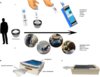
The process flow for semen analysis using the smartphone-based device and conventional methods.
(A) (i) Process of operation: A small volume of an unwashed, unprocessed semen sample is loaded into a microfluidic device that has a capillary-based disposable tip at the inlet and a rubber bulb at the outlet to create negative pressure in the microchannel for manual, power-free sample loading.
The user manually detaches the capillary disposable tip from the microfluidic device through a simple snap-off mechanism and inserts the clean microfluidic device into the smartphone optical attachment. The user then initializes the smartphone application, which analyzes the sample with <5-s mean video processing time.
(ii) Conventional method of semen analysis performed in a laboratory setting. The sample is drawn using a pipette and is loaded onto a semen glass slide counting chamber. The glass slide is placed under a desktop microscope, and a technician performs the analysis either manually or using a CASA system.
(B) Actual image of the smartphone accessory and the microchip (C) along with its side view.
Although male infertility is as common as female infertility, it often goes undiagnosed because of socioeconomic factors such as stigma, high cost of testing, and availability of laboratory facilities.
To facilitate the necessary testing, Kanakasabapathy et al. have designed a smartphone-based assay that can be performed at home or in a remote clinic without access to laboratory equipment.
The assay uses an inexpensive device that attaches directly to a phone and is operated through a smartphone application.
The accuracy of this approach was very similar to that of computer-assisted laboratory analysis, even when it was performed by untrained users with no clinical background, demonstrating its potential for use at home and in low-resource settings.
Kanakasabapathy MK, Sadasivam M, Singh A, et al. An automated smartphone-based diagnostic assay for point-of-care semen analysis. Science Translational Medicine 2017;9(382). http://stm.sciencemag.org/content/9/382/eaai7863
The process flow for semen analysis using the smartphone-based device and conventional methods.
(A) (i) Process of operation: A small volume of an unwashed, unprocessed semen sample is loaded into a microfluidic device that has a capillary-based disposable tip at the inlet and a rubber bulb at the outlet to create negative pressure in the microchannel for manual, power-free sample loading.
The user manually detaches the capillary disposable tip from the microfluidic device through a simple snap-off mechanism and inserts the clean microfluidic device into the smartphone optical attachment. The user then initializes the smartphone application, which analyzes the sample with <5-s mean video processing time.
(ii) Conventional method of semen analysis performed in a laboratory setting. The sample is drawn using a pipette and is loaded onto a semen glass slide counting chamber. The glass slide is placed under a desktop microscope, and a technician performs the analysis either manually or using a CASA system.
(B) Actual image of the smartphone accessory and the microchip (C) along with its side view.


