stiff leg deadlifts: isolation or compound?

skywalk

New Member
10+ Year Member
20+ Year Member
As much as i've tried to analyze the movement, I still think this is an isolation exercise. unless you consider the shoulder as a 2nd point of joint motion as you bend over. so is this a compound or isolation exercise? I know I get much more sore after a few good sets of stiff leg deadlifts, than multiple (10+) sets of leg curls or seated curls.
 
I agree that it is a compound movement. That being said I like to do them after I perform leg curls so that my hammys are pre-exhausted. Which kind of makes it more of an isolation excersise since it is mainly only the hammys at this point.
 
It's a great lift for those attempting to enhance the mid to upper hamstrings, lower glutes and to increase TT levels "naturally".

Leg curls do not "work" the upper hams because their attachment to the lower pelvis and the sitting position, effectively prevents them participating in that particular motion.

Consequently SLDLs are a great isolation exercise for the lower to mid gluteal area and the upper hams since both extend the pelvis at the hip.

Ergo the hypertrophy which occurs provides a lift to the lower gluteal region and promotes symmetry to the upper hamstring area, something leg curls and/or squats do not accomplish, optimally.

Nonetheless I agree SLDLs are indeed a compound exercise.

Jim
:)
 
Ewww, just the word DeadLift sounds scary..

I do lunges, with 1 liter water bottle, in each hand..
Thighs are 16" around pumped.. Yup, no kiddin

Strained my little toe the other day doing them,
But that's the price us powerlifters pay
 
It's a great lift for those attempting to enhance the mid to upper hamstrings, lower glutes and to increase TT levels "naturally".

Leg curls do not "work" the upper hams because their attachment to the lower pelvis and the sitting position, effectively prevents them participating in that particular motion.

Consequently SLDLs are a great isolation exercise for the lower to mid gluteal area and the upper hams since both extend the pelvis at the hip.

Ergo the hypertrophy which occurs provides a lift to the lower gluteal region and promotes symmetry to the upper hamstring area, something leg curls and/or squats do not accomplish, optimally.

Nonetheless I agree SLDLs are indeed a compound exercise.

Jim

:)

How about deep leg presses squats after pre-fatiguing your quads to hit the upper hamstring?
 
I agree that it is a compound movement. That being said I like to do them after I perform leg curls so that my hammys are pre-exhausted. Which kind of makes it more of an isolation excersise since it is mainly only the hammys at this point.

Why would you "pre-exhaust" your hamstrings before SLDL? This means you'll end up relying more on accessory muscles (other than hams). Thus, you're kinda negating the whole point of SLDL not to mention increasing the risk of injury.
 
Glutes/hamstrings/low back. By definition that makes it a compound lift.

And don't forget traps/upper back. Maybe not stressed as much as during regular deadlifts but anyone lifting decent weight on SLDL will feel it in this area too.
 
Why would you "pre-exhaust" your hamstrings before SLDL? This means you'll end up relying more on accessory muscles (other than hams). Thus, you're kinda negating the whole point of SLDL not to mention increasing the risk of injury.


When I pre exhaust a smaller muscle before a compound movement then the specific muscle will fail first. Example being doing dumbell flyes before bench press, my pec muscles tire out well before my delts or tris. I can't do as much weight but I hit the target muscle.

If I were to do SLDL first I would be able to do more weight and target my lower back more but that is not what I'm trying to do. I do regular deadlifts and that hits my lower back. On seperate days I do my hams and to make the SLDL a ham excercise I find preexhausting works well. Care must be taken in form and I don't go too heavy on this movement as I don't want to target my lower back.
 
Most people here have been training a long ass time. There is definitely more then one way to skin a cat. Personally, I think pre-exhausting is a Joe Weider fucking myth to get people on machines. It's never done anything for me except make the core "important' lift numbers go down for that workout. IMO, if you bench heavy, and "pre-exhaust" with DB flyes or pec deck, you are setting yourself up for an injury.

That said, some guys swear buy it. If it's working for you GR, by all means continue on. You know your body best. The squat routine you posted in another thread is an old classic, so I know you know how to train.

As far as "functional" exercises go, SLDL is great. Leg Curls are useless IMO, mainly for the reasons Dr Jim posted above. Good BB exercise I guess, but the way a leg curl works isn't how your hamstrings function in real life. Just another reason why machines suck overall IMO. They do have their place I guess, but they aren't really necessary. I know more guys who have torn up their shoulders on the hammer strength bench, then actually performing a bench press with sound form.

I love that some training talk is picking up in here. Drugs are great, but moving Iron and eating right is what makes the world go round.

Most guys meet a guy and want to know how much they bench. I want to know your squat. I've met plenty of guys with a huge bench who can't squat for shit, but I've never met a guy with a big squat who doesn't have at least a respectable bench #.
 
When I pre exhaust a smaller muscle before a compound movement then the specific muscle will fail first. Example being doing dumbell flyes before bench press, my pec muscles tire out well before my delts or tris. I can't do as much weight but I hit the target muscle.

If I were to do SLDL first I would be able to do more weight and target my lower back more but that is not what I'm trying to do. I do regular deadlifts and that hits my lower back. On seperate days I do my hams and to make the SLDL a ham excercise I find preexhausting works well. Care must be taken in form and I don't go too heavy on this movement as I don't want to target my lower back.

The last thing I would want to happen during any form of deadlift is for any single muscle group to reach failure before another. It tends to alter form. Sure if you use sufficiently light weight and careful form, you can avoid injury. But IMHO, the benefits of heavier weight on ham development in this exercise are far superior to training pre-exhausted hams with light SLDL. (Still risky. But the cost-benefit seems greater to me.)
 
Most people here have been training a long ass time. There is definitely more then one way to skin a cat. Personally, I think pre-exhausting is a Joe Weider fucking myth to get people on machines. It's never done anything for me except make the core "important' lift numbers go down for that workout. IMO, if you bench heavy, and "pre-exhaust" with DB flyes or pec deck, you are setting yourself up for an injury.

That said, some guys swear buy it. If it's working for you GR, by all means continue on. You know your body best. The squat routine you posted in another thread is an old classic, so I know you know how to train.

As far as "functional" exercises go, SLDL is great. Leg Curls are useless IMO, mainly for the reasons Dr Jim posted above. Good BB exercise I guess, but the way a leg curl works isn't how your hamstrings function in real life. Just another reason why machines suck overall IMO. They do have their place I guess, but they aren't really necessary. I know more guys who have torn up their shoulders on the hammer strength bench, then actually performing a bench press with sound form.

I love that some training talk is picking up in here. Drugs are great, but moving Iron and eating right is what makes the world go round.

Most guys meet a guy and want to know how much they bench. I want to know your squat. I've met plenty of guys with a huge bench who can't squat for shit, but I've never met a guy with a big squat who doesn't have at least a respectable bench #.

Training and nutrition is where everyone should look for the "secrets" to getting bigger, stronger, faster. If people in the gym only spent equal amount of time learning about this as they do on drugs/supplements, there would be 100s of 1000s of additional lbs of LBM entering the gyms around the country.

GR has likely had great success with his approach to training hamstrings. His approach doesn't necessarily match my bias for DLs of all types for ham development. I would consider variations of the DL as a top hamstring developer; leg curls and machines are an afterthought. So, I cry to think the DL is relegated to such pre-exhaust technique :eek: Nonetheless, I'm always interesting in learning why people train in different ways!
 
Obviously I'm no pro (defined as those actively involved in competition yet whom are good enough to acquire several sponsors, including myself) by far, but I have a few as patients.

Most I suspect would perform compound exercises such as SLDL, first followed by an isolation movement such as leg curls.

However most also have "isolation" WO days used exclusively for refining a particular muscle groups appearance with an emphasis on definition in particular.

So muscular attachments and the orientation of muscles is the primary determinant of muscular function IN ISOLATION.

Consequently like the biceps the hamstrings pass over TWO joints from the femur. Included are TWO lower attachments to the Tibia AND Fibula.
The lower muscles attach to the INNER and OUTER leg small degrees of leg rotation will cause the medial or lateral aspect of the muscle to contract with greater intensity.

There is ONE upper attachment to the Pelvis (ischial tuberosity that part of the pelvis we SIT ON now you know WHY the sitting position excludes full hamstring contraction especially the upper portion)

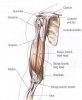
Take a look at the biceps anatomy and it should be apparent WHY using a curl bench is not considered a compound exercise.

jim
 
Sometimes a picture speaks a thousand words.


:)
jim
 

Attachments

  • hamstring.jpg
    hamstring.jpg
    43.6 KB · Views: 5
  • biceps.jpg
    biceps.jpg
    39.3 KB · Views: 6
Correct, but if you can tell me WHY it can NOT be the brachioradialis, you will receive an A+ for the day, AND the day is quite young!

:)
 
Oh the answer must be thoroughly descriptive based on the related anatomy.

STRONG WORK IDSTER.

:)
 
Back
Top
