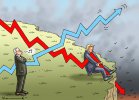
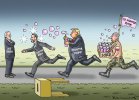
There is an atmosphere in Washington of high anxiety. Trump is melting down, to put it charitably. His campaign has been about lashing out, about wanting his former political opponents – President Obama and Joe Biden, who’s now running against him, of course – to be indicted then charged. Then there was his announcement that he is not necessarily going to accept the electoral result against him. The idea that the president would put in doubt the basic process of democracy and voting is not only unacceptable, it is a nightmare.
Now you have the added factor that Trump’s also had Covid-19 and he’s on steroids, saying things like, “It is a blessing from God that I got the virus”. I can’t think of anything more absurd, or crueller, than calling it a blessing from God. More than 210,000 people have died in the US. For the president of the US to talk like that is unbelievable, but I think people have become numb to it. The outrages pile up, in a way. People have forgotten the risks. I think Kamala Harris put it very well in the vice-presidential debate: what’s happened in the US with Covid-19 is
the biggest failure of the president to exercise his responsibilities, perhaps in the history of the US.
This is a really dangerous period before the election. I got to know Trump very well in hours and hours of interviews I did with him for my book,
Rage, and I think if there were to be some accident, some problem, during the final campaign weeks, he would capitalise on it. Henry Kissinger, of all people, was warning recently that we should worry about some sort of crisis, and reminded people that the first world war started because of an accident. Probably no one’s wanting to start a war right now, but we have a climate in the Middle East, and in the South China Sea, which China has really militarised, where you could have some spark trigger a mild confrontation – not that I think Trump’s going to manufacture that.
Trump is not sufficiently tuned into the attitudes and experiences of other people, which is an essential requirement of a leader. After
George Floyd was killed, I asked him about the tensions ignited in this country not seen since the heights of the civil rights movement. I said we were men of white privilege, that we’ve got to understand the pain and anger black people feel in this country. That’s when he said something that astonished me: “Wow, you sure drank the Kool-Aid! I don’t feel that at all.” He just rejected the idea that somehow white people have to understand the pain and anger of others. I think that’s one of his chief problems. He thinks in terms of his own pain and anger, and what he wants to do, which is to be re-elected.
Trump also told me the US has nuclear weapons that are so devastating even President Putin and President Xi of China don’t know about them. I’m not exactly sure even today whether he was exaggerating or talking about something real. But what’s a really important question to consider here is how much power is in the presidency: when we decide to go to war, whether you look at Vietnam or Afghanistan or Iraq, it’s all been led by the president, essentially, as commander in chief. As we’ve gone into a media environment of impatience and speed because of the internet, the president is also in this position to seize the airwaves. As his son-in-law Jared Kushner said, the news is going along and then Trump tweets something and everyone drops whatever it is. Trump realises this. He uses it. He has that power. He loves being in control. He loves the spectacle. The circumstances have all converged here to give him extraordinary power.
Looking to the aftermath of the election, Trump’s set the table to say that if he doesn’t win, he’s going to be suspicious of mail-in votes. I think the question is: if he loses, will his political party get together and go see him and talk to him, and say, you can’t do this? You can’t do it to the Republican party and most importantly you can’t do it to the country. There has to be an orderly transference of power, if that’s what it comes to.
This is the level of anxiety I have now as a reporter: I go to sleep and get up in the middle of the night and start checking the news because God knows what might have happened. We are sitting on pins and needles in this country about every moment, every action, every assessment, and it is draining. I think lots of people have got to the point where they are tuning Trump and the political situation out as well as they can.
Unfortunately, the impacts on people’s lives carry on, given the virus, given there’s no plan, or organised way of dealing with this. It’s all seat-of-the-pants impulsive decision-making. I can’t think of a time – and I’ve been a reporter for nearly 50 years – where I’ve felt more anxiety about the country and the presidency and the future.