Trump Timeline ... Trumpocalypse


Officials at the U.S. Centers for Disease Control and Prevention and epidemic experts from universities around the world conferred last month about what might happen if the new coronavirus gained a foothold in the United States. How many people might die? How many would be infected and need hospitalization?

One of the agency’s top disease modelers, Matthew Biggerstaff, presented the group on the phone call with four possible scenarios — A, B, C and D — based on characteristics of the virus, including estimates of how transmissible it is and the severity of the illness it can cause. The assumptions, reviewed by The New York Times, were shared with about 50 expert teams to model how the virus could tear through the population — and what might stop it.

The C.D.C.’s scenarios were depicted in terms of percentages of the population. Translated into absolute numbers by independent experts using simple models of how viruses spread, the worst-case figures would be staggering if no actions were taken to slow transmission.

Between 160 million and 214 million people in the U.S. could be infected over the course of the epidemic, according to one projection. That could last months or even over a year, with infections concentrated in shorter periods, staggered across time in different communities, experts said. As many as 200,000 to 1.7 million people could die.

And, the calculations based on the C.D.C.’s scenarios suggested, 2.4 million to 21 million people in the U.S. could require hospitalization, potentially crushing the nation’s medical system, which has only about 925,000 staffed hospital beds. Fewer than a tenth of those are for people who are critically ill.

The assumptions fueling those scenarios are mitigated by the fact that cities, states, businesses and individuals are beginning to take steps to slow transmission, even if some are acting less aggressively than others. The C.D.C.-led effort is developing more sophisticated models showing how interventions might decrease the worst-case numbers, though their projections have not been made public.


Bolsonaro's first test tests positive for coronavirus

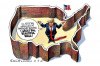
He waits for the result of the counter-proof this Friday (13) to confirm or not the contamination. There is tension in the air. Despite spending quiet time on TV, and asking the people to avoid the streets (a clear cancellation of the call for Sunday's pro-government demonstrations), Bolsonaro does not hide the evidence of health care. He appeared in a mask this morning and did not leave the Palácio da Alvorada, the official residence.

Whether Bolsonaro will disclose the result - whether positive or not - is a personal question, but it also involves a situation of national sovereignty. Giving the population an image of an infected president can cause general fear and even mess with the stock market indexes, which have been oscillating strongly for a week, with circuit breakers as a routine.

Bolsonaro will call Alvorada the presidential nucleus - all high-ranking military men - to decide what to say. While the nation stands by.


For three years Donald Trump led a charmed life. He faced only one major crisis that he didn’t generate himself — Hurricane Maria — and although his botched response contributed to a tragedy that killed thousands of U.S. citizens, the deaths took place off camera, allowing him to deny that anything bad had happened.

Now, however, we face a much bigger crisis with the coronavirus. And Trump’s response has been worse than even his harshest critics could have imagined. He has treated a dire threat as a public relations problem, combining denial with frantic blame-shifting.

His administration has failed to deliver the most basic prerequisite of pandemic response, widespread testing to track the disease’s spread. He has failed to implement recommendations of public health experts, instead imposing pointless travel bans on foreigners when all indications are that the disease is already well established in the United States.

And his response to the economic fallout has veered between complacency and hysteria, with a strong admixture of cronyism.


It took until the second half of President Trump’s first term, but the crisis has arrived in the form of the coronavirus pandemic; and it’s hard to name a president who has been as overwhelmed by a crisis as coronavirus has overwhelmed Donald Trump.

To be sure, the president isn’t responsible for either the coronavirus or the disease it causes, COVID-19, and he couldn’t have stopped it from hitting our shores even if he had done everything right. Nor is it the case that the president hasn’t done anything right; in fact, his decision to implement a travel ban on China was prudent. And any narrative that attempts to pin all of the blame on Trump for the coronavirus is simply unfair. The temptation among critics of Donald Trump to use the coronavirus pandemic to get back at Trump for every bad thing he’s done should be resisted, and schadenfreude is never a good look.

That said, the president and his administration are responsible for grave, costly errors, most especially the epic manufacturing failures in diagnostic testing, the decision to test too few people, the delay in expanding testing to labs outside the Centers for Disease Control, and problems in the supply chain. These mistakes have left us blind and badly behind the curve, and, for a few critical weeks, they created a false sense of security. What we now know is that the coronavirus silently spread for several weeks, without us being aware of it and while we were doing nothing to stop it. Containment and mitigation efforts could have significantly slowed its spread at an early, critical point, but we frittered away that opportunity.

...

Taken together, this is a massive failure in leadership which stems from a massive defect in character. Trump is such a habitual liar that he is incapable of being honest, even when being honest would serve his interests. He is so impulsive, short-sighted and undisciplined that he is unable to plan or even think beyond the moment. He is such a divisive and polarizing figure that he long ago lost the ability to unite the nation under any circumstances and for any cause. And he is so narcissistic and unreflective that he is completely incapable of learning from his mistakes. The president’s disordered personality makes him as ill-equipped to deal with a crisis as any president has ever been. With few exceptions, what Trump has said is not just useless; it is downright injurious.

The nation is recognizing this, treating him as a bystander “as school superintendents, sports commissioners, college presidents, governors and business owners across the country take it upon themselves to shut down much of American life without clear guidance from the president,” in the words of Peter Baker and Maggie Haberman of the New York Times.

Donald Trump is shrinking before our eyes.

The coronavirus is quite likely to be the Trump presidency’s inflection point, when everything changed, when the bluster and ignorance and shallowness of America’s 45th president became undeniable, an empirical reality, as indisputable as the laws of science or a mathematical equation.

It has taken a good deal longer than it should have, but Americans have now seen the con man behind the curtain. The president, enraged for having been unmasked, will become more desperate, more embittered, more unhinged. He knows nothing will be the same. His administration may stagger on, but it will be only a hollow shell. The Trump presidency is over.
 
Back
Top