

MESO-Rx
Anabolic Steroids

Navigation
Install the app
How to install the app on iOS
Follow along with the video below to see how to install our site as a web app on your home screen.
Note: This feature may not be available in some browsers.
More options
Style variation
You are using an out of date browser. It may not display this or other websites correctly.
You should upgrade or use an alternative browser.
You should upgrade or use an alternative browser.
Trump Timeline ... Trumpocalypse
- Thread starter CdnGuy
- Start date

Such a child
RACING THE RACIST
Racing The Racist
Donald Trump is a racist.
Yesterday, Donald Trump went on a racist tweet binge. In addition to his usual “China Virus” tweets, he went after the Washington Redskins and Cleveland Indians for considering changing their racist names and tweeted, “Indians, like Elizabeth Warren, must be very angry right now!” And, he went after NASCAR and the sport’s only black driver, Bubba Wallace.
Last month after NASCAR banned the hate flag from all its events, a noose was found in the garage of Wallace’s team. There was an investigation by the FBI which determined the noose was left there from last season and used as a rope pulley-thingy for the garage door…the electric garage door. But before they came to that determination, NASCAR and all the drivers stood in support for Wallace and held a demonstration against hate. Racist hated that. They saw it as another threat to their white privilege.
Trump tweeted, “Has Bubba Wallace apologized to all of those great NASCAR drivers & officials who came to his aid, stood by his side, & were willing to sacrifice everything for him, only to find out that the whole thing was just another HOAX? That & Flag decision has caused lowest ratings EVER!”
No. Bubba Wallace never did apologize for that. Why? Because he doesn’t owe anyone an apology. Bubba didn’t do anything. While Trump and his spokesgoon are calling the noose incident a “hoax,” and yesterday Kaleigh McEnany, who promised she’d never lie to us, compared it to the Jussie Smollett incident, this was not a hoax.
There was a noose in Bubba Wallace’s garage. Bubba Wallace didn’t put it there or even saw it. NASCAR discovered the noose and informed him. Even the FBI used the term “noose” to describe it. Why? Because it was a noose. And while saying it was there from last year, that’s not very reassuring. Why was it ever cool to hang nooses in NASCAR? According to the FBI, it wasn’t a hate noose, instead, just your average everyday common garage noose.
Also, there are over 1,100 garages at NASCAR venues. Only one had a noose in it. And out of over 1,100 garages, they gave the only one that had a noose in it to the ONLY black guy? I’m not into conspiracy theories but I am into facts. Those are the facts.
Donald Trump’s other racist contention was the Confederate flag being banned from NASCAR. McEnany said he wasn’t taking a position on it, yet he clearly did in his tweet. If racist Trump wasn’t taking a position, then why did he lie about the ratings and blame it on the hate flag being removed?
Donald Trump is a racist and he’s putting all his eggs into one basket of racist deplorables. But even NASCAR realizes the racist redneck base is shrinking and they’re appealing to a wider fan base. Donald Trump is refusing to do that. While Donald Trump bitches about fictional ratings, he should look at real polls. If polls were ratings, and they are, Donald Trump’s ratings are in the gutter…just like his politics.
If Donald Trump had a race car, it would have Pepe the Frog on it. Donald Trump is sponsored by hate. White supremacists and neo-Nazis love him. The hate conspiracy and online forums, 4chan and Qanon are working to reelect Trump. Sean Hannity, Tucker Carlson, and Laura Ingraham, the Eva Braun of cable news, love him. Donald Trump is their champion.
Every day, Donald Trump tells his supporters he’s a racist while at the same time, telling the rest of us he’s not. While he tweets support for the Confederate flag, spokesgoon McEnany says he hasn’t taken a position. Beyond the lie, also note she didn’t state he opposes the flag. He is a racist.
But we should also take note of who else is sponsoring his hate…so we can make sure we aren’t inadvertently sponsoring his racism by supporting those corporations. Corporations like Taco Bell, Jimmy John’s, WWE, Equinox, Bubba Gump, Marvel, Joe’s Crab Shack, Shell Oil, Nathan’s Famous, Estee Lauder, UFC, Molson Coors, Lending Tree, Hobby Lobby, CVS, Planet Fitness, LL Bean, Wendy’s, and Chick-fil-A. These are only a portion of them. Google people.
And when you see ads on my site for Donald Trump, that’s not me or WordPress supporting him. That’s his campaign buying ads and wasting money on an audience that will never support him. I don’t control the ads so stop screaming at me, fuckers.
Donald Trump is revving his engine, spinning his tires, and blowing smoke for racism. Make sure you’re not putting gas in his tank.
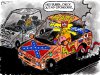
Racing The Racist
Donald Trump is a racist.
Yesterday, Donald Trump went on a racist tweet binge. In addition to his usual “China Virus” tweets, he went after the Washington Redskins and Cleveland Indians for considering changing their racist names and tweeted, “Indians, like Elizabeth Warren, must be very angry right now!” And, he went after NASCAR and the sport’s only black driver, Bubba Wallace.
Last month after NASCAR banned the hate flag from all its events, a noose was found in the garage of Wallace’s team. There was an investigation by the FBI which determined the noose was left there from last season and used as a rope pulley-thingy for the garage door…the electric garage door. But before they came to that determination, NASCAR and all the drivers stood in support for Wallace and held a demonstration against hate. Racist hated that. They saw it as another threat to their white privilege.
Trump tweeted, “Has Bubba Wallace apologized to all of those great NASCAR drivers & officials who came to his aid, stood by his side, & were willing to sacrifice everything for him, only to find out that the whole thing was just another HOAX? That & Flag decision has caused lowest ratings EVER!”
No. Bubba Wallace never did apologize for that. Why? Because he doesn’t owe anyone an apology. Bubba didn’t do anything. While Trump and his spokesgoon are calling the noose incident a “hoax,” and yesterday Kaleigh McEnany, who promised she’d never lie to us, compared it to the Jussie Smollett incident, this was not a hoax.
There was a noose in Bubba Wallace’s garage. Bubba Wallace didn’t put it there or even saw it. NASCAR discovered the noose and informed him. Even the FBI used the term “noose” to describe it. Why? Because it was a noose. And while saying it was there from last year, that’s not very reassuring. Why was it ever cool to hang nooses in NASCAR? According to the FBI, it wasn’t a hate noose, instead, just your average everyday common garage noose.
Also, there are over 1,100 garages at NASCAR venues. Only one had a noose in it. And out of over 1,100 garages, they gave the only one that had a noose in it to the ONLY black guy? I’m not into conspiracy theories but I am into facts. Those are the facts.
Donald Trump’s other racist contention was the Confederate flag being banned from NASCAR. McEnany said he wasn’t taking a position on it, yet he clearly did in his tweet. If racist Trump wasn’t taking a position, then why did he lie about the ratings and blame it on the hate flag being removed?
Donald Trump is a racist and he’s putting all his eggs into one basket of racist deplorables. But even NASCAR realizes the racist redneck base is shrinking and they’re appealing to a wider fan base. Donald Trump is refusing to do that. While Donald Trump bitches about fictional ratings, he should look at real polls. If polls were ratings, and they are, Donald Trump’s ratings are in the gutter…just like his politics.
If Donald Trump had a race car, it would have Pepe the Frog on it. Donald Trump is sponsored by hate. White supremacists and neo-Nazis love him. The hate conspiracy and online forums, 4chan and Qanon are working to reelect Trump. Sean Hannity, Tucker Carlson, and Laura Ingraham, the Eva Braun of cable news, love him. Donald Trump is their champion.
Every day, Donald Trump tells his supporters he’s a racist while at the same time, telling the rest of us he’s not. While he tweets support for the Confederate flag, spokesgoon McEnany says he hasn’t taken a position. Beyond the lie, also note she didn’t state he opposes the flag. He is a racist.
But we should also take note of who else is sponsoring his hate…so we can make sure we aren’t inadvertently sponsoring his racism by supporting those corporations. Corporations like Taco Bell, Jimmy John’s, WWE, Equinox, Bubba Gump, Marvel, Joe’s Crab Shack, Shell Oil, Nathan’s Famous, Estee Lauder, UFC, Molson Coors, Lending Tree, Hobby Lobby, CVS, Planet Fitness, LL Bean, Wendy’s, and Chick-fil-A. These are only a portion of them. Google people.
And when you see ads on my site for Donald Trump, that’s not me or WordPress supporting him. That’s his campaign buying ads and wasting money on an audience that will never support him. I don’t control the ads so stop screaming at me, fuckers.
Donald Trump is revving his engine, spinning his tires, and blowing smoke for racism. Make sure you’re not putting gas in his tank.
...
A tell-all book by President Trump’s niece describes a family riven by a series of traumas, exacerbated by a daunting patriarch who “destroyed” Donald Trump by short-circuiting his “ability to develop and experience the entire spectrum of human emotion,” according to a copy of the forthcoming memoir obtained by The Washington Post.
President Trump’s view of the world was shaped by by his desire during childhood to avoid his father’s disapproval, according to the niece, Mary L. Trump, whose book is by turns a family history and a psychological analysis of her uncle.
Donald escaped his father’s scorn and ridicule, Mary Trump wrote, because “his personality served his father’s purpose. That’s what sociopaths do: they co-opt others and use them toward their own ends — ruthlessly and efficiently, with no tolerance for dissent or resistance.”
The president, Mary Trump wrote, is a product of his domineering father and was acutely aware of avoiding the scorn that he heaped on his older brother, called Freddy, Trump writes.
“By limiting Donald’s access to his own feelings and rendering many of them unacceptable, Fred perverted his son’s perception of the world and damaged his ability to live in it.”
Mary Trump wrote that her grandfather’s children routinely lied to him but for different reasons. For her father, “lying was defensive — not simply a way to circumvent his father’s disapproval or to avoid punishment, as it was for the others, but a way to survive.”
Mary L. Trump, President Trump’s niece, plans to publish a tell-all family memoir next week, describing how a decades long history of darkness, dysfunction and brutality turned her uncle into a reckless leader who, according to her publisher, Simon & Schuster, “now threatens the world’s health, economic security and social fabric.”
The book, “Too Much and Never Enough: How My Family Created the World’s Most Dangerous Man,” depicts a multigenerational saga of greed, betrayal and internecine tension and seeks to explain how President Trump’s position in one of New York’s wealthiest and most infamous real-estate empires helped him acquire what Ms. Trump has referred to as “twisted behaviors” — attributes like seeing other people in “monetary terms” and practicing “cheating as a way of life.”
Ms. Trump, who at 55 has long been estranged from President Trump, is the first member of the Trump clan to break ranks with her relatives by writing a book about their secrets. Since late June, her family — led by the president’s younger brother, Robert S. Trump — has been trying to stop the publication of the book, citing a confidentiality agreement that she signed nearly 20 years ago during a dispute over the will of the family patriarch, Fred Trump Sr., the president’s father. But a judge in New York has refused to enjoin Simon & Schuster from releasing the memoir and is expected to soon rule on whether Ms. Trump herself violated the confidentiality agreement.
Here are some of the highlights from her manuscript: ...
Ms. Trump, a clinical psychologist, asserts that her uncle has all nine clinical criteria for being a narcissist. And yet, she notes, even that label does not capture the full array of the president’s psychological troubles.
“The fact is,” she writes, “Donald’s pathologies are so complex and his behaviors so often inexplicable that coming up with an accurate and comprehensive diagnosis would require a full battery of psychological and neurophysical tests that he’ll never sit for.”
At another point she says: “Donald has been institutionalized for most of his adult life, so there is no way to know how he would thrive, or even survive, on his own in the real world.”
Mary L. Trump, President Trump’s niece, plans to publish a tell-all family memoir next week, describing how a decades long history of darkness, dysfunction and brutality turned her uncle into a reckless leader who, according to her publisher, Simon & Schuster, “now threatens the world’s health, economic security and social fabric.”
The book, “Too Much and Never Enough: How My Family Created the World’s Most Dangerous Man,” depicts a multigenerational saga of greed, betrayal and internecine tension and seeks to explain how President Trump’s position in one of New York’s wealthiest and most infamous real-estate empires helped him acquire what Ms. Trump has referred to as “twisted behaviors” — attributes like seeing other people in “monetary terms” and practicing “cheating as a way of life.”
Ms. Trump, who at 55 has long been estranged from President Trump, is the first member of the Trump clan to break ranks with her relatives by writing a book about their secrets. Since late June, her family — led by the president’s younger brother, Robert S. Trump — has been trying to stop the publication of the book, citing a confidentiality agreement that she signed nearly 20 years ago during a dispute over the will of the family patriarch, Fred Trump Sr., the president’s father. But a judge in New York has refused to enjoin Simon & Schuster from releasing the memoir and is expected to soon rule on whether Ms. Trump herself violated the confidentiality agreement.
Here are some of the highlights from her manuscript: ...
Ms. Trump, a clinical psychologist, asserts that her uncle has all nine clinical criteria for being a narcissist. And yet, she notes, even that label does not capture the full array of the president’s psychological troubles.
“The fact is,” she writes, “Donald’s pathologies are so complex and his behaviors so often inexplicable that coming up with an accurate and comprehensive diagnosis would require a full battery of psychological and neurophysical tests that he’ll never sit for.”
At another point she says: “Donald has been institutionalized for most of his adult life, so there is no way to know how he would thrive, or even survive, on his own in the real world.”
Similar threads
- Replies
- 186
- Views
- 5K

- Replies
- 38
- Views
- 691


- Replies
- 21
- Views
- 1K
