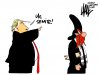
I've been plagued by a nauseating sense of recognition lately. Story after story of the pandemic response in the United States reminds me of the country that I spent most of my professional life writing about: the Soviet Union and also the Russian state that was born after its collapse but which couldn’t shake many of its traits.
One persistent Soviet trait is the ways in which Russian institutions handle information—what we might call “the culture of reporting upstairs.” The best-known example is the Soviet government’s coverup of the extent, nature, and danger of the Chernobyl nuclear disaster.
This wasn’t only, or even primarily, a matter of suppressing uncomfortable truths. What drove officials to lie was not so much a desire to conceal the facts from ordinary people as it was a need to supply the leadership with upbeat reports. For many officials, before and after Chernobyl, the production of cheerful stories that were entirely divorced from reality was a full-time job.
They lied about the number of shoes that the country’s factories had made and about the length and location of roads that its workers had built. (Once, when I was eleven or so, my parents saw a television story about a newly built road and decided to take a trip to it in our recently acquired Zhiguli car. It turned out that there was no road—only a few feet of pavement where the report had been filmed.)
Little that was made or said by official Soviet institutions fit, worked as intended, or made any sense, because so much of it existed only for the purpose of reporting upstairs. (An old Soviet joke: “What doesn’t buzz and doesn’t fit in your ass? A Soviet machine for buzzing inside your ass.”)
I find myself recognizing this culture in the U.S. now, when, for example, I read a
report in the
Times on how the
Trump Administration convinced itself, back in April, that the covid-19 pandemic was on the wane. Or when the Administration shifted the duty of collecting coronavirus data from the Centers for Disease Control and Prevention to the Department of Health and Human Services—the C.D.C. had been pliant but not, it seemed, pliant enough for Trump.
Could moving data collection to a Cabinet agency explain why the curve of new cases seemed to flatten?
I felt a similar sense of recognition when I read the
Times’ report on the fifty-two-million-dollar temporary hospital in New York City that ended up treating a total of seventy-nine covid-19 patients, while people died of the virus in other hospitals, sometimes for lack of access to care.
The facility, set up at the Billie Jean King National Tennis Center, in Queens, turned some patients away because they weren’t sick enough and others because they had a fever. Because confusion reigned over whether patients could be transferred there from other hospitals, very few were.
The chaos recalled the
U.S.N.S. Comfort, which also was supposed to ease the burden on hospitals in New York City. At what was nearly the local peak of the pandemic, only twenty of its thousand beds were occupied. Arcane and absurd rules and procedures kept it from admitting more patients.
I thought back to all the times when I would tell a story about Russia to an American friend, and how they couldn’t understand how nonsensical rules could govern and destroy people’s lives. I could never really explain it, and I always had the sense that my friends didn’t quite believe me.
For example: a person who had served time in prison in the U.S.S.R. could not obtain a residence registration—a government permit to live at a particular address—if they didn’t have a job, and they couldn’t get a job without a residence registration; not working, in turn, was an offense punishable by incarceration.
The intentional institutional ineptitude and callous nihilism of contemporary Russian society is the product of a seventy-year Soviet totalitarian experiment—or so I have long believed. No such experiment took place in the United States.
So how is it that the pandemic has made the U.S. resemble the post-Soviet Russian state?
Part of the explanation lies with Donald Trump himself, in the ways in which he
performs power. He acts like a totalitarian leader in the absence of totalitarianism—
a Mafia boss without a Mafia—and to an astonishing degree he gets away with this act. He has created a culture of reporting upstairs that is reminiscent of the Central Committee of the Communist Party; ...