Zafgen Inc.
http://zafgen.com/ (Zafgen - Dedicated to the Treatment of Obesity)
[Note: They are PRIVATE.!]
At Zafgen, we are dedicated to developing novel therapeutics to treat obesity, one of the most critical and widespread health issues, affecting more than 400 million people worldwide. Rates of obesity in developing countries have tripled in the last 20 years, and American obesity rates are the highest in the world:
Zafgen is the world’s first biopharmaceutical company dedicated to developing novel obesity therapeutics that directly target and shrink fat tissue to help the body regain and sustain a lean, healthy state. Adipose tissue (fat) in obese subjects expands because of an imbalance between fat storage and fat being converted to various other forms of readily utilizable energy, such as ketone bodies. Fat tissue loses its sensitivity to normal control mechanisms that stimulate fat release, and the liver loses its responsiveness to circulating fatty acids and cannot stimulate formation of ketone bodies. Instead, the circulating fatty acids are repackaged by the liver and are returned to the adipose tissue for storage. Consequently, dietary fats are sequestered in the growing fat tissue, and are unavailable to the body as fuel. The nature of the tissue and the interplay between fat cells and hormones plays a critical and active role in determining the overall size of the fat tissue, and therefore, an individual’s weight.
Zafgen’s groundbreaking approach targets obesity at its biological foundation by safely manipulating and restoring sensitivity of the fat tissue to natural control mechanisms, driving the loss of fat and a return to a more healthy body weight. For more information regarding Zafgen's groundbreaking technology, click here.
Zafgen is continuing to explore these remarkable insights and their potential application to a breakthrough treatment for obesity and associated co-morbidities. Substantial proof-of-concept data has been demonstrated in recognized, gold-standard animal models of obesity, and our lead molecules are currently being advanced toward clinical testing.

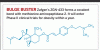
At such low doses, says Thomas E. Hughes, president and chief executive officer of Zafgen, toxicity concerns tend to evaporate, in part because so little opportunity exists to inhibit off-target proteins. Zafgen, a small pharmaceutical company in Cambridge, Mass., sees high selectivity and low toxicity with its covalent molecule for treating obesity, beloranib hemioxalate, also known as ZGN-433.
“You’re passing a wave of the molecule through the body,” he says. “It hits the different tissues, silences the target enzyme where it finds it, and then it goes away.”
Zafgen’s drug candidate inhibits an enzyme called methionine aminopeptidase 2 (MetAP2), which had been of interest in oncology circles until it turned out to be a poor target for treating cancer in mice. However, animals treated with a MetAP2 inhibitor lost weight. Zafgen pursued the enzyme as a target for obesity.
Its drug candidate contains a spiroepoxide that bonds with a histidine in the protein’s active site. ZGN-433 has undergone a Phase I clinical trial, in which obese volunteers lost up to 2 lb per week. It will enter Phase II trials within a year, Hughes says, funded by $33 million the company raised from investors.
With dosing of up to 2 mg twice per week, ZGN-433 reaches a maximum concentration in the body of just a few nanomolar for several hours before the body quickly eliminates it, Hughes says. During that time, the drug is much more likely to interact with MetAP2 than with anything else.
“You’re flying under the radar of a lot of concerns,” he says. “Drug-drug interactions are not an issue. There’s just not enough inhibitor to go around. The same is true for off-target inhibition: The chance of off-target toxicity is largely gone.”
http://zafgen.com/ (Zafgen - Dedicated to the Treatment of Obesity)
[Note: They are PRIVATE.!]
At Zafgen, we are dedicated to developing novel therapeutics to treat obesity, one of the most critical and widespread health issues, affecting more than 400 million people worldwide. Rates of obesity in developing countries have tripled in the last 20 years, and American obesity rates are the highest in the world:
Zafgen is the world’s first biopharmaceutical company dedicated to developing novel obesity therapeutics that directly target and shrink fat tissue to help the body regain and sustain a lean, healthy state. Adipose tissue (fat) in obese subjects expands because of an imbalance between fat storage and fat being converted to various other forms of readily utilizable energy, such as ketone bodies. Fat tissue loses its sensitivity to normal control mechanisms that stimulate fat release, and the liver loses its responsiveness to circulating fatty acids and cannot stimulate formation of ketone bodies. Instead, the circulating fatty acids are repackaged by the liver and are returned to the adipose tissue for storage. Consequently, dietary fats are sequestered in the growing fat tissue, and are unavailable to the body as fuel. The nature of the tissue and the interplay between fat cells and hormones plays a critical and active role in determining the overall size of the fat tissue, and therefore, an individual’s weight.
Zafgen’s groundbreaking approach targets obesity at its biological foundation by safely manipulating and restoring sensitivity of the fat tissue to natural control mechanisms, driving the loss of fat and a return to a more healthy body weight. For more information regarding Zafgen's groundbreaking technology, click here.
Zafgen is continuing to explore these remarkable insights and their potential application to a breakthrough treatment for obesity and associated co-morbidities. Substantial proof-of-concept data has been demonstrated in recognized, gold-standard animal models of obesity, and our lead molecules are currently being advanced toward clinical testing.
At such low doses, says Thomas E. Hughes, president and chief executive officer of Zafgen, toxicity concerns tend to evaporate, in part because so little opportunity exists to inhibit off-target proteins. Zafgen, a small pharmaceutical company in Cambridge, Mass., sees high selectivity and low toxicity with its covalent molecule for treating obesity, beloranib hemioxalate, also known as ZGN-433.
“You’re passing a wave of the molecule through the body,” he says. “It hits the different tissues, silences the target enzyme where it finds it, and then it goes away.”
Zafgen’s drug candidate inhibits an enzyme called methionine aminopeptidase 2 (MetAP2), which had been of interest in oncology circles until it turned out to be a poor target for treating cancer in mice. However, animals treated with a MetAP2 inhibitor lost weight. Zafgen pursued the enzyme as a target for obesity.
Its drug candidate contains a spiroepoxide that bonds with a histidine in the protein’s active site. ZGN-433 has undergone a Phase I clinical trial, in which obese volunteers lost up to 2 lb per week. It will enter Phase II trials within a year, Hughes says, funded by $33 million the company raised from investors.
With dosing of up to 2 mg twice per week, ZGN-433 reaches a maximum concentration in the body of just a few nanomolar for several hours before the body quickly eliminates it, Hughes says. During that time, the drug is much more likely to interact with MetAP2 than with anything else.
“You’re flying under the radar of a lot of concerns,” he says. “Drug-drug interactions are not an issue. There’s just not enough inhibitor to go around. The same is true for off-target inhibition: The chance of off-target toxicity is largely gone.”
Attachments
Last edited: