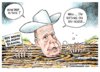
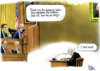
There are two ways to interpret the testimony of Attorney General Jeff Sessions as he faced
yet another round of questioning over his role in the Russian interference scandal. The first is that he is a skillful liar, flagrantly flirting with perjury as he denies or pretends to forget his
well-documented connections to Russian officials and his relationships with Kremlin-tied Trump lackeys like
George Papadopolous and
Carter Page. The second is that Sessions is suffering from severe memory loss, has a poor understanding of US law and is incapable of meeting basic requirements of his job, like properly
filling out security clearance forms.
But both of these interpretations lead me to the same conclusion: It is dangerous for Jeff Sessions to be the Attorney General of the United States.
There is arguably no one in the Trump administration who has been as loyal and consistent a player as Sessions. He was the first Senator to endorse Trump,
appearing at a rally with him in August 2015 when Trump was still a long-shot candidate. He has remained a steady presence ever since: Running the national security board of Trump’s campaign starting in March 2016 before becoming Attorney General in February 2017. In an administration replete with resignations and dramatic dismissals, Sessions has remained stable and bore witness to it all, making him perhaps one of the most well-informed people in Trump’s circle.
But despite his unparalleled access — or, more likely, because of it — Sessions claims to have tremendous difficulty recalling the last two years, at least when it comes to discussing matters of national security while under oath. When forced to confront new developments in the Russian case head on, Sessions simply changed his story, seemingly unfazed that this made his prior testimonies look deceitful.
...
Eroding the rule of law may well be the point. At the heart of the hearings are three disturbing questions: first, was Sessions involved in or aware of the Trump campaign’s possible collusion with Russia; second, did he obstruct the federal investigation by hiding what he knew; and third, is he planning to use his position to go after Trump’s enemies, as the plan to open a
second special counsel into debunked Hillary Clinton conspiracy theories seems to indicate?
These are the sorts of questions one generally asks in an autocracy, not a democracy. And unfortunately, autocratic tendencies are what we should expect from Sessions, who has long acted more as
Trump’s personal attorney than as a protector of the Constitution and a public servant to the American people. The administration of “alternative facts” has sought from the start to dilute the value of truth — both to soothe Trump’s ego, but also because the value of truth is closely linked to the integrity of law.
An experienced politician and prosecutor, Sessions is no fool, but it is in his best interest — and Trump’s — to play one. Doing so is not only a protective legal strategy, but part of a purposeful dissolution of legal norms. When truth erodes, and the law crumbles, an independent judiciary loses its rigor. In this formulation, Trump does not serve the law; Trump is the law, and Sessions is Trump’s willing servant.