

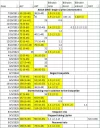
Am I correct that the blood testing results below, along with the dates of drug stops and starts, indicates that reta is likely causing liver problems

keengkong

Member
Am I correct that the blood testing results below, along with the dates of drug stops and starts, indicates that reta is likely causing liver problems? The one alternative explanation that I was able to conceive is that there is a viability in liver enzyme tests, just as a person may weigh three pounds more or less 24 hours apart without there being a real change in terms of lasting effect. I don't have enough experience or knowledge of liver test results to know whether the alternative explanation is reasonable. I did not exercise for a few days before the liver enzyme tests. By the way, I don't plan on resuming Lipitor (atorvastatin) since I already had elevated enzymes while on it. I intend to speak with my cardiologist about pitavastatin. I take no drugs designed to increase muscle size or strength (e.g., AAS, TRT, HGH). I'm only asking on Meso because I figure people here are likely better at interpreting blood results than folks on GLP-1 forums; I do often hang out on Meso, though. These results are are little concerning to me since tirz alone was not getting me to a weight that I wanted to be. Reta plus tirz had already resulted in a 55 pound weight loss and it appeared I could lose more, although I would be quite happy to simply maintain the 55 pound weight loss. The tirz alone resulted in about a 40 pound weight loss, which then stopped. I'm not a big risk taker: I don't want to do anything risky with my liver. My inclination is to stop taking reta today and not to take it again without the hepatologist's approval; as a practical matter, he is unlikely to approve me resuming reta at least until it's FDA approved.
1759426311162.webp
 
Last edited:
Yes. It's rare, but in a very small number of trial subjects. very rapid liver fat clearance becomes hepatoxic. At least one subject even developed hepatitis, turned yellow. etc. Fully recovered.

Any reason to believe. you have high levels of liver fat?
 
Yes. It's rare, but in a very small number of trial subjects. very rapid liver fat clearance becomes hepatoxic. At least one subject even developed hepatitis, turned yellow. etc. Fully recovered.

Any reason to believe. you have high levels of liver fat?
Thanks for your response.

I had been trying to find liver hepatoxicity information on retatrutide but hadn't found any incidents through my own own research. I had read about a few examples for tirzepatide. For years, I've been told that I have fatty liver disease. The endocrinologist ordered some sort of scan that supposedly showed that I have a fatty liver. Then I went to the hepatologist who who conducted the attached Fibroscan, which shows, according to my understanding, that I do not have a fatty liver disease.

I have listed the tirzepatide articles below in case anyone else is having liver issues with tirzepatide. But I hadn't found anything on hepatoxicity with retatrutide.

In the tirzepatide articles, there is usually a mention of a possibility that the liver toxicity was caused by rapid defatting of the liver. However, I don't recall any conclusions that that is what likely happened. In my case, it appears that the most recent increase is liver enzymes is not caused by rapidly defatting of the liver since my liver was not fatty.

Abdullah, et al. (2024). Tirzepatide-Related Acute Liver Injury. Eur. J. Case Rep. Internal Med., 11(9), 004813 [24-year old female teacher; 6 months to onset].

Ahmed, et al. (2025). A Rare Case of Tirzepatide-Induced Hepatitis - Causality Assessment With the RUCAM Criteria. Annals Internal Med., 4(1) [female in her thirties; three months to onset].

Berihun, et al. (2023). A Rare Case of Tirzepatide-Induced Liver Injury. Am J. Gastroenterology, 118(10S), S2282 [37-year old woman; 2.5 months to onset].


Fontana, et al. (2024). First Report of Tirzepatide Hepatotoxicity with Jaundice. Clin. Gastroentereology Hepatology, 22(12), 2538 [64-year old male; six weeks to onset; article attached].

Phox, et al. (2025). Tirzepatide-Induced Liver Injury - A Rare Medication Side Effect. ACG Case Rep. J. 12(4), e01661 [76-year old female; eight weeks to onset].

Sohal, et al. (2024). A rare case of tirzepatide-induced hepatotoxicity. ACG Case Reps. J. 11(10), e01484 [37-year old female; 2 1/2 months to onset]. This appears to the same incident reported in Berihun, et al. (2023). A Rare Case of Tirzepatide-Induced Liver Injury. Am J. Gastroenterology, 118(10S), S2282.
 

Attachments

I was very impressed with ChatGPT when I had a long chat where ChatGPT said that reta had a likely RUCAM score of 7 (probable cause of liver injury) compared to a RUCAM score of 1 (unlikely cause) for atorvastatin. Unfortunately, after I read how ChatGPT was calculating stuff and compared that to instructions on calculating a RUCAM score, I realized that ChatGPT is has trouble following the rules it says it's following even if you give it the numbers. Although I can debunk what ChatGPT says, I can't confidently independently run the numbers. Still I don't plan on returning to reta other than by doing a challenge with a doctor's approval. And that won't happen until reta is FDA approved.
 
Back
Top