Wuhan Wansheng Biotechnology Co., Ltd. (USA, International)

I was wondering whatever happened to your order!

This is the first reported seizure from WWB since SSA went down. At least I think.

EU or US??

US

I know can’t recall a single person actually getting a seizure letter here that’s why I wanted to post. I honestly just assumed it was lost in a shipping container bc of the storm and holiday.

Reship landed. Mom has it in possession just have to wait to head to their house this week to video open it
 
WWB Black Friday Sale 2025
* Event Dates: 11/24st *

Please contact the WWB sales rep to obtain an updated price list for shipments from the China warehouse

Telegram:@Cavan221
Whatsapp:+1 (840) 220 7435(Cavan)
Whatsapp:+1 (912) 996 6694(Gary)
Whatsapp:+1 (912) 577 6269(Harlan)
Whatsapp:+1 (912) 419 0244(Angel)
Whatsapp:+44 7928 317187(Daisy)

Summary
All products are 5-15% off compared to before the promotion.

✅ Guarantees
✔ Mass Guarantee
✔ Reshipment Policy(USA and Europe only)

SHIPPING
* Free on orders $1000+(Only before 11/28)

Tracking number updated within 3-4 business days after payment verification.

WWB Team
 
WWB Black Friday Sale 2025
* Event Dates: 11/24st *

Please contact the WWB sales rep to obtain an updated price list for shipments from the China warehouse

Telegram:@Cavan221
Whatsapp:+1 (840) 220 7435(Cavan)
Whatsapp:+1 (912) 996 6694(Gary)
Whatsapp:+1 (912) 577 6269(Harlan)
Whatsapp:+1 (912) 419 0244(Angel)
Whatsapp:+44 7928 317187(Daisy)

Summary
All products are 5-15% off compared to before the promotion.

✅ Guarantees
✔ Mass Guarantee
✔ Reshipment Policy(USA and Europe only)

SHIPPING
* Free on orders $1000+(Only before 11/28)

Tracking number updated within 3-4 business days after payment verification.

WWB Team
Am I reading your price list correctly, you have 100iu hgh vials? 1000iu a kit for $365?
 
CC

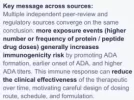
It 1000% depends on the peptide look at specific studies on glp1s they generally show that antidrug antibodies have little effect on effectiveness even with long term use.

That’s a misinterpretation, albeit an understandable one, of the situation.

You’re only seeing the end result, the winner at the finish line, of one of the most challenging parts of creating a new protein therapeutic drug.

Until recently, 70% of new protein drugs failed because immunogenicity couldn’t be overcome. That’s improved because of potent AI based systems that can predict every one of millions of potential ways peptides can go wrong in manufacturing, or degrade in storage, and show if they’ll trigger immunogenicity, so those immunogenic defects and contaminants can be dealt with early in the process of designing a new protein drug. (Or killing it before time and money is wasted if immunogenicity can’t be overcome).

By the time development has successfully gotten past the immunogenicity control stage of development into publicly visible studies and trials, you’re seeing the end product of a massive effort.

What you’re actually seeing is that-

Levels of anti-drug antibodies don’t rise high enough to cause a problem in these specific conditions:

-A very carefully controlled, repeatable manufacturing process that identifies, minimizes, and analyzes every single potential contaminant that does or could form.

-Delivered in a precise formulation where excipients are used to protect the peptide against degradation by controlling things like PH and preventing immunity triggering aggregates from forming.

-Using dosing on a scheduled protocol established by Pharma with immunogenicity control as part of the design.

The end result is anti-drug antibodies rise after administration of a dose, and by the time the next dose of this perfected, low antibody triggering formulation is administered, they’ve dropped to the point that when the next dose triggers more, levels of anti-drug antibodies level off and don’t keep rising week after week.

Unlike UGL:

-Manufactured in uncontrolled, highly variable conditions, with no assessment of that process’s unique impurities and how it impacts immunogenicity.

-The protein is sold by the lab and put into random formulations, using different excipients by the UGL to make the final lyophilized vial.

-Reconstituted to random concentrations therefor volume for each dose is random, so pharmacokinetics (speed of absorption) is random, with the sensitive protein exposed to random levels of PH in solution, depending on what was used for BAC, and how much, ranging from Hospira to contaminant filled Amazon “reconstitution solution” tap water and rubbing alcohol, with a randomly chosen .5ml to 3ml for the entire vial.

It goes on and on, to include the leachables unique to the container, in our case shit class vials that shed borosilicate shards into the liquid (that literally turns proteins into a “spike vaccine” that helps build an immunity against the drug), and lowest grade Chinese rubber vial stoppers that leak the chemical equivalent of used-tire soup into the solution the protein is in. (By contrast, if the stopper or plunger material changes in a pharma pen, pharma has to demonstrate and certify to the FDA the immunogenic risk profile hasn’t changed).

Now add in to this nightmare recipe for immunogenicity maximization, the coups-de-gras, more frequent “exposure events” via micro-dosing.

And before anyone chimes in with “but it works”, usually, sure, but as well as the same dose as pharma? Not in my experience, anecdotal as that is. Immunogenicity’s effects aren’t developed quickly or do anything dramatic. The drug’s impact just slowly dims over months or years, sometimes never to return.

Do these UGL compounds lose effectiveness over time (and not the normal dynamic of GLPs lessening in effect as weight is lost)? A lot of people claim they do, anecdotally. How difficult would that be to assess accurately? It sure seems like the success rate is higher in the large scale, multi year pharma trials involving tens of thousands of subjects, than on Reddit, where doses keep rising, people leap from one compound to another, stacking is now the norm, and the complaints of falling efficacy are endless.

No one is monitoring this, no antibody tests are taken, UGLs cant be held liable, and no one cares what happens to users of black market drugs.

So we should try to control what we can, to most closely replicate the conditions that were established by Pharma to minimize immunogenicity, perhaps even filter to remove the aggregates that are enemy #1, because the worst effect isn’t lessening of efficacy by developing immunity to these drugs. It’s the potential of cross immunity developing to the endogenous incretin hormones they mimic. The threat of this happening is real, a “low probability high impact” event. It’s used as THE justification for the huge focus and effort by Pharma and regulators to minimize the risk of immunogenicity before it happens.

This isn’t a theory of mine, it’s based on years of research into this topic, and seeing how it applies to UGL. I can back up every concept expressed here, I just don’t bother putting in the effort to link endless references that no one will read.

 
Last edited:
“oNcE a wEEk??” dErP “wHaT dO 800 dRuG dEvELOpMEnT sCiEnTisTs On ElI’s gLp tEaM knOw?” dErP

“gOnNa gEt mE sUm
sTaBLe LEvELs!!
1763941192372.webp
Once a week administrations are already showing clinical effectiveness subsiding after about a year, which is why most semaglutide users switched to tirzepitide. If switching from one blast a week to three moderate doses reduces the effectiveness even more, I'm already on Reta longer than I was on sema before it stopped working. So I guess I'm either a special case, or perhaps the risk they purport is just that, and not an assurance that this is a statistically proven result of violating their precious once a week approach, which yields maximum public compliance and profit, not optimal administration.

And as far as their "concern" over immunogenicity, at least in my case both my homocysteine and CRP have come down significantly during my taking of Reta (CRP by 50%), so I'm not sure when that is supposed to kick in, but it sure is taking a while, and frankly moving in the opposite direction.

I see zero concern based on this risk characterization, but to the degree that some people get scared back into once a week administrations, good on you...
 
Cardarine just landed. Ordered 11/2, delivered today. Bottles Hepius branded. Tablet not pressed well enough to split. Pretty much dissolved on tongue before I could take a swig of water.
So. I've let the last 2 of these tablets dissolve on my tongue and there's been no bitter drug flavour at all as i'd expect. A little googling has suggested that Cardaine GW50516 is actually quite unpleasantly bitter.

Anyone have any experience?

Do WWB reimburse testing? Hard to justify $170 plus shipping to Jano test a few bottles that cost $25 each.

Currently assuming its bunk/fillers, based on taste alone.
 
Last edited:
So we should try to control what we can, to most closely replicate the conditions that were established by Pharma to minimize immunogenicity, perhaps even filter to remove the aggregates that are enemy #1, because the worst effect isn’t lessening of efficacy by developing immunity to these drugs. It’s the potential of cross immunity developing to the endogenous incretin hormones they mimic. The threat of this happening is real, a “low probability high impact” event. It’s used as THE justification for the huge focus and effort by Pharma and regulators to minimize the risk of immunogenicity before it happens.

This isn’t a theory of mine, it’s based on years of research into this topic, and seeing how it applies to UGL. I can back up every concept expressed here, I just don’t bother putting in the effort to link endless references that no one will read.

That's fair, and is a great argument in favor of a pharma-only approach. In the absence of that option, as pharma is priced (even considering recent discounts) orders of magnitude out of the reach of your average grey market user, one could at least minimize exposure by dosing their UGL GLPs once a week to minimize immunogenicity effects. For people set on taking GLPs for the long term that would be in their best interest. But for those of us planning to cycle them and/or eventually get off of them entirely you could argue that aggregate exposure to the riskier elements of UGL products will have less total exposure vs a life-long diabetic pharma GLP user. Not to mention our propensity to step further out on the risk curve anyways in our pursuit of everything from UGL GLPs to AAS vials that have bugs floating in them.

Everyone has a different level of risk acceptance. This is another interesting layer of that, but your average UGL GLP buyer is far more concerned with price and availability vs a potential risk of the drug not working because of overexposure to unsanitary elements.
 
Back
Top