Spectrum Services

:popcorn:

I'm leaving this thread; it seems that threats and accusations have been made towards me as well.
But I'm not going to be pressured into taking sides to protect any of the parties involved as a result of these threats. If any of the parties choose to bring greater attention to themselves through their continued participation in this thread, that is their prerogative. They are encouraged to defend themselves and identify any specific misinformation posted by members. They will not be censored for doing so.
 
How could a patient be prosecuted because a doctor prescribed them a medication? Do you have any idea what the implications would be if that were to happen? Do you know how many doctors prescribe pain killers to patients who don't need them? Or medications in general to patients that don't need them? It happens all the time. The gov't is very careful not to intervene, because of the obvious implications.

You cited an article about a Cleveland cop who got busted for buying steroids for non-medical purposes. My interpretation of that was he had purchased so much juice that it was obvious he was distributing (ie a non-medical purpose). He was probably a source for other officers in the department. Not only that, but he was having the insurance company pay for it all. His downfall was likely the insurance company crying foul. He was committing fraud.

You probably didn't catch this about the fireman in Cleveland who was busted for the same thing, yet plead guilty...

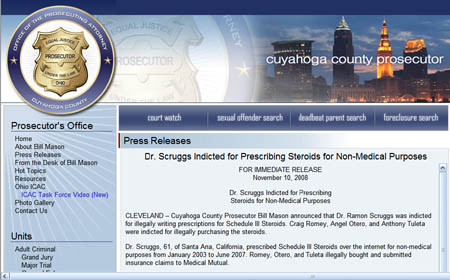
" Former Cleveland firefighter Craig Romey, 39, also bought steroids from Scruggs and billed Medical Mutual. He served 30 days of probation after pleading guilty in May to drug possession.

His driver's license was suspended until Nov. 14. He paid back $22,355 to Medical Mutual and now lives in Las Vegas, according to court records. "


Jury finds Cleveland police officer guilty of buying steroids illegally | cleveland.com

The dude bought $22,000 worth of AAS, likely distributed to his co-workers, committed insurance fraud and got 30 days probation on a plea deal. And you are worried about the Feds prosecuting someone for being prescribed medication by a doctor? Would be a complete waste of taxpayer money, not to mention the totally wrong thing to do as it is obvious here there were honest-hearted clients of this organization who didn't have a clue what they were getting into. (and that's assuming these claims about spectrum are true -- which i have no way of knowing)

I'm not a lawyer, but unless you are buying tons of juice and getting your insurance company to cover it all, I think you have nothing to worry about.

I wrote about this at this at the time. I think this may have been one of the first times an individual was prosecuted for "invalid" (illegal) prescriptions for steroids:


Prosecutors have rarely pursued cases against individual steroid users who obtained steroids with a doctor’s prescription. Successful prosecution would require successfully defining and proving legally ambigous issues like what constitutes a “valid medical prescription,” “legitimate medical purpose,” and “doctor-patient relationship.” Only recently has legislation (i.e. Ryan Haight Act) been introduced to clarify such definitions. Perhaps prosecutors are now emboldened to take on such cases now that the Act has passed and will be enacted in April 2009Â (“Ryan Haight Act: Internet Pharmacy Criminal Defense Issues,” October 1).

The Ryan Haight Act attempts to clear up the ambiguity associated with with what constitutes valid prescriptions. The current version of the The Controlled Substances Act makes it illegal to distribute any of its schedule III and IV drugs; however, it exempts from prosecution individuals that have licenses to distribute controlled Schedule III and IV substances with a valid prescription (i.e. physicians). 21 USC 829(b). The CSA refrains from noting what a valid prescription is. Instead, one must look to the C.F.R. 1306.04(a):
“A prescription for a controlled substance to be effective must be issued for a legitimate medical purpose by an individual practitioner acting in the usual course of his professional practice.​

The confusion lies, as I have previously discussed, in what actually constitutes “acting in the usual course of professional practice.â€Â Previous cases and the DEA equate that to the need for a doctor-patient relationship. Unfortunately, the Federation of State Medical Boards has expressly said that online consultations without doctor physical examinations do, in fact, constitute doctor-patient relationships.

The defendants brought attention to their steroid use by submitting insurance claims for large quantities of anabolic steroids and/or other performance enhancing drugs ($95,000, $23,355 and $9,262 worth of steroids and HGH over a 3-1/2 year period). The insurance company determined that the steroids were prescribed for non-medical purposes and turned the case over to the DEA.
 
Still no one has answered can patients of Spectrum be in legal trouble? Were the prescriptions obtained legally? If not can you then be charged with possession?

It looks like this dispute will be hitting the courts and will certainly open the eyes of the govt.

How could a patient be prosecuted because a doctor prescribed them a medication? Do you have any idea what the implications would be if that were to happen? Do you know how many doctors prescribe pain killers to patients who don't need them? Or medications in general to patients that don't need them? It happens all the time. The gov't is very careful not to intervene, because of the obvious implications.

You cited an article about a Cleveland cop who got busted for buying steroids for non-medical purposes. My interpretation of that was he had purchased so much juice that it was obvious he was distributing (ie a non-medical purpose). He was probably a source for other officers in the department. Not only that, but he was having the insurance company pay for it all. His downfall was likely the insurance company crying foul. He was committing fraud.

You probably didn't catch this about the fireman in Cleveland who was busted for the same thing, yet plead guilty...

" Former Cleveland firefighter Craig Romey, 39, also bought steroids from Scruggs and billed Medical Mutual. He served 30 days of probation after pleading guilty in May to drug possession.

His driver's license was suspended until Nov. 14. He paid back $22,355 to Medical Mutual and now lives in Las Vegas, according to court records. "


Jury finds Cleveland police officer guilty of buying steroids illegally | cleveland.com

The dude bought $22,000 worth of AAS, likely distributed to his co-workers, committed insurance fraud and got 30 days probation on a plea deal. And you are worried about the Feds prosecuting someone for being prescribed medication by a doctor? Would be a complete waste of taxpayer money, not to mention the totally wrong thing to do as it is obvious here there were honest-hearted clients of this organization who didn't have a clue what they were getting into. (and that's assuming these claims about spectrum are true -- which i have no way of knowing)

I'm not a lawyer, but unless you are buying tons of juice and getting your insurance company to cover it all, I think you have nothing to worry about.


That pretty much says it. The word is INTENT.
 
The DEA has decided to make the medical determination about whether a prescription is valid (legal). Whether the DEA has any business in determining appropriate medical prescriptions is another question.

According to the Drug Enforcement Administration: "For a prescription to be valid under [U.S.] federal and state law, there must be a bona fide doctor patient relationship, which is defined by most state laws to require a physical examination. Completing a questionnaire that is then reviewed by a doctor hired by the internet pharmacy could not be considered the basis for a doctor/patient relationship." Vol. 66 Federal Register 82, PP 21181-21184 (April 27, 2001)

Of course, the aforementioned Ryan Haight Act attempted to clarify (and codify) this.
 
The DEA has decided to make the medical determination about whether a prescription is valid (legal). Whether the DEA has any business in determining appropriate medical prescriptions is another question.

Of course, the aforementioned Ryan Haight Act attempted to clarify (and codify) this.

Correct me if I am wrong, but in the case of the Cleveland cop, the DEA was not prosecuting that case, were they? I could have read it wrong. Obviously with the Cleveland cop, you've got a guy who bought $95,000 worth of roids and put in insurance claims for all of it. That's going to raise some eyebrows ESPECIALLY if somebody else on the squad finds out about it that wasn't supposed to know. That guy was a cop and I'm assuming he was distributing to other cops. So, we don't know who was on the inside working against him also. We don't have all the facts of the case either. There could have been mountains of evidence against him and the only charges they pursued were the ones they knew they would nail him on. Different set of circumstances imho.
 
HCG is prescribed for secondary hypogonadism and fertility issues which is used for inconjunction to TRT. I fillout the damn insurance verifications all the time LOL

Yes, but hCG is NOT approved by the FDA for long-term use as an ADJUVANT to TRT to prevent testicular atrophy. Google the PI for Novarel and read it.

- Dan
 
[It should be noted that AAS do have certain statutory restrictions on their use. That is for another post, but can be found within the state CSA as well as the federal statutes. There is also the very real and imposing state restriction of the Medical Practice Act, which is fairly uniform amongst states. The consideration is the term "legitimate medical purpose." Again, for a later discussion]

The FDCA gives the Food and Drug Administration ("FDA") the authority and responsibility for approving newly developed drugs or medical devices before they may be used in medical practice. [21 U.S.C. § 355.] Approval of a drug or device is contingent upon a showing of its safety and its efficacy in achieving its purported effects. [21 U.S.C. § 355(d).]

Once the FDA approves a drug or device for one particular use, however, a physician may legitimately prescribe it for uses other than those identified in the FDA approval - so-called "off-label" uses - according to the physician's professional judgment regarding the best course of treatment. [21 U.S.C. § 396 ("Nothing in this chapter shall be construed to limit or interfere with the authority of a health care practitioner to prescribe or administer any legally marketed device to a patient for any condition or disease within a legitimate health care practitioner-patient relationship."). See also Buckman Co. v. Plaintiffs' Legal Comm., 531 U.S. 341, 350-51 (2001) ("[T]he FDCA expressly disclaims any intent to directly regulate the practice of medicine and... off-label use is generally accepted." (internal citations omitted)); James M. Beck and Elizabeth D. Azari, FDA, Off-Label Use, and Informed Consent: Debunking Myths and Misconceptions, 53 Food & Drug L.J. 71,72 (1998) ("It is an accepted principle that once FDA determines that a drug or device can be marketed, a physician's discretionary use of that product (the practice of medicine) is not restricted to the uses indicated on FDA-regulated labels. Off-label use is widespread in the medical community and often is essential to giving patients optimal medical care....").]

Therefore, while FDA approval of the specific use of a drug may support a conclusion that such a use constitutes the legitimate practice of medicine, the lack of approval for a specific use does not necessarily mean that use falls outside the scope of legitimate medical practice. [See United States v. Evers, 643 F.2d 1043, 1049 (5th Cir. 1981) ("[T]he provisions of the [FDCA] and the regulations of the FDA that are now in force do not prevent [a physician] from prescribing for uses not approved by the FDA drugs which have been approved by the FDA for some other purpose.").]

I believe I said that, albeit in a less verbose form. ;)

- Dan
 
Correct me if I am wrong, but in the case of the Cleveland cop, the DEA was not prosecuting that case, were they? I could have read it wrong. Obviously with the Cleveland cop, you've got a guy who bought $95,000 worth of roids and put in insurance claims for all of it. That's going to raise some eyebrows ESPECIALLY if somebody else on the squad finds out about it that wasn't supposed to know. That guy was a cop and I'm assuming he was distributing to other cops. So, we don't know who was on the inside working against him also. We don't have all the facts of the case either. There could have been mountains of evidence against him and the only charges they pursued were the ones they knew they would nail him on. Different set of circumstances imho.

Upon further research of the case, the DEA was involved. The insurance company contacted them when they saw inordinate amounts of roids being prescribed to the cop. I also didn't realize the doctor that went down was the same guy who supplied Troy Glaus and Scott Schoenweis (two MLB players). :rolleyes: Anyway, it will be interesting to see how this all plays out. :popcorn:
 
They were not selling them,

Investigators believe the men used the drugs for bodybuilding and did not sell them, Miday said. None of the four men could be reached to comment on the charges


http://www.zimbio.com/Anabolic+Steroids+Information/articles/112/Police+Lieutenant+Charged+Possession+Steroids
 
I'm not a lawyer, but unless you are buying tons of juice and getting your insurance company to cover it all, I think you have nothing to worry about.

Especially if you have a bona fide diagnosis of hypogonadism (aka "Low-T") by pre-treatment lab values.

- Dan
 
They were not selling them,

Investigators believe the men used the drugs for bodybuilding and did not sell them, Miday said. None of the four men could be reached to comment on the charges


http://www.zimbio.com/Anabolic+Steroids+Information/articles/112/Police+Lieutenant+Charged+Possession+Steroids

I still say unless you've been prescribed tens of thousands of dollars worth of roids and billed your insurance company for all of it, you more than likely have nothing to worry about. I mean, they gave that firefighter guy 30 days of probation and no jail time for the guilty plea bargain. What does that tell you? highly unlikely they would peg you just because you were an occasional HRT client of this company. If that is the case, I wouldn't worry yourself over it. THat's all I am saying.
 
I'm 51 years old and I have been a Spectrum client for 3 years and am pleased with their services. My consultant is not Chip Wadowski so I cannot comment on him, but my consultant has conducted yearly blood tests and I have discussed the results and my HRT dosages yearly with a doctor.
I think cvictorg has a vendetta against Chip and/or Spectrum and this thread could jeopardize my (and others) HRT treatment with his unsubstantiated accusations. Its probably too late to delete the thread, but I just wanted to comment that my interactions with Spectrum have been lawful and the medications have been authentic and have improved my quality of life.
 
Just received a note from my Spectrum consultant as he responded to my private message at another board - Chip was fired on friday for a valid reason (he gave me the details, but I'll refrain from posting it as this thread is ugly enough). He stated Chip is not a doctor and cannot practice and has broken Hippa laws by contacting spectrum patients. He added that spectrum lawyers will take care of Chip.
 
DEA Publishes Policy on Prescribers’ Legitimate Use of Agents
FDA Law Blog: DEA Publishes Policy on Prescribers’ Legitimate Use of Agents

By John A. Gilbert & Peter M. Jaensch

On October 6, 2010, the Drug Enforcement Administration (“DEA”) announced a Statement of Policy - http://edocket.access.gpo.gov/2010/pdf/2010-25136.pdf - concerning the procedure by which a registrant-prescriber may use an agent, including a nurse in a long term care facility (“LTCF”), to communicate controlled substances prescriptions to a pharmacy.

DEA notes on background that “[w]hile the core responsibilities [of] prescribing controlled substances may not be delegated…an individual practitioner may authorize an agent to…communicat[e] such prescriptions to a pharmacy in order to make the prescription process more efficient.”

The Policy provides a discrete summary of “acts that an agent may take in connection with controlled substance prescriptions.” It enumerates that:

1. An agent may “prepare a written prescription for the signature of the practitioner,” provided the practitioner has “in the usual course of professional practice” made the necessary determinations regarding the legitimate medical need, and has specified the “required elements” of the prescription to the agent.

2. An agent may telephone a pharmacy concerning a prescription for a controlled substance in schedules III through V and convey the practitioner’s otherwise valid oral prescription provided the prescriber has specified all required prescription information.

3. Where otherwise permissible to fax a controlled substance prescription to a pharmacy, the agent may do the actual faxing.

The Notice further states that “[d]ue to the legal responsibilities of practitioners and pharmacists under the CSA and the potential harm to the public from inappropriate and unlawful prescribing and dispensing of controlled substances,” DEA advises practitioners and their agents to commit their agency authorization to writing.

Importantly, DEA states that a nurse in a LTCF may act as practitioner’s agent. The Notice closes with a sample of a written authorization that DEA would consider adequate. This is an area that industry has been seeking clarification on for a long time. DEA’s Notice moves this issue in the right direction.

Notably, the Notice advises that although “not required by DEA,” the agency authorization original should be kept by the practitioner during the life of the agency, and for the two years following. The DEA further notes that a pharmacist’s corresponding duty applies, and even where the pharmacists has a copy of the agency authorization, depending on circumstances, further inquiry may still be necessary to fulfill that duty in connection with a prescription communicated via agent.

The Federal Register Notice advises parties seeking further information to contact Mark W. Caverly, Chief of the Liaison and Policy Section, Office of Diversion Control, DEA, 8701 Morrissette Drive, Springfield, VA 22152, (202) 307-7297.

 

Attachments

A simple search reveals the tangled web of SPECTRUM SERVICES LLC: Vinson M Disanto Business Relationships

8461
 

Attachments

  • SPECTRUM-LLC.gif
    SPECTRUM-LLC.gif
    9.2 KB · Views: 64
I've never used Spectrum but I use APS, which is mentioned in the OP.

So as far as we know, are they or are they not under investigation?
 
I've never used Spectrum but I use APS, which is mentioned in the OP.

So as far as we know, are they or are they not under investigation?

They've been under federal investigation, executives/doctors indicted for steroid distribution/conspiracy, and president sentenced to prison for 10 years. This is old news.


They've been under federal investigation, executives/doctors indicted for steroid distribution/conspiracy, and president sentenced to prison for 10 years. This is old news.


A pharmacy called APS in North Florida is far from the same pharmacy you are bringing up FROM ALABAMA in this thread. Are you really as pompous and arrogant as you come across in all your post?[:o)]
 
They've been under federal investigation, executives/doctors indicted for steroid distribution/conspiracy, and president sentenced to prison for 10 years. This is old news.


I think that's a different APS. The one I use is based out of Florida, not Alabama.


http://apsmeds.com/company.html
 
I think that's a different APS. The one I use is based out of Florida, not Alabama.


http://apsmeds.com/company.html

My mistake. It is unfortunate that they share the similar name to one that was prosecuted. Confusion is inevitable.
 

Sponsors

Latest posts

Back
Top