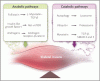
Anabolic and Catabolic Signaling Pathways - Skeletal-Muscle Mass

Michael Scally MD

Doctor of Medicine
10+ Year Member
10346


Androgens, growth hormone mimetics, and follistatin activate anabolic pathways, a process that results in the accrual of muscle mass. In the opposing process, catabolic pathways that are regulated by myostatin and ubiquitin ligases result in the breakdown of skeletal muscle. The abbreviation mTOR denotes mammalian target of rapamycin, and TGF-? transforming growth factor ?.
 

Attachments

  • Anabolic-Catabolic.gif
    Anabolic-Catabolic.gif
    151 KB · Views: 48
Guardiola O, Lafuste P, Brunelli S, et al. Cripto regulates skeletal muscle regeneration and modulates satellite cell determination by antagonizing myostatin. Proc Natl Acad Sci U S A. Cripto regulates skeletal muscle regeneration and modulates satellite cell determination by antagonizing myostatin

Skeletal muscle regeneration mainly depends on satellite cells, a population of resident muscle stem cells. However, our understanding of the molecular mechanisms underlying satellite cell activation is still largely undefined. Here, we show that Cripto, a regulator of early embryogenesis, is a novel regulator of muscle regeneration and satellite cell progression toward the myogenic lineage. Conditional inactivation of cripto in adult satellite cells compromises skeletal muscle regeneration, whereas gain of function of Cripto accelerates regeneration, leading to muscle hypertrophy. Moreover, we provide evidence that Cripto modulates myogenic cell determination and promotes proliferation by antagonizing the TGF-beta ligand myostatin. Our data provide unique insights into the molecular and cellular basis of Cripto activity in skeletal muscle regeneration and raise previously undescribed implications for stem cell biology and regenerative medicine.
 
Useless, to whom? Perhaps you would appreciate these pathways if you were more cognizant of their significance since if either "side" is modulated, using the varied drugs available to athletes today, the end product atrophy vs hypertrophy is also modified. I will admit the biochemical nomenclature are not for the
"faint of heart" or the everyday Meso member. However, there are a few members on this forum whom believe the basic sciences are the inception of understanding physiological processes and I thank Dr S for posting the article. It will certainly expedite my search for related material in the future.
:)
 
another useless post

Useless, to whom? Perhaps you would appreciate these pathways if you were more cognizant of their significance since if either "side" is modulated, using the varied drugs available to athletes today, the end product atrophy vs hypertrophy is also modified. I will admit the biochemical nomenclature are not for the
"faint of heart" or the everyday Meso member. However, there are a few members on this forum whom believe the basic sciences are the inception of understanding physiological processes and I thank Dr S for posting the article. It will certainly expedite my search for related material in the future.
:)

Thanks Dr JIM.

UFgrad777, IMO, was referring to his own post!
 
Miretti S, Martignani E, Accornero P, Baratta M. Functional effect of mir-27b on myostatin expression: a relationship in piedmontese cattle with double-muscled phenotype. BMC Genomics 2013;14(1):194. BMC Genomics | Abstract | Functional effect of mir-27b on myostatin expression: a relationship in piedmontese cattle with double-muscled phenotype

BACKGROUND: In Piedmontese cattle the double-muscled phenotype is an inherited condition associated to a point mutation in the myostatin (MSTN) gene. The Piedmontese MSTN missense mutation G938A is translated to C313Y myostatin protein. This mutation alters MSTN function as a negative regulator of muscle growth, thereby inducing muscle hypertrophy. MiRNAs could play a role in skeletal muscle hypertrophy modulation by down-regulating gene expression.

RESULTS: After identifying a 3[prime]-UTR consensus sequence of several negative and positive modulator genes involved in the skeletal muscle hypertrophy pathway, such as IGF1, IGF1R, PPP3CA, NFATc1, MEF2C, GSK3b, TEAD1 and MSTN, we screened miRNAs matching to it. This analysis led to the identification of miR-27b, miR-132, miR-186 and miR-199b-5p as possible candidates. We collected samples of longissimus thoracis from twenty Piedmontese and twenty Friesian male bovines. In Piedmontese group miR-27b was up-regulated 7.4-fold (p < 0.05). Further, we report that the level of MSTN mRNA was about 5-fold lower in Piedmontese cattle vs Friesian cattle (p < 0.0001) and that less mature MSTN protein was detected in the Piedmontese one (p < 0.0001). Cotransfection of miR-27b and psi-check2 vector with the luciferase reporter gene linked to the bovine wild-type 3[prime]-UTR of MSTN strongly inhibited the luciferase activity (79%, p < 0.0001).

CONCLUSIONS: These data demonstrate that bovine MSTN is a specific target of miR-27b and that miRNAs contribute to explain additive phenotypic hypertrophy in Piedmontese cattle selected for the MSTN gene mutation, possibly outlining a more precise genetic signature able to elucidate differences in muscle conformation.
 
I always like the "CONCLUSION" part the best,
cause I can't understand shit you write most the time..
as you can tell, by the look on my face :D

I just learned what the word ADAMANT
means not too long ago :(


Right now, I think we are in a contest to see who can change their avatars more often.
 
I always like the "CONCLUSION" part the best,
cause I can't understand shit you write most the time..
as you can tell, by the look on my face :D

I just learned what the word ADAMANT
means not too long ago :(

10919

Is your face in there somewhere? Is this a game like "Where's Waldo?"
 

Attachments

  • MW.gif
    MW.gif
    26.3 KB · Views: 14
Last edited:
Being the ass man that I am I may seriously crank one out if MW keeps that pic!

My girl looks like that and she
used to always walk around the
house in panties and little shirt..
when we first met..

I had to tell her, that she has to stop
or I want sex all day long.
She just smiled :D
 
I have written previously about RNAi technology. This technology is being currently investigated in humans. The main impediment is getting into the cell. Further, IMO, the future for muscle is NOT AAS. The future is downstream or side-stream pathways.

Hu S, Ni W, Sai W, et al. Knockdown of Myostatin Expression by RNAi Enhances Muscle Growth in Transgenic Sheep. PLoS One 2013;8(3):e58521. PLOS ONE: Knockdown of Myostatin Expression by RNAi Enhances Muscle Growth in Transgenic Sheep

Myostatin (MSTN) has been shown to be a negative regulator of skeletal muscle development and growth. MSTN dysfunction therefore offers a strategy for promoting animal growth performance in livestock production. In this study, we investigated the possibility of using RNAi-based technology to generate transgenic sheep with a double-muscle phenotype.

A shRNA expression cassette targeting sheep MSTN was used to generate stable shRNA-expressing fibroblast clones. Transgenic sheep were further produced by somatic cell nuclear transfer (SCNT) technology. Five lambs developed to term and three live lambs were obtained. Integration of shRNA expression cassette in three live lambs was confirmed by PCR. RNase protection assay showed that the shRNAs targeting MSTN were expressed in muscle tissues of three transgenic sheep. MSTN expression was significantly inhibited in muscle tissues of transgenic sheep when compared with control sheep.

Moreover, transgenic sheep showed a tendency to faster increase in body weight than control sheep. Histological analysis showed that myofiber diameter of transgenic sheep M17 were bigger than that of control sheep. Our findings demonstrate a promising approach to promoting muscle growth in livestock production.
 
[OA] mTOR as a Key Regulator in Maintaining Skeletal Muscle Mass

Maintenance of skeletal muscle mass is regulated by the balance between anabolic and catabolic processes. Mammalian target of rapamycin (mTOR) is an evolutionarily conserved serine/threonine kinase, and is known to play vital roles in protein synthesis.

Recent findings have continued to refine our understanding of the function of mTOR in maintaining skeletal muscle mass. mTOR controls the anabolic and catabolic signaling of skeletal muscle mass, resulting in the modulation of muscle hypertrophy and muscle wastage.

This review will highlight the fundamental role of mTOR in skeletal muscle growth by summarizing the phenotype of skeletal-specific mTOR deficiency. In addition, the evidence that mTOR is a dual regulator of anabolism and catabolism in skeletal muscle mass will be discussed.

A full understanding of mTOR signaling in the maintenance of skeletal muscle mass could help to develop mTOR-targeted therapeutics to prevent muscle wasting.

Yoon MS. mTOR as a Key Regulator in Maintaining Skeletal Muscle Mass. Front Physiol 2017;8:788. https://www.frontiersin.org/articles/10.3389/fphys.2017.00788/full

 
[OA] mTOR as a Key Regulator in Maintaining Skeletal Muscle Mass

Maintenance of skeletal muscle mass is regulated by the balance between anabolic and catabolic processes. Mammalian target of rapamycin (mTOR) is an evolutionarily conserved serine/threonine kinase, and is known to play vital roles in protein synthesis.

Recent findings have continued to refine our understanding of the function of mTOR in maintaining skeletal muscle mass. mTOR controls the anabolic and catabolic signaling of skeletal muscle mass, resulting in the modulation of muscle hypertrophy and muscle wastage.

This review will highlight the fundamental role of mTOR in skeletal muscle growth by summarizing the phenotype of skeletal-specific mTOR deficiency. In addition, the evidence that mTOR is a dual regulator of anabolism and catabolism in skeletal muscle mass will be discussed.

A full understanding of mTOR signaling in the maintenance of skeletal muscle mass could help to develop mTOR-targeted therapeutics to prevent muscle wasting.

Yoon MS. mTOR as a Key Regulator in Maintaining Skeletal Muscle Mass. Front Physiol 2017;8:788. https://www.frontiersin.org/articles/10.3389/fphys.2017.00788/full


A reasonable understanding of anabolic/catabolic pathways sure helps “but it all together” on a physiologic basis.

Of course the problem for many is understanding how modulating
one pathway CAN and often does
influence anabolic processes in OTHER pathways.

A word of caution in this regard,
MANY resalers use single pathway verbiage as a means of
misrepresenting the effects of compounds being sold as “anabolic”.

And In doing so a number of PEDs from SARMS to Myostatin inhibitors could be expected to be more anabolic than AAS yet NONE have even come close!

Why, the influence of OTHER pathways
on anabolic metabolism!

Jim
 
Last edited:
[OA] mTORC Inhibitors as Broad-Spectrum Therapeutics for Age-Related Diseases

Chronological age represents the greatest risk factor for many life-threatening diseases, including neurodegeneration, cancer, and cardiovascular disease; ageing also increases susceptibility to infectious disease. Current efforts to tackle individual diseases may have little impact on the overall healthspan of older individuals, who would still be vulnerable to other age-related pathologies. However, recent progress in ageing research has highlighted the accumulation of senescent cells with chronological age as a probable underlying cause of pathological ageing.

Cellular senescence is an essentially irreversible proliferation arrest mechanism that has important roles in development, wound healing, and preventing cancer, but it may limit tissue function and cause widespread inflammation with age. The serine/threonine kinase mTOR (mechanistic target of rapamycin) is a regulatory nexus that is heavily implicated in both ageing and senescence.

Excitingly, a growing body of research has highlighted rapamycin and other mTOR inhibitors as promising treatments for a broad spectrum of age-related pathologies, including neurodegeneration, cancer, immunosenescence, osteoporosis, rheumatoid arthritis, age-related blindness, diabetic nephropathy, muscular dystrophy, and cardiovascular disease.

In this review, we assess the use of mTOR inhibitors to treat age-related pathologies, discuss possible molecular mechanisms of action where evidence is available, and consider strategies to minimize undesirable side effects. We also emphasize the urgent need for reliable, non-invasive biomarkers of senescence and biological ageing to better monitor the efficacy of any healthy ageing therapy.

Walters H, Cox L. mTORC Inhibitors as Broad-Spectrum Therapeutics for Age-Related Diseases. International Journal of Molecular Sciences 2018;19. http://www.mdpi.com/1422-0067/19/8/2325/htm
 
Back
Top