Alzheimer’s

What I've been trying to find - if it exists at all - is if MCT use is contraindicated for T2 diabetics. She's just recently T2D and on metformin.
 
What I've been trying to find - if it exists at all - is if MCT use is contraindicated for T2 diabetics. She's just recently T2D and on metformin.

I`ll see what I can find out about it and T2.

My pharmacist couldnt find any contraindicatinon re T2, but is if hyperTG

I didnt mean starting at full dose.
Its needs to be titrated up for sure. See link.
I meant dividing the daily dose into maybe 3 parts as in with meals, rather than one larger dose once a day as per Rx. Seems like you would get a more consistant supply of ketones. to the brain. But I dont know beans about ketone metabolism yet.
 
Last edited:
I`ll see what I can find out about it and T2.

My pharmacist couldnt find any contraindicatinon re T2, but is if hyperTG

I didnt mean starting at full dose.
Its needs to be titrated up for sure. See link.
I meant dividing the daily dose into maybe 3 parts as in with meals, rather than one larger dose once a day as per Rx. Seems like you would get a more consistant supply of ketones. to the brain. But I dont know beans about ketone metabolism yet.

Hyper TG? What is that?


What I'm thinking is starting off at only one small dose (maybe one-third or about 7 gm) right after breakfast for two or three days. Then increase the dose to two-thirds. That would be one-third dose twice a day right after meals for 2 or 3 days. Then full daily dose (20 mg) split into 3 parts, one for each meal.

All I see on contraindications that's relevant is this one for Axona:

http://www.webmd.com/drugs/drug-151...rugid=151755&drugname=Axona+Oral&pagenumber=5

She doesnt have any of those.
 
Hyper TG? What is that?


What I'm thinking is starting off at only one small dose (maybe one-third or about 7 gm) right after breakfast for two or three days. Then increase the dose to two-thirds. That would be one-third dose twice a day right after meals for 2 or 3 days. Then full daily dose (20 mg) split into 3 parts, one for each meal.

All I see on contraindications that's relevant is this one for Axona:

Contraindications for Axona Oral

She doesnt have any of those.

High triglycerides. If so could cut some of them from the diet. No big deal.
Skimmed half a dozen papers on the subject and it seems that the kidney plays a role in the very complex chemistry of ketone body metabolism as does the liver. I get the impression that ketoacidosis might possibly sometimes maybe be an issue in T2diabetes.
We are talking about a couple tablespoons of oil, albeit a special oil.
The brain requires ~4-6g glucose/hr. That equalls a couple grams/hr of ketone bodies.
1g carb=5kcal
1g fat=9kcal
I find the entire chain of chemical reactions that are involved but no TIME REFERENCE.
I`m going with 3 times a day.
Axona probably diceided on once a day for the convenience of the user of some shit like that.
 
Also read somewhere that it takkes an hour or 2 to do the chemistry of the MCT to ketone bodies conversion. So the first dose of the day is first thing in the morning.
The stuff doesnt have any taste so shouldnt be a problem.
Regarding milkfat:
"About 50 percent of milk fat is made from short-chain fatty acids" which are more readily convertable to ketone bodies via the Krebbs Cycle. So whole milk is back in the diet.
 
I'm getting more conservative in how we're going to ramp up her dosage.

With the Ultra Nutr. MCT Oil:

1 teaspoon is about 5 ml and full dose is 22 ml. I wont exceed 22 ml, so we'll only go up to 20 ml at full dose or 4 teaspoons. Sheez, the volumes are small!

I dose per day, am right after breakfast

0.5 teaspoon days 1 and 2

1.0 teaspoon days 3 and 4

1.5 teaspoon days 4 and 5

repeat up to 4 teaspoons a day and see how it goes at each step and then maybe go to 5 teaspoons.

She gets milk in the half-and-half in her coffee every morning - she wont start her day without it.

If we see results right away, we're going to annoy the hell out of her doctor for a script for Axona. Their insurance will cover it.
 
Guess you didnt find anything contraindicative re T2D? Hope so.
Seems like a safe and sound dosing plan. We are taking a more all out approach.
You and others have pretty much convinced me of the benefits of cutting carbs in the diet.
Hers and mine. Not sure how to accomplish it exactly but am sure there is a way.
Also am requesting lipids panels for both of us within the week.
:)
 
No, I havent found anything that seems to be a contraindication.

Right after that last post I realized she's already been on two teaspoons of coconut oil a day, so that's already about one-third the full dose. That allows me to start her off a bit higher with MCT oil, say, about one-half full dose or two teaspoons. It hasnt arrived yet, so we may start tomorrow.

That's great to hear re cutting carbs! Start with the ones everyone agrees are BAD: sugar and wheat. Do no be afraid to eat FAT: meat, fish, eggs and PLEASE give it more than a week - let me explain why....

When you greatly lower your carb intake, your insulin level will start dropping and once that happens the fat cells will more easily release stored fat into the bloodstream. So, INITIALLY, your lipids may go up, but after some time - it can be as soon as a week for some people, but it's usually more like 10 or 15 days, minimum - they will drop. When your insulin level has been lowered for a while here's what happens:

Your BP will go down. As soon as you see it and if you're on meds for it, start tapering because it can get dangerously low. Low carb (less than 20-50 gm/day) is wickedly diuretic! Drink LOTS of water!

Your cells will slow their manufacture of cholesterol (because less insulin means less HMG-CoA-reductase stimulation) and will start sending more receptors to pull cholesterol out of the bloodstream so your serum lipid concentration will eventually drop. This doesnt happen overnight, but it will happen. At that point, start tapering your statin/niacin. Btw, you should start taking Ubiquinol (best absorbed form of Co-Q10) if you're on a statin or have just come off it. IMHO, the very minor benefit statins have comes from their supression of rho-kinase and not from lowering LDL:

Statins Inhibit Rho Activation

That is supression of inflammation (IMHO, that's what REALLY causes heart disease, not cholesterol) and there are better ways to do it (e.g., take fish oil) than putting a sledgehammer to your liver.

Eventually, your fasting BG will drop too, but that can take even longer.

Keep me posted!
 
And yes, I remembered you have FH. Just go easy and monitor with bloodwork as often as you like - you're smart enough to make good judgements. At the very least, you might reduce your statin/niacin dose.

I just heard this morning that she's perked up a bit after two days back on coconut oil!
 
And yes, I remembered you have FH. Just go easy and monitor with bloodwork as often as you like - you're smart enough to make good judgements. At the very least, you might reduce your statin/niacin dose.

I just heard this morning that she's perked up a bit after two days back on coconut oil!

LMAO- Wanna read what her GP wrote about me in his notes? :(
I`m very glad to hear that about your mom.:)
Also gonna run the Atkins diet, for me, by my kidney Dr. He`s been on top of everything I`ve thrown at him. Unlike my wifes GP.
Did you see the tv program on sugar metabolism? Think it was either the Research Channel or UCTV. Something you said in another thread was right on. Anyway, they went into detail- surprising how much fructose contributes to LDL.
BTW what do you Atkins people do for fiber? Cardboard or Metamucil?


:)
 
Last edited:
Veggies. Pork rinds are good to satisfy the starchy cravings.

Ive done every drug known to mankind at one time or another. Even suspect we cooked up some new ones one semester in the organic lab. But this shit scares the hell out of me.
I have a pretty firm Dx of familial hypercholesterolemia. That is a defect in the LDL receptor.
[ame="http://en.wikipedia.org/wiki/Familial_hypercholesterolemia"]Familial hypercholesterolemia - Wikipedia, the free encyclopedia@@AMEPARAM@@/wiki/File:Xanthelasma_palpebrarum.jpg" class="image"><img alt="" src="http://upload.wikimedia.org/wikipedia/commons/thumb/e/e3/Xanthelasma_palpebrarum.jpg/230px-Xanthelasma_palpebrarum.jpg"@@AMEPARAM@@commons/thumb/e/e3/Xanthelasma_palpebrarum.jpg/230px-Xanthelasma_palpebrarum.jpg[/ame]
If I choose to commit suicide, I`m not going alone.
All for the veggies, the more complex the carb structure the better, but need MUCH better evidence befor starting the lard.
 
Memories Can’t Wait
Researchers rethink the role of amyloid in causing Alzheimer’s
http://www.sciencenews.org/view/feature/id/70236/title/Memories_Can%E2%80%99t_Wait

By Laura Sanders
March 12th, 2011

The polite term for what Alzheimer’s disease does to the brain is “neurodegeneration.”

In reality, it’s more like violent, indiscriminate devastation. Alzheimer’s scrambles communication channels, incites massive inflammation and demolishes entire brain regions as once plump cells shrivel and die, burying memories in the wreckage. As the attack intensifies, Alzheimer’s gradually strips away a person’s mind, and ultimately the cognitive abilities that permit a conversation with a loved one, a smile or a taste of food.

A couple of decades ago, some researchers thought they knew the root cause of this brain invasion?—?dangerous buildups of a protein called amyloid-beta. Get rid of these big, sticky globs and cure the disease, the reasoning went. But in recent years, a deeper understanding of the disease, along with a few disappointing clinical trials, has challenged long-held assumptions and forced a reevaluation of this strategy.

Many researchers are convinced that A-beta is still a key target. A litany of damning evidence from genetics, pathology reports and lab experiments makes that case. Yet recent results show that A-beta is not the same foe it was originally thought to be. Smaller pieces of A-beta?—?not the large plaques that were formerly indicted?—?are likely to be malicious, capable of destroying nerve cell connections, several new studies show. Other data coming from sophisticated imaging techniques may illuminate how, when and where A-beta accumulates in the brain, and how this buildup might relate to diminished mental powers.

Yet the fact that A-beta can also accumulate in healthy brains, among other findings, has caused some Alzheimer’s researchers to shift their sights away from that protein. A new model proposes that inflammation, along with the harmful marinade it brings, might be a central cause of the disease. Other studies are turning up links between Alzheimer’s and the curious tendency of brain cells under stress to double their genetic material.

While the cause of Alzheimer’s remains elusive, the extent of its threat to the brain is becoming increasingly clear. Each week, new studies chronicle the damage in ever more detail: Chemicals that carry messages between nerve cells go MIA, brain cells’ birthrates plummet, cells’ energy output goes haywire, cell waste begins to pile up and harmful reactive chemicals get produced. Ultimately, brain cells die.

Teasing apart this tangled web?—?in which it’s nearly impossible to distinguish a diabolical mastermind from a lowly hired gun or even an innocent bystander?—?isn’t easy. If it were, the problem would be solved by now. “I think we have to be honest and say this is an incredibly complicated condition, and it’s going to be very hard to tackle it,” says Alzheimer’s researcher Lennart Mucke of the University of California, San Francisco.

A tangled web

It’s no surprise that A-beta has attracted so much attention from those intent on unraveling the mysteries of Alzheimer’s. Ominous deposits of the protein (along with tangles of another protein, called tau, that has also garnered a fair share of investigation) were what caught the eye of German physician Alois Alzheimer when he first described the disease a little over a century ago. His postmortem exam of a patient’s brain revealed the amyloid plaques that have been associated with Alzheimer’s disease ever since.

But much remains unknown about A-beta. While it has been shown that A-beta is a snippet cut from the larger amyloid precursor protein, found in nearly every cell in perfectly healthy brains, A-beta’s normal function remains murky. Studies have hinted that the protein might aid nerve cell activity or combat dangerous pathogens. Others suggest A-beta is merely a cellular by-product that adopted a new and damaging role.

In the tangle of Alzheimer’s, one thing is clear: Old age is the No. 1 risk factor, a frightening realization as the front edge of the baby boomer tide turns 65 this year. The disease is “obviously an epidemic of staggering proportions, and obviously of great economic impact,” says neuroscientist Sam Sisodia of the University of Chicago. Alzheimer’s is the fastest growing cause of death from major disorders in the United States, and a recent analysis estimates that the nation’s annual cost of Alzheimer’s-related care will exceed $1 trillion by 2050.

Alzheimer’s is unlike anything else clinicians have treated: In most cases, no one knows what causes it. It can’t be definitively diagnosed until a pathologist cuts into the dead brain. There is no known cure or therapy for prevention, and even if there were, it wouldn’t be clear when to use either one. Many believe the disease causes its irreparable damage years before symptoms appear.

“We have therapies that help with the symptoms, but we don’t have disease-modifying treatments,” says Paul Aisen of the University of California, San Diego School of Medicine, a neurologist who tests potential Alzheimer’s drugs. “And we don’t know what the best target is, and we don’t know what the best timing is.”

But many scientists in the field find hope in the fact that they have sketched out the broad outline of how the disease works, pointing to new targets for therapies. One key to filling in that sketch, scientists now know, is understanding brain cell communication.

Brain chatter, interrupted

A-beta scrambles neural dispatches in an unexpected way, new work from neuro¬scientist Gabriel Silva of the University of California, San Diego suggests. In a dish of brain cells called astrocytes, a droplet of the A-beta protein sparked a signal that can silence chatter between nerve cells, the brain’s main communicators. The signal traveled as a wave of calcium atoms that washed across cells, kicking off a series of damaging events that could end with disrupted nerve cell communication.

“Amyloid-beta is sufficient, completely on its own, to induce these things,” Silva says of the finding, which was published last year in ASN Neuro. These calcium waves have also been spotted in mice loaded down with the human form of A-beta to mimic the high levels found in some Alzheimer’s patients. (A-beta doesn’t usually accumulate in the brains of mice.) It’s still not clear whether A-beta triggers calcium waves in human brains.

A-beta probably has a more direct path to harming synapses, the junctures where messages, including those that create memories, are transmitted between nerve cells. In mice, an abundance of A-beta can order an assassination of a protein that’s important for forming memories, a study by Mucke and colleagues published in the Jan. 6 Natureshowed.

Normally this protein, called EphB2, oversees the action of a signaling molecule that moves across synapses and helps create new memories. In the experiments, A-beta latched on to EphB2 and helped move it to the cellular dump. Without the right levels of EphB2, synapse-traveling molecules went haywire. “Nerve circuits couldn’t perform properly anymore, and the mouse couldn’t learn or remember properly,” Mucke says. “The whole information processing pathway comes apart.”

Mucke and his colleagues reversed these memory deficits in mice carrying heavy loads of A-beta by boosting levels of the EphB2 protein. Studies show that people with Alzheimer’s have less EphB2 in their brain cells, so protecting the protein from A-beta or artificially boosting its levels might be a way to reverse cognitive decline, Mucke says.

A-beta may also hit another target at the synapse. In mouse brains with high levels of A-beta, a protein called Caspase-3 was busier than normal, a dangerous hyperactivity that led to the disintegration of dendrites, a nerve cell’s message-receiving extensions. This A-beta–Caspase-3 combo caused dendrites’ demise in the hippocampus, the brain’s center for forming memories, researchers reported in the January issue of Nature Neuroscience. Dampening Caspase-3’s activity protected these dendrites, suggesting that, like EphB2, Caspase-3 might be a good place to intervene to protect nerve cell communication from Alzheimer’s disease.

Small but dangerous

These assaults at the synapse were led by diminutive forms of A-beta called oligomers. Small, dissolvable pieces of A-beta, they are the building blocks of the large, insoluble fibrils that form the plaques first spotted by Alois Alzheimer. Oligomers are quickly gaining notoriety as a more probable villain than the well-studied plaques.

Data from neuroscientist Caleb Finch’s group at the University of Southern California in Los Angeles, and work by other researchers, have made the case that the oligomers are the most damaging form of A-beta. “We are convinced that the oligomeric forms, small assemblies of three to 10, are more toxic than the long fibrils,” Finch says.

In fact, mice with a form of A-beta that can’t accumulate into large fibrils still show memory troubles, Takami Tomiyama of Osaka City University Graduate School of Medicine in Japan and colleagues reported last year in the Journal of Neuroscience.

This result “adds powerfully to our theory,” Finch says.

Right now, there’s no way to visualize these A-beta oligomers in a living human brain. Autopsies and recent developments in brain imaging allow researchers to see larger A-beta plaques, but working backward from the plaque to estimate amounts of the smaller oligomers is tricky. This elusive relationship, says Sam Gandy of Mount Sinai Medical Center in New York City, throws a wrench in studying oligomers in the brain. “It’s really hard to get a good accounting of how much is there.”

Lots of simulations and test-tube experiments have attempted to demystify the oligomer-plaque relationship?—?for example, by considering whether there’s a critical mass of oligomers required for plaque formation. But the “exploded drugstore” in the brain confounds the math, Finch says. Chemicals and salts floating around in the brain may influence the conversion rate of A-beta oligomers into plaques. “You can do beautiful model assemblies in a test tube … but how relevant that is to the mess of small molecules in the brain is imponderable,” he says.

A-beta logistics

Even though it’s not yet clear how to measure oligomer levels from plaque, or vice versa, new brain imaging techniques may help clear up another problem: identifying who’s at risk.

In 2002, University of Pittsburgh researchers William Klunk and Chester Mathis tested a compound, Pittsburgh Compound B or PiB, that sticks to plaques of A-beta in the brain and may serve as an Alzheimer’s beacon in an imaging scan. Though relatively new, PiB is gaining more and more credence as a reliable measure of A-beta plaques. An autopsy on the first Alzheimer’s patient to ever undergo a PiB scan confirmed that the tracker was indeed detecting A-beta plaques, Swedish researchers reported January 1 inBrain.

A major question researchers expect PiB to help answer is when A-beta buildup starts. Though PiB hasn’t been around long enough for long-term studies, preliminary results suggest that A-beta plaques appear years before brainpower declines. Healthy people with a strong PiB signal in their brains are more likely to exhibit mild dementia within the next few years, a small study published in 2009 in the Archives of Neurology found.

This potentially long lag time between the start of the disease and debilitating symptoms fits with clinical observations, says neurologist Randall Bateman of Washington University School of Medicine in St. Louis. “Clinical symptoms are only seen when the neurons are dead,” he says. “We know that people aren’t symptomatic until they lose 60 to 70 percent of the neurons in key brain regions.”

Waiting until a person exhibits severe cognitive problems and then trying to reverse them is like “throwing a rope to a guy that’s already jumped off the building,” says neuroscientist Charles Glabe of the University of California, Irvine, who is working on a vaccine-based strategy to decrease A-beta in the brain. “He’s going to hit.”

Modern medicine’s approach to treating heart disease isn’t to withhold therapies until after the heart fails, Aisen and colleagues pointed out January 18 in Neurology. Once treatments are found, figuring out exactly when Alzheimer’s sets in will probably help to make them much more effective.

Yet caution is needed when interpreting a PiB-positive or PiB-negative brain scan, especially when considering estimates that 20 to 50 percent of healthy people go about their business with brains chock-full of A-beta plaques. Many of those fully functional brains would easily earn an Alzheimer’s diagnosis with PiB scanning. It’s not clear whether, if people were to live long enough, anyone walking around with A-beta plaques in the brain would eventually succumb to Alzheimer’s.

“If I’m cognitively normal, do I care if I have amyloid in my brain?” Klunk said at the 2010 Society for Neuroscience meeting in San Diego. “Is it irrelevant, or is it like blood pressure, where you’re not sick but you’re walking around with 200 over 120? That’s not a good thing.”

A-beta buildup may be the most obvious, common and even leading cause of Alzheimer’s. But for some people, A-beta may indeed be irrelevant.

A new battle plan

Neurobiologist Karl Herrup of Rutgers University says that the idea of Alzheimer’s without A-beta must be considered. Herrup points to patients who exhibit all of the cognitive impairments that follow Alzheimer’s disease, yet for whom subsequent imaging experiments or postmortem tests find no plaques in the brain. “When I talk to clinicians about it, they all agree that this is a real category, that it’s not just the occasional person.”

Other pieces of evidence don’t add up either, Herrup says. The presence of A-beta plaques in cognitively healthy people raises doubts about A-beta as the bad actor it was once assumed to be. So does A-beta’s failure, in mice, to elicit the kind of massive and widespread neuron death seen in Alzheimer’s.

“We’ve filled mouse heads with plaques, and oligomers for that matter,” Herrup says. “And what we’ve created is, at best, mild cognitive impairment…. If you go to the Alzheimer’s ward of any institution, most of the residents there would be ecstatic to be returned to the level of function in our worst mouse model.”

Another particularly troubling piece of data is that, so far, lowering A-beta levels in human brains hasn’t improved brainpower. A drug called bapineuzumab, thought to shuttle A-beta out of the brain, decreased amyloid plaques in the brain but didn’t boost brainpower in patients with mild to moderate disease, a clinical trial published in Lancet Neurology last year showed.

“The main issue is that none of these amyloid-lowering therapies have improved cognitive function,” Gandy says. “If there had been a benefit to any of the things that lowered amyloid, then that would obviously put all the doubt to rest.”

That’s not to say A-beta doesn’t have a role in the disease. But in some cases A-beta may not be leading the charge.

Instead, Herrup proposes a new model of how Alzheimer’s disease sets in and spreads?—?a model that moves A-beta out of the limelight. First comes an injury, which may be related to some sort of vascular event such as a microstroke or mild head trauma suffered during a fall. This minor event then kicks off an inflammatory response in the brain.

This inflammation, Herrup and others argue, may be at the core of Alzheimer’s disease. The “inflammation hypothesis” holds that given enough time, the harmful stew of factors triggered by an injury can cause major, irreversible damage to brain cells.

Herrup’s model demotes A-beta but doesn’t discharge it entirely. It turns out that A-beta probably worsens inflammation, and inflammation may spur more A-beta formation.

“The major issue is chicken and egg,” says Finch. “Right now, I don’t think the cause-and-effect aspect of inflammation in Alzheimer’s disease can be resolved, but everybody recognizes that it’s enmeshed in the process in a fundamental way.”

Extended inflammation triggers a permanent change in brain cells, a point of no return, Herrup proposes. “The cells don’t care any longer about whether there’s amyloid in their environment, or whether there’s inflammation in their environment,” he says. “They have crossed the Rubicon.” After this point, no intervention or therapy could help.

Herrup’s hunch is that this switch might be related to a curious fact about neurons: When they’re under stress, they duplicate their genetic material. Usually, when most cells in the body do this, it’s in preparation for replication of the whole cell, and the new copy of the cell gets the extra set of DNA. But instead of dividing, neurons under duress just chug along with double the amount of DNA. Once the DNA is doubled, there’s no way for a brain cell to get rid of it, short of dividing. And neurons don’t divide.

“I’m afraid it’s been one of those observations that no one can fit anywhere, so they always smile and say, ‘Well, that’s really interesting,’ and go back to what they were doing,” Herrup says.

Researchers don’t yet know whether this extra DNA is harmful, but it’s clear that the stunted duplication occurs more in brain cells battling Alzheimer’s. In people with the disease, not only were brain cells more likely to have extra copies of DNA, but those cells were also at a greater risk of death, German researchers suggested in a paper published in July in the American Journal of Pathology.

The link between extra DNA and neurons fated for destruction, though intriguing, is preliminary. It may turn out to be another red herring on the quest to find Alzheimer’s ultimate cause. Neatly assigning roles to the entire cast of characters at work in Alzheimer’s disease, and finding ways to counteract them, remains challenging.

“How close are we to understanding Alzheimer’s disease? That’s the same question we were asking 10 years ago,” Sisodia says. “And we’ll be asking that same question 10 years from now.”


8985


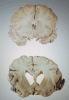
Differences in a healthy brain (top) and a diseased one (bottom) clearly show the damage wrought by Alzheimer’s.


8986


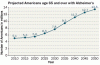
As the baby boomers age, the number of elderly Americans with Alzheimer’s is projected to reach 13.5 million by 2050. Assuming no breakthroughs in treatment, health care costs will continue to increase as well.


8987


Though amyloid-beta has long been implicated in Alzheimer’s disease, figuring out just how the protein harms the brain has proved tricky. A-beta appears to cause problems when it aggregates into other forms and accumulates, perhaps because of overproduction or slow clearance. In its small oligomer form, A-beta can damage synapses, message-relaying connections between nerve cells. By setting off cascades of reactions, oligomers can also damage neural extensions called dendrites. Oligomers can clump into fibrils, which then form the large amyloid plaques characteristic of the disease. Many other potential culprits are also being investigated, some of which alter A-beta activity and some of which appear to cause damage in different ways.


8988


In a PET scan, labeled PiB protein lights up when bound to amyloid plaques in the brain. A healthy person (top) has little binding compared with the high levels seen in an Alzheimer’s patient (middle). But high levels are also found in some healthy people with no cognitive problems (bottom).


8989


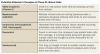
A small number of Alzheimer’s interventions, some highlighted below, are currently in Phase III clinical trials, which are undertaken after preliminary studies show that a drug is safe and may be effective. Right now, more than 800 clinical trials?—?including those at earlier stages of testing?—?are searching for potential Alzheimer’s therapies. Among those are therapies that examine the effects of exercise, diet and inflammation-reducing drugs.

 

Attachments

  • 02.gif
    02.gif
    63.1 KB · Views: 25
  • Alzheimer’s_boom.gif
    Alzheimer’s_boom.gif
    12.6 KB · Views: 25
  • alzheimers_illustration_zoo.gif
    alzheimers_illustration_zoo.gif
    184 KB · Views: 25
  • Plaque_marker__.gif
    Plaque_marker__.gif
    40.8 KB · Views: 25
  • alzheimers_table_zoom1.gif
    alzheimers_table_zoom1.gif
    54.4 KB · Views: 25
Last edited:
But this shit scares the hell out of me.
I have a pretty firm Dx of familial hypercholesterolemia. That is a defect in the LDL receptor.

All for the veggies, the more complex the carb structure the better, but need MUCH better evidence befor starting the lard.

That's why I'm saying lose the sugar and wheat first. There's too many empty calories in both and you wont have to start snacking on bars of butter right away.:D

Which type of FH are you? Het or Hom?

The science behind the heart benefits of fiber in the diet is about as strong as the science behind the idea that cholesterol causes heart disease. I.e., it isnt. In fact, there are many reasons to think fiber may actually be harmful!

Whole Health Source: Dietary Fiber and Mineral Availability

It might be useful if you get constipated, but otherwise, I wouldnt worry too much over it.

I know the new Atkins diet book is out, but you might also want to read "Protein Power" written by Drs Michael and Mary Dan Eades. It's from 1996 and I've seen it listed on amazon for a penny! It explains this way of eating better than Atkins, IMHO.

Didnt see the TV program. What did they say? Sugar promotes more LDL? No kidding! And it will be the small and dense (atherogenic) variety too! Carbs, in general can/will do this if you're eating most of your calories as carbs.They've known this for, like, 30 friggin years and they still dont want to tell people to lay off the carbs! SIGH!

You want large, boutant, non-atherogenic LDL? EAT FAT. You want to lower your Lp(a)? EAT FAT. You want to raise your HDL and lower your TRIGS? EAT FAT. All the biochemistry was sorted out a long time ago and none of it is controversial, but NOBODY except a few want to recognize and implement the dietary benefits of avoiding carbs and eating more fat.


Btw: That last post from Dr. Scally was excellent!
 
Last edited:
Did someone say Lard?

http://www.proteinpower.com/drmd_blog/nutrition/lardy-lardy-when-will-they-learn/
 
[We never have eaten much sugar. A bit in the coffee with the cocao.
That's why I'm saying lose the sugar and wheat first. There's too many empty calories in both and you wont have to start snacking on bars of butter right away.:D
Peanut butter, Smuckers, works well.FONT=["Arial Black"] The cheaper MCT oil, really coconut oil has a nice nutty taste, btw.[/FONT]

Which type of FH are you? Het or Hom? The Dx was based on personal and family Hx. Never looked at it further, probably hetero

The science behind the heart benefits of fiber in the diet is about as strong as the science behind the idea that cholesterol causes heart disease. I.e., it isnt. In fact, there are many reasons to think fiber may actually be harmful!

Whole Health Source: Dietary Fiber and Mineral Availability

It might be useful if you get constipated, but otherwise, I wouldnt worry too much over it.

I know the new Atkins diet book is out, but you might also want to read "Protein Power" written by Drs Michael and Mary Dan Eades. It's from 1996 and I've seen it listed on amazon for a penny! It explains this way of eating better than Atkins, IMHO.
I wish I had the time to research all this properly!!! Not that I doubt your credability or anything like that.

Didnt see the TV program. What did they say? Sugar promotes more LDL? No kidding! And it will be the small and dense (atherogenic) variety too! Carbs, in general can/will do this if you're eating most of your calories as carbs.They've known this for, like, 30 friggin years and they still dont want to tell people to lay off the carbs! SIGH!
They went thru all the pathways for all the different sugars in a lecture format. .


You want large, boutant, non-atherogenic LDL? EAT FAT. You want to lower your Lp(a)? EAT FAT. You want to raise your HDL and lower your TRIGS? EAT FAT. All the biochemistry was sorted out a long time ago and none of it is controversial, but NOBODY except a few want to recognize and implement the dietary benefits of avoiding carbs and eating more fat.
You present convincing argumentts. Thats for sure.


Btw: That last post from Dr. Scally was excellent!
Yes it was :)
 
No problem, my friend. If/when you feel like going LC, let me know and I'll be glad to help out.

No MCT Oil delivery yet so no news on that front today.
 
A Door Closes

Brown RE. A Door Closes. JAMA: The Journal of the American Medical Association 2011;305(10):977-8. A Door Closes, March 9, 2011, Brown 305 (10): 977 — JAMA

“Why am I here?” she asked for the fifth time in as many hours. The tone of her voice was at once plaintive and a bit belligerent. “Why am I here?” she repeated, as if I had not answered fast enough. I looked up from the book I was reading. “You are here in the hospital because you got pneumonia and were very sick,” I answered, just as I had each of the other times. “Oh, that's right,” she mumbled and went back to watching Wheel of Fortune . . . unequivocally her favorite pastime.

Helen, 86, has progressive dementia; maybe multi-infarct, perhaps Alzheimer’s. Who knows? As one might expect, her tendency is to forget the things that happened ten minutes ago while remembering well all of the events that punctuated my childhood. After my father died, several years ago, she went to a progressive care facility and has done well, mostly; but as time has passed, I have witnessed an indolent and relentless change in the clarity of her thinking. This hospitalization had taken her another step or two down the road to severe.

“What does DNR mean anyway?” she inquired, having spied the purple bracelet on her arm. I told her that it meant “Do not resuscitate.” “Oh,” she said and went back to her program again for nearly ten minutes. “What does resuscitate mean?” she inquired, unexpectedly. “Mom, it means do not pump on your chest,” I responded. “Why would someone want to do that?” she continued. “Well, if something happened to you, like, like . . . ” My voice trailed off as I had trouble saying the D word. “Like if I died!” she interrupted. “Yes, like if you died, exactly,” I interjected, and she finished with, “Well, I should think not!”

The progression of dementia in my mother has been heartbreaking, and the perverse slide down the hill to total incapacity looms in front of us. Now, some days she can remember things, some days she cannot. Sometimes she can use a fork; sometimes she has to rake her food in with a spoon. It varies weekly, daily, and, sometimes, hourly.

Occasionally, she will ask about her grandchildren; usually not. I have noticed that she has become less clear on who belongs to what individual generation in our extended family; who is the son of whom, who is the person graduating from college and why do I know them. I clearly remember talking to her on the telephone one day last year about the upcoming marriage of my oldest son, her grandson. During the course of the conversation, she chided me for getting married without telling her. (I have been married, happily, for 20 years.) “No, Mom, not me! Your grandson!” When I asked her about what kind of person her father, my grandfather, was, she began to describe my dad, as if they were the same person. During the last months, she has wandered into the parking lot to stand in the cold in her pajamas and has tried to get up on her walker, only to fall and fracture her pelvis. A year ago she was much more mobile and aware of the environment around her.

Therefore, as I watch my mom progress down the road that her disease takes her, her mind failing faster than her body, I think about how one day might be better than the next now, or worse. I guess I should have known that; only now, having seen it, now I really understand. It has been said that dementia makes you a more intense version of who you already are: more nice, more angry, more needy; more (fill in the blank). I understand that too, now, because needy she was and needy she is. (I think it would be safe to assume that she will continue to be ever more needy as the days pass.) If cranberry juice does not come with every meal, then I should get it for her. If I tell her there is no cranberry juice available, she will ask every person she sees for the next hour, until someone gives up and begins to search for cranberry juice on every floor of the hospital. “No, not grape juice, I don't drink grape juice, cranberry juice!” As I watch her in these situations, I am left with the realization that she emulates closely the behavior of some of the 2-year-olds I have observed in my practice and my life. Sometimes I find myself,sometimes, exasperated and falling back into patterns of child behavior management established over years of caring for my own children and those of others. “No, Mom, there is no oatmeal. You may have cold cereal or eggs . . . those are the choices. Which would you like?” When the dietary assistant comes in to ask about her next meal, more than two choices means that, inevitably, there will be a repeated return to “Now what was the first thing on the list?” often in a never-ending feedback loop that if not interrupted, I am convinced could go on for days.

“Who was that person who was in here?” She is asking about the nurse who has, very kindly, introduced herself each of the last three times she has come in the room in the last hour; the nurse whose name is printed in large black letters on the white board in front of Mom's bed. “What is your name?” she asks of the young woman who brought her dinner 45 minutes ago and has just returned to pick up her tray. Now, she still recognizes my sister and me when we walk into her room. How long will that last?

In reflecting on her behavior of the last few days, as I have been sitting with her in her hospital room, I know I have seen the future; where the door closes for the last time; the part where she doesn't recognize me, or my sister, who lovingly cares for her more than I can; the part where she becomes more easily frustrated and angry because she is frightened, unsure of her surroundings; the part where she looks at me with the vacant stare of someone who is looking but is not seeing the person standing in front of her. As sad as it is, I know I am catching a glimpse of that phase of her life where there are not good days and bad days; simply, bad days; the phase where one hospitalization morphs into another and another; the phase in which one cannot pull her back to the reality of the situation by simply prompting her that her sister is not her daughter. The phase where all of the activities of daily living have to be performed by someone else . . . or not at all, because she cannot manage herself.

When I leave her for the night, to try to get a little sleep, and I tell that her I love her, I look at her and wonder: What day will it be that the curtain will finally come down; the door shuts for the last time; her little candle grows very dim? How soon before she can't remember that she was married to Gene and that she is Helen? How soon before she doesn't know where she is, or how she got there? I look at her and I know that day is coming, and it may be coming soon. When that happens; when that door closes for the last time, that is the day I do not look forward to. That is the day the mother I have known and loved, the mother who raised me, the mother who helped to make me what I have become, may be alive by some broad definition of the term, but, in reality, is gone, forever.
 
Back
Top