


RodgerThat
New Member
(Disclaimer: I will not be citing anything, all of this is my knowledge of how I understand it and am hoping to pass it on to the next guy for improvement or learning purposes.)
Understanding a few principles will help when either designing your own program or following someone else's:
First and foremost you are building strength not testing it, if you are curious of what your 1rm is weekly you'll have the same 1rm every week (this will be covered later why).
Secondly when doing any programming you have to understand progression isn't linear and sometimes there's bad days and sometimes there is good days. Know when to hold em and know when to fold em if your body is letting you know something up damn well listen to it, this concept is lost are far too many until it is far too late.
Third would be the RPE (rate of perceived exertion). It's scaled from 1-10 but for lifting purposes you only need be concerned with 5 and higher.
10 - This is everything on the line absolute max effort, should be avoided unless for meets or specific overload principle training which I won't be getting into.
9.5 - Possibly one more rep in the tank but unsure, not ideal for training purposes
9 - definitely one more rep in the tank, consider this your training cap
8.5 - two possibly three reps in the tank, bar speed slows with each rep
8 - Bar speed is constant throughout entire set
7.5 - final warm up set or form working weight, enough weight on the bar to breakdown poor form
7 - speed work bar moves at maximum speed with high intensity force
6.5 - light speed work bar moves at maximum speed with moderate working force
6 - deload weight generally something you can do 12-15 reps of
5 - initial warm up weight something you can perform 20 reps of or greater
Creating your program:
Each person has different goals and different weaknesses that need to be tweaked so creating a cookie cutter program doesn't always work this is where creating your own or possibly even basterzising an existing program comes into play.
Reps and sets scheme are controversial as they should be, what works for me might not work for someone who's the same size and pushes the same weight as me because there are endless variables to how we recover and that's what matters most. For the broad spectrum of this I use Prilepin's chart in combination with my knowledge of the RPE system.
(Insert chart here dumby)
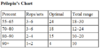
Prilepin's chart is based off of a % system and if you were to program I would use a 9.5RPE as 100% training max then work down from there ex. If my deadlift 1RTM (rep training max) is 495lb that's my 100% and 90% = 445.5lb and according to the chart I should utilize that with a range between 1-2 reps per set, I'd have an optimal working reps of 4 but i could possibly work to a total of 10 working reps over 5-10 sets. When you look at the chart optimal is subjective but the total range is a great tool to utilize, you can either test the waters and try to find what part of the range you best recover with or program all ranges into your week having one on the high end (preferably your high calorie day with optimal rest period after) one in the middle (preferably as the starting of your training week) and one on the low end (preferably between the moderate and high end days).
For training strength it's best to work full body days as opposed to a body split, this way you can work you're entire body 3-4x per week instead of the usual trying to cramp all muscles in 2x a week like a brosplit does (I ain't hating on brosplits there is a time and a place but strength orientated programs is neither the time or the place).
For compound leg movements it's generally accepted that you can work them 3-7x per week with 3x per week being the norm for moderate to advanced lifters. (Compound legs includes: squats ((all variations)), good mornings, Olympic lifts and sprinting).
For compound pressing 2-4x per week is best as the musculature and ligaments tend not to be happy with you if done more (compound pressing includes: bench press ((all variations)), weighted dips, overhead press (dumbbell or barbell), behind the neck press, push press and Olympic lift accessory work).
For compound pulling 1-4x per week is what seems to build the best balance for recovery 2x per week being optimal with 1x being conventional or sumo deadlift and the other being a speed or volume day
(Compound pulling includes: deadlift sumo or conventional, block pulls/ rack pulls, power clean, clean/snatch pull, weighted pull ups, bent over row and deadlift accessory variations)
Rarely touched on in strength programming is body weight work in a fan of doing pull ups, push ups, lunges, burpees, sprints and jumping. The great thing about all of these things if it's the one area that you can always work to failure with minimal hinderance to recovery. Pick one or two to do at the end of every workout do as much or as little as you'd like.
Basic program layout (there are 365 different ways I could layout a program so I'm just doing a stamped cookie cutter idea to show as an example)
Day 1:
Legs: moderate intensity/volume
Press: high intensity low volume
Pull: low intensity high volume
Day 2: rest
Day 3:
Press: moderate intensity/volume
Legs: low intensity high volume
Press: moderate intensity/volume
Day 4: rest
Day 5:
Legs: high intensity low volume
Pull: high intensity moderate volume
Accessory work
Day 6:
Press: low intensity high volume
Lagging body parts or imbalances
Day 7: rest
That's just a example template ideally you can rest between each workout day but understanding scheduling sometimes doesn't allow that so just avoiding working pulling back to back days or pushing back to back days is ideal, you can get away with working legs in sequential days as long as you dial your intensity level in accordance to how you recover.
Central nervous system
This is it, the big thing that separates advanced lifters and intermediate lifts and that's understanding that your CNS does not recover or burn out like your muscles do. Your CNS takes far longer to recover and it can also burn out from training over a period of time and not just in a singular day so that's why you have to utilize multiple rep and set schemes to avoid CNS burn out.
Gainz!!!!
There are two ways to increase strength one way is to increase muscular size but that caps out at a certain point and that's where more advanced programming comes into play. Whether it's trying to remain in a weight class your you've truly tapped out your size potential you can still increase strength through neural adaptations; this is only done by following a proper periodization and by NOT maxing out during training because it takes everything and then some to recover from a maxing out so you don't gain anything from it. Gainz are made from stressing the body ever so slightly making it adapt to its requirements if you stress the body to the max it doesn't adapt it copes and it's favourite coping mechanism is the ol one and done fight or flight which yields no return.
What program to pick?
For beginner level a linear program would be best, cookie cutter beginner programs to choose from would include:
Strong lifts 5x5
Starting strength
Greyskull
Wendlers 5/3/1
Canditos linear method
For intermediate a periodization program can begin to be utilized or a overloading style program, some programs to choose from would include:
Madcow 5x5
Texas method
Juggernaut training
Cube method
West side barbell
Smolov jr
For advanced lifters a periodization program is necessary to continue to make results, some programs to choose from would include:
Sheiko
Smolov
RTS training
DUP training
Customized program
Finally if you are curious where you stand strength and level wise here's a chart you can play around with:
Symmetric Strength
Understanding a few principles will help when either designing your own program or following someone else's:
First and foremost you are building strength not testing it, if you are curious of what your 1rm is weekly you'll have the same 1rm every week (this will be covered later why).
Secondly when doing any programming you have to understand progression isn't linear and sometimes there's bad days and sometimes there is good days. Know when to hold em and know when to fold em if your body is letting you know something up damn well listen to it, this concept is lost are far too many until it is far too late.
Third would be the RPE (rate of perceived exertion). It's scaled from 1-10 but for lifting purposes you only need be concerned with 5 and higher.
10 - This is everything on the line absolute max effort, should be avoided unless for meets or specific overload principle training which I won't be getting into.
9.5 - Possibly one more rep in the tank but unsure, not ideal for training purposes
9 - definitely one more rep in the tank, consider this your training cap
8.5 - two possibly three reps in the tank, bar speed slows with each rep
8 - Bar speed is constant throughout entire set
7.5 - final warm up set or form working weight, enough weight on the bar to breakdown poor form
7 - speed work bar moves at maximum speed with high intensity force
6.5 - light speed work bar moves at maximum speed with moderate working force
6 - deload weight generally something you can do 12-15 reps of
5 - initial warm up weight something you can perform 20 reps of or greater
Creating your program:
Each person has different goals and different weaknesses that need to be tweaked so creating a cookie cutter program doesn't always work this is where creating your own or possibly even basterzising an existing program comes into play.
Reps and sets scheme are controversial as they should be, what works for me might not work for someone who's the same size and pushes the same weight as me because there are endless variables to how we recover and that's what matters most. For the broad spectrum of this I use Prilepin's chart in combination with my knowledge of the RPE system.
(Insert chart here dumby)
Prilepin's chart is based off of a % system and if you were to program I would use a 9.5RPE as 100% training max then work down from there ex. If my deadlift 1RTM (rep training max) is 495lb that's my 100% and 90% = 445.5lb and according to the chart I should utilize that with a range between 1-2 reps per set, I'd have an optimal working reps of 4 but i could possibly work to a total of 10 working reps over 5-10 sets. When you look at the chart optimal is subjective but the total range is a great tool to utilize, you can either test the waters and try to find what part of the range you best recover with or program all ranges into your week having one on the high end (preferably your high calorie day with optimal rest period after) one in the middle (preferably as the starting of your training week) and one on the low end (preferably between the moderate and high end days).
For training strength it's best to work full body days as opposed to a body split, this way you can work you're entire body 3-4x per week instead of the usual trying to cramp all muscles in 2x a week like a brosplit does (I ain't hating on brosplits there is a time and a place but strength orientated programs is neither the time or the place).
For compound leg movements it's generally accepted that you can work them 3-7x per week with 3x per week being the norm for moderate to advanced lifters. (Compound legs includes: squats ((all variations)), good mornings, Olympic lifts and sprinting).
For compound pressing 2-4x per week is best as the musculature and ligaments tend not to be happy with you if done more (compound pressing includes: bench press ((all variations)), weighted dips, overhead press (dumbbell or barbell), behind the neck press, push press and Olympic lift accessory work).
For compound pulling 1-4x per week is what seems to build the best balance for recovery 2x per week being optimal with 1x being conventional or sumo deadlift and the other being a speed or volume day
(Compound pulling includes: deadlift sumo or conventional, block pulls/ rack pulls, power clean, clean/snatch pull, weighted pull ups, bent over row and deadlift accessory variations)
Rarely touched on in strength programming is body weight work in a fan of doing pull ups, push ups, lunges, burpees, sprints and jumping. The great thing about all of these things if it's the one area that you can always work to failure with minimal hinderance to recovery. Pick one or two to do at the end of every workout do as much or as little as you'd like.
Basic program layout (there are 365 different ways I could layout a program so I'm just doing a stamped cookie cutter idea to show as an example)
Day 1:
Legs: moderate intensity/volume
Press: high intensity low volume
Pull: low intensity high volume
Day 2: rest
Day 3:
Press: moderate intensity/volume
Legs: low intensity high volume
Press: moderate intensity/volume
Day 4: rest
Day 5:
Legs: high intensity low volume
Pull: high intensity moderate volume
Accessory work
Day 6:
Press: low intensity high volume
Lagging body parts or imbalances
Day 7: rest
That's just a example template ideally you can rest between each workout day but understanding scheduling sometimes doesn't allow that so just avoiding working pulling back to back days or pushing back to back days is ideal, you can get away with working legs in sequential days as long as you dial your intensity level in accordance to how you recover.
Central nervous system
This is it, the big thing that separates advanced lifters and intermediate lifts and that's understanding that your CNS does not recover or burn out like your muscles do. Your CNS takes far longer to recover and it can also burn out from training over a period of time and not just in a singular day so that's why you have to utilize multiple rep and set schemes to avoid CNS burn out.
Gainz!!!!
There are two ways to increase strength one way is to increase muscular size but that caps out at a certain point and that's where more advanced programming comes into play. Whether it's trying to remain in a weight class your you've truly tapped out your size potential you can still increase strength through neural adaptations; this is only done by following a proper periodization and by NOT maxing out during training because it takes everything and then some to recover from a maxing out so you don't gain anything from it. Gainz are made from stressing the body ever so slightly making it adapt to its requirements if you stress the body to the max it doesn't adapt it copes and it's favourite coping mechanism is the ol one and done fight or flight which yields no return.
What program to pick?
For beginner level a linear program would be best, cookie cutter beginner programs to choose from would include:
Strong lifts 5x5
Starting strength
Greyskull
Wendlers 5/3/1
Canditos linear method
For intermediate a periodization program can begin to be utilized or a overloading style program, some programs to choose from would include:
Madcow 5x5
Texas method
Juggernaut training
Cube method
West side barbell
Smolov jr
For advanced lifters a periodization program is necessary to continue to make results, some programs to choose from would include:
Sheiko
Smolov
RTS training
DUP training
Customized program
Finally if you are curious where you stand strength and level wise here's a chart you can play around with:
Symmetric Strength


